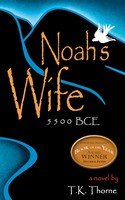
Based on evidence of a massive Black Sea flood in 5500 BCE, a new look at the ancient tale through the unique perspective of Noah's young wife, Na'amah.
Noah's Wife, was named "Book of the Year" for Historical Fiction by ForeWord Reviews Magazine and has been nominated for the 2010 Alabama Librarian Proffessional Association's Author Awards.
Noah's wife is Na'amah a brilliant young girl with a form of autism we (now) know as Asperger's. She wishes only to watch the sheep on her beloved hills of ancient Turkey--a desire shattered by the hatred of her powerful brother, the love of two men, and a disaster only she knows is coming. First chapters and video trailer available on my website at www.tkthorne.com.
Excerpt
My name, Na’amah, means pleasant or beautiful. I am not always pleasant, but I am beautiful. Perhaps that is why I am trundled atop this beast like a roll of hides for market and surrounded by grim-faced men.
If my captors had bothered to ask me, I would have told them that their prize is of questionable value because my mind is damaged. But they did not, and I lie draped, belly down, across the back of an auroch, a large black ox with an eel stripe that runs down his spine and a stench worse than a rutting goat. My mouth is parched and swollen with dried blood, and every step the animal takes sends a jolt of pain into my chest. Snatches of ground appear between the cloven hooves--a succession of earth, grass, and rock obscured by the dark tangle of my hair--all I have to measure the growing distance from the life I have known.
Professional Reviews
Malcolm's Round Table
Malcolm's Round Table AboutMy Books
Review: ‘Noah’s Wife’ by T. K.
My rating: 5 of 5 stars
Author T. K. Thorne brings us the mythic story of Na’amah in her beautifully written novel “Noah’s Wife.” Using research indicating that a flood about 5500 BCE nearly decimated the settlements along the southern shore of a fresh water lake known today as the Black Sea, Thorne has created a rich, multidimensional and richly imagined account of the Biblical flood from a feminine point of view.
Na’amah’s difficult birth left her with a pinched-head disfigurement that would have given the elders cause to cast her out had her grandmother Savta not convinced them the condition was temporary. Tubal-Cain will not forgive his sister for killing their mother in childbirth, though his actions stem in part from a secret Na’amah does not know. As a member of the hunting clan, Tubal-Cain despises Na’amah’s obsession with sheep and for being, in his estimation, somewhat dimwitted and without value. When Na’amah is twelve years old, she asks her grandmother why she keeps telling her she is special.
She is special, Savta says, in a way that can never be spoken of openly. Mother-Goddess has chosen her as a spokeswoman; yet this is a time when the goddess’ influence is waning in favor of a patriarchal Father-God belief system. The highly superstitious elders would throw Na’amah into a pit in the center of town used for meting out punishments if she openly professed a belief in the goddess.
Na’amah, who–in today’s terms–is an Asperger savant, does not believe in either Mother-Goddess or Father-God. While she doesn’t understand why her extreme sensitivity to sound produces color visualizations or why she can perceive the low-frequency vibrations that precede earthquakes, she has no interest hearing about secret missions for a purported Mother-Goddess. She wants to be left alone to tend her sheep and experience the magic of life as the natural world presents it to her.
“Noah’s Wife” begins twenty-one years before the flood and focuses on Na’amah’s betrothal and marriage to Noah the boat builder, her mistreatment at the hands of her own people as well as the nearby River People, and her forced need to come to terms with her special talents. In mythic terms, she undergoes both an outer, physical quest and an inner spiritual journey.
Thorne has created a deep and fully formed cultural backdrop for Na’amah’s quest, complemented with a highly detailed physical world and well-defined characters. Like Tosca Lee’s account of First Woman in “Havah: The Story of Eve,” Thorne’s “Noah’s Wife” represents an epic alternative to a well-known patriarchal story. The result is a novel of great enchantment, suspense and power.
View all my reviews >>
Malcolm R. Campbell is the author of “The Sun Singer” and “Jock Stewart and the Missing Sea of Fire”
LikeBe the first to like this post.
--------------------------------------------------------------------------------
4 Responses to “Review: ‘Noah’s Wife’ by T. K. Thorne”
Feed for this Entry Trackback Address
1 Teresa on November 13, 2009 said:
Hi Malcolm,
You obviously put a great deal of thought and time into this review. Thank you so much! I am so glad that you thought highly of NW.
–Teresa
Reply
2 knightofswords on November 13, 2009 said:
It’s among the top books I read this year. What an amazing novel.
–Malcolm
Reply
3 Kelly Hayes-Raitt on November 18, 2009 said:
I read this riveting book in a weekend! Meticulously researched, it transported me to another era. Like “Wide Sargasso Sea,” it told a familiar tale (Noah and his ark) from the wife’s perspective. Surprisingly feminist. I’m buying two copies to give as gifts!
Kelly Hayes-Raitt
http://www.PeacePATHFoundation.org
Reply
4 knightofswords on November 19, 2009 said:
The book really pulls one back to another time. Great gift!
Reply
Leave a Reply
Click here to cancel reply.
Logged in as tkthorne. Logout »
Alabama Writer's Forum
Noah's Wife
By T.K. Thorne
Reviewed by Perle Champion
In Noah’s Wife, consummate storyteller T.K. (Teresa) Thorne takes us back to 5500 BCE. Here we meet Noah’s future wife. Born to a mother who dies giving her life, Na’amah is a beautiful girl with peculiarities. She sees the colors and patterns of words overlaid with the color of their truth.
Betrothed to Noah, she learns the precarious place of women in a society turning away from Mother Goddess and Father God as a unit, toward an austere patriarchal view of deity. Na’amah does not believe in Goddess or God, because she cannot see them. She cannot say this aloud; she would be pitted.
All transgressors are “pitted”—thrown into a deep well in the market square, shunned, and left to die without food, water, or clothing. Her fear grows when someone is pitted for thinking of Mother Goddess when it has been decreed that now there is only Father God.
Na’amah’s peculiarities fit smoothly with the story. It gives her an outsider’s perspective for this first person narrative, which reads much like a personal journal. As she matures, she tells herself, “I wish I could just sit and rock and sing like when I was a child, but I am a woman now, and I cannot.” Her pain is universal as she realizes she must grow up and face her demons or lose what is most precious to her.
She wants only to be Noah’s wife and tend her sheep. Reaching that goal takes her on a tortuous path. Ruthlessly raped on the eve of her wedding, she runs away and gets captured by another tribe as a gift for their king, and that is just the beginning—to tell more is to spoil your enjoyment.
As with Na’amah, all of Thorne’s characters are believable people with traits we recognize in ourselves and others—endearing, abhorrent, exasperating, and often surprising.
Many stories of the Bible come to us over thousands of years, told and retold until the scholar writes them down. How much of the original tale makes it to the page? How much is edited away as extraneous?
Too often women are left out of history or they appear as footnotes. Not since Mists of Avalon or Ahab’s Wife have I enjoyed such a finely crafted woman’s point of view on an oft-told tale. Here, the nameless woman who bore Noah’s children has a name. Here we have the story imagined as it could have been, and who can say for sure. Nov 2009
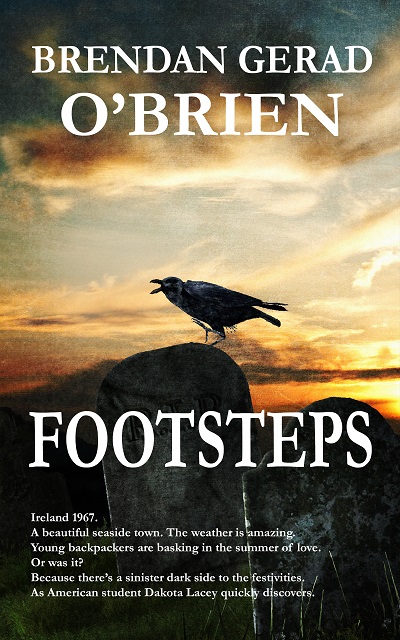
Ireland 1967. The Summer of love. Or was it?
A holiday weekend. Amazing weather. American student Dakota Lacey is hiking around Kerry.
But there’s a sinister, dark side to the atmosphere. Lone female hikers are being brutally attacked.
Sometimes, vacations just don't turn out the way you hoped they would. An idyllic wilderness house boating get-a-way soon turns into a hellish nightmare...