Excerpt
Few childhood memories give sharp clues to my developing thought on matters of God, country, pacifism and patriotism. In those formative years, a child is immersed and bathed in the surrounding culture. Like a dry sponge, the mind soaks up any water it contacts whether that contact be accidental or purposeful. Much “water” is pumped from the home well, but a family is a unit of society, molded by tradition and custom.
Two significant recollections, however, stand out. First, I remember asking my mother, in essence, why all the money spent by countries on military hardware couldn’t be used for helping poor people around the world. This was asked some time during the early grade school years when our life was still partially secluded. My age of innocence was experienced on a South Dakota farm where playtime was spent manning the discarded horse-drawn implements with an imaginary friend, and the biggest thrill was the first spring when the hired man took me to the field where Dad was planting.
There was no television. The “bathroom” was a little house outside. Water was hand-pumped out of a cistern. Drinking water was carried from the artesian well in the cattle yard. Of course there were school and Sunday School. How military spending popped into my thinking, I’ll never know. Everyone knows that kids ask the darndest questions....
The second vivid memory concerns a scene years later. I recall a very distinct feeling of disappointment when my parents remarked, “We hope there will never be another war and you won’t ever have to fight.”
Maybe I had seen Hopalong Cassidy and Roy Rogers shooting at the bad guys too often. At some stage, everybody wants a chance to wrestle the villain to the ground and be a hero
Professional Reviews
Beautifully Written and a Very Succinct View of Pacifism
One of the best books I've read on pacifism.
We can justify many of our actions from the Old Testament, including the support for war and violence. But, a closer examination of the OT will reveal that God does not accept or condone violence. I was surprised to learn that King David was not given the opportunity to build the Jewish temple because of all the blood he had shed in time of war. Mr. Snow provides many other examples taken from Scripture that supports pacifism. These passages are most prevalent in the New Testament for any disciple of Jesus Christ to follow. But, clearly pacifism is the way of the disciple. Violence, war, and military force is only the easy way out. Nevertheless, pacifism must always be lived with the Spirit of Christ, otherwise it is done in vain.
As a 10-year military veteran who struggled with this issue while serving in the Armed Forces, ultimately leading to my departure from the service; it was refreshing to hear the testimony of Mr. Snow who also struggled with this issue as well during his time in service. I am glad to see more fellow Christians examine their hearts and prayerfully reconsider the charge Jesus gives us to "turn the other cheek" and to "love our enemies". No disciple of Christ should kill anther human being, especially in light of the fact that there is not a single instance in all of Scripture where a follower of Jesus took up a sword to fight against another man.
When kingdoms collide
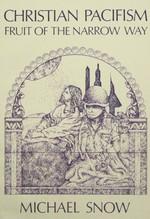
Mahatma Gandhi has been attributed with saying, “The only people on earth who don’t see Jesus and his teachings as non-violent are Christians!” But Michael Snow is one Christian to whom these words do not apply. Mr. Snow is a former Marine officer and author of the book Christian Pacifism: Fruit of the Narrow Way. The 30th anniversary edition of his work can be purchased at Amazon and is available for either Nook or Kindle, including a UK version, each of which can be found here.
What? A former military man who advocates pacifism? Yes, you heard me right. In case you’re wondering how one goes from participating in the largest military industrial complex in the history of the world to following Christ in the way of non-violent resistance to the powers of this age, you will want to check out Michael’s story. It is the most well-balanced, deeply challenging presentation of pacifism I have yet to read.
The first thing to note about Mr. Snow’s writing on pacifism is his exceedingly gracious attitude toward those who may disagree with his stand. Nowhere does the reader find any tone of elitism. On the contrary, the author is quick to admit that pacifism is not the one-and-only way to know Christ as Lord and follow him in life. That said, however, he goes on to offer a passionate and convincing plea for the superiority of the pacifist position. And he offers no apologies in doing so.
While more could be said in regards to the many arguments made against non-violence, Mr. Snow is not afraid to engage any potential detractors. The reader will quickly come to respect his refusal to dodge any question in regards to the practical implications of his position.
Christian Pacifism is a short read. I completed it in four relatively brief sittings. The tone of the book is conversational, which adds to its unique personal touch. Michael begins by recounting his own story from childhood to his involvement in the military and subsequent struggle with the harsh and unforgiving realities of war. The reader will be intrigued to hear this engaging perspective from one on the inside who came to see the falsehood of his own position as a Christian bearing arms.
Recounting his experience in chapel services the author says the following:
I attended chapel where a contemporary service fed my hungry soul. The week was lived looking forward to that hour. However, something about the physical structure left me uneasy. It was those striking, etched glass windows: each depicted a scene from military history and was captioned by a verse of scripture.
Surrounded by these scenes of men bearing arms, tanks and artillery, helicopters and jets, my mind wondered who was really worshipped. Malaise set in at the sight of such distortions as a Marine marksman standing over Paul’s words to Timothy: “Fight the good fight of faith, lay hold on eternal life.” The depiction of a drill instructor indoctrinating a recruit brought to mind the obscenities and the constant disrespect for the Lord’s name. Then there was the window “dedicated to the campaigns which were waged by Marines as an instrument of United States policy short of war,” portraying a resolute Marine, rifle with attached bayonet in hand, inscribed, “Watch ye, stand fast in the faith, be strong” (1 Cor. 6:13). The bayonet troubled me most. Remembering the gleeful cries of “Kill… blood and guts… Arrrraah!” during training forced me to try to ignore this surrounding graphic panorama each Sunday.
From personal experience Mr. Snow goes on to answer the objections of critics to the pacifist position, both as to scripture and everyday life. While allowing for every possible argument and maintaining a graceful dispostion toward those who hold differing opinions, he does not relent in holding forth a standard of conduct often unmatched in our day of rampant nationalism bordering often on idolatry. I wish I could get this book into the hands of every person I know who likes to wax eloquent about his or her devotion to “God and country,” for when the kingdom of God collides with the kingdom of man, the sword must be relinquished for the cross.
More than anything else I was impressed with the stunning Christ-centeredness of Michael’s call to non-violence. His is not a pacifism based upon blind sentimentality or some vaugely defined notion of brotherhood. It is crisp, clear, and born out of loving obedience to the example and teaching of the Lord Jesus Christ.
In short, Christian Pacifism is worth your attention. It will surely challenge you in some way. Visit Michael at his blog and pick up a copy today.
To believe the promise of Jesus that his followers shall possess the earth, and at the same time to face our enemies unarmed and defenseless, preferring to incur injustice rather than to do wrong ourselves, is indeed a narrow way. (Dietrich Bonhoeffer, The Cost of Discipleship)
Finally! Understand and learn from the New Testament Books of Hebrews, James, 1 Peter, 2 Peter, 1 John, 2 John, 3 John, and Jude.
Try James first for free
Now there is a Bible translation that is easy to read, understand, and stud
Galatians: The Easy Study Bible Commentary
This commentary is for you if you struggle to understand the New Testament and would like to discover what God’s word has to say to you!
In Galatians: The Easy Study Bible Commentary, I hav
Finally! Understand and learn from the New Testament Book of Luke.
Try James first for free
Now there is a Bible translation that is easy to read, understand, and study.
This translation is unique in that it is arranged