|

Click here to buy this book!
Kindle Edition
Download to your Nook (eBook)
Download from Apple iTunes (eBook)
Download from Smashwords (eBook)
Amazon
Lulu
Barnes & Noble.com
Novels by William Walling
Novels by William Walling
Category:
Humor
Publisher: Virtualbookworm.com Publishing, Inc., College Station, Texas, 2002
ISBN-10: 1589392353
Type: Fiction
Pages: 462
Copyright: © 2013 by William Walling.
ISBN-13: 9781589392359
Price: $9.99 (eBook)
A satirical spoof of the American aerospace industry.
It's lighter than air! Joseph Heller?s rollicking "tour de farce," CATCH-22, used black humor to illustrate the inanities and insanities experienced by men at war. In a similar vein, this satirical novel employs plain vanilla humor to dramatize the idiocies and frustrations afflicting those employed in an industry the author, a former longtime aerospace engineer, knew only too well. You'll encounter a one time porn queen who's into blackmail; the wealthy great-grandson of a Russian aviation pioneer who's obsessed with re-acquiring the giant aerospace firm he insists was "stolen" from his family; a former Air Force lieutenant colonel who reinvents himself as a totally inept favorite of management; a wannabe Western film actor who's never been within fifty yards of a horse; an ultra-paranoid executive vice president; a nymphomaniac lady manager and sundry others, all embroiled in pluperfectly Quixotic situations ranging from the ridiculous to the sublime, and beyond. Enjoy!
Excerpt
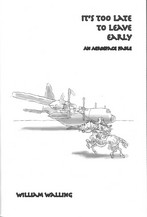
It’s Too Late to Leave Early
An Aerospace Fable
William Walling
For every disillusioned, downtrodden aerospace
engineer who ever fought the good fight
Plus ça change, plus c’est la même chose
Prologue
On a blistering afternoon in the month destined to commemorate a despot still more despotic than he himself, Great King Khufu called a halt to the procession of spearmen, archers, priests, chamberlains and court hangers-on making up his retinue. Desolated to think the mighty looked upon his works without despair — a sore point — he motioned for the bearers to set down his lapis lazuli-encrusted palanquin. Shielding his eyes from the westering sun, a swollen, yellow-orange blaze near the horizon, the king let his steadfast gaze rove across the Nile, where a dancing thermal mirage mirrored the Great Sand Sea.
Minutes passed. A khamsin blew steadily from the southwest, kicking up dust devils among the idling soldiers and porters. At last Great King Khufu clapped his hands and summoned his master builder, T’Ankh Salot.
The architect dropped to his knees, fell forward and prostrated himself, his nose pressed to the scorching sand. “Your wish, O confidant of celestial Osiris, O consort of divine Isis, O ruler of all he surveys, O mightiest of —?”
“Yes, yes, yes,” rattled Great King Khufu. He gestured impatiently with his golden flail. “There, on the far shore of the Father of Waters you shall erect My pyramid, My triumph of triumphs, My glory. See to the matter at once.”
T’Ankh Salot stiffened slightly. “A pyramid, O favored of Geb and Sekmet, O bountiful Lord of the Upper and Lower lands, O beneficent —?”
“Yes, pyramid — P-Y-R-A-M-I-D.”
“A . . . real pyramid?”
“Of course, you dullard.”
The architect licked his lips, getting sand on his tongue. “L-like the t-tomb,” he faltered, “of your illustrious sire, Great King Snefru?”
“Only in a manner of speaking. You shall erect a gigantic edifice many times larger and more grandiose than anything dreamt of by Snefru. While you’re at it, specify flat sides all the way up to the peak, not bent in the middle at some obscene angle.”
“Flat,” murmured the architect.
“Indeed!” affirmed Great King Khufu. “My pyramid will soar to the skies in My everlasting tribute, a home away from home in My afterlife, the abode of My eternal Ka.”
“Oh wisest of . . . the w-wise,” stammered T’Ankh Salot, “in this modern day and age don’t you think . . ? What I mean is, uh, . . . All things considered, wouldn’t a towering, old-fashioned mound of stones be, well . . . perhaps a tad passé? Reconsider, I beg you! P-please don’t . . . That is, I’m not . . . quibbling, but certainly would be remiss in failing to explain that a huge, clumsy pyramid could never —”
“Stop nattering! Spit it out!”
T’Ankh Salot dared an upward glance, gauged the demeanor of Egypt’s lord and master, and did not like what he saw. His throat constricted. “O Exalted One, I’m l-loathe to . . . Please take no offense, but it behooves me tell you the b-building fraternity believes ostentatious, grandiose pyramidal tombs went out with Djoser. I fear a huge, clumsy mound of squared stones might be more than, well . . . a bit gauche.”
Overtaken by a paroxysm of teeth-gnashing indignation, Great King Khufu bellowed, “T’Ankh Salot!”
For his failure to keep pace with Fourth Dynasty state-of-the-art requirements, the architect was scourged, pummeled with sharp rocks, and had boiling oil poured over his tender insteps. He was impaled on stakes wrought of cheap bronze. He was sawn and mangled. The residue was tossed to a pack of fat crocodiles bilious at the very thought of dining on any more disfavored Egyptians.
Renamed Cheops much, much later by imprecise Greek vagabonds, Great King Khufu eventually came to realize that vast projects could never be accomplished with half-vast plans. He commissioned Neferhotep, a far more compliant master builder, who was abjectly terrified by the assignment, yet mindful of his predecessor’s fate. Nevertheless Neferhotep labored for decades to oversee the extremely labor-intensive erection of a colossal monument to human folly containing roughly two and one-third million unwieldy stone blocks no one counted closely.
Construction of the Great Pyramid, a monumental government project without equal, ensured full employment for tens of thousands of stonecutters, sculptors, slaves, overseers, money lenders, camel drovers, brewers, barge men, courtesans, concubines and gross quantities of shady ladies. Great King Khufu’s selfish endeavor not only revived a questionable fad, it provided further centuries of profitable activity for priests, tomb builders, tomb robbers, embalmers, middlemen, con men, tax collectors, guides, archaeologists, mystics, and film producers.
Centuries passed. Egypt waxed prosperous as millennial dynasties rose and fell, then waned in disrepair. Egyptian dreams of ancient grandeur faded as Greeks and Romans, Celts, Saxons, Goths, Norsemen and Mongols sacked and pillaged, settled, invented, and built their own ephemeral places on history’s center stage. Hordes of newbies came to view Khufu’s geometric mountain looming above the Nile alongside a pair of tawdry imitations, and walked away shaking their heads, mumbling to themselves, thinking how absurd the Egyptians had been to imagine they could ever amount to anything while occupying their minds and hands with such foolishness.
One - Burton
On an unseasonably warm spring afternoon of the sort Southern California chambers of commerce take for granted — temperature wobbling in the high eighties, with a persistent inversion layer trapping the polluted air onshore breezes wafted against encircling mountain ramparts — an exceptional motorcar exuded noble majesté. Cresting the freeway’s grade, dipping its classic grille dipped into warm smog shrouding the San Fernando Valley, the motorcar began a regal descent of the Hollywood Hills. Fiercely driven Isuzus, Priuses and skittering Volkswagens thrashed past on either flank, drivers and passengers alike craning to ogle the motorcar’s immaculate coachwork, its genteel lack of trim. A nouveaux riche Mercedes or sleek stretch limousine often cruised alongside, only to suffer invidious comparison and slink away to lose itself in the moiling traffic flow.
The motorcar, a Bentley town coupé of post-World War II vintage, champion of many a concours d’elegance, had been restored to pristine splendor by its proud owner-driver, Benjamin Claridge Mason III, the president and chief executive officer of Aerospace General Corporation. His features every whit as patrician as the Bentley’s nine coats of hand-rubbed silver lacquer, Mr. Mason was a cum laude graduate of the Harvard Business School, a devout Episcopalian, a Republican of the first water, and an enthusiastic Freemason, no pun intended, who owed his ruddy complexion to golf and tennis, his exquisitely cut, tropical-weave linen suit to the salesmanship of a private tailor in Rodeo Drive, his platinum locks to sixty-three years of gracious living, and his petulance to the fact that a ranking corporate officer was not at the moment everything Mr. Mason might have wished him to be.
Slouched in the passenger seat, AGC Vice President Franklin Burton contemplated the unreeling freeway with watery blue eyes. Having accompanied Mr. Mason to a luncheon at the Beverly Hills Women’s Club, a function arranged by a member of distinction, socially prominent, painfully thin Mrs. Millicent Maddox Mason, Burton was only distantly aware of his leader’s pique. At the luncheon, he had scarcely touched his lobster salad supreme, electing to seek sustenance among skewered olives nestled at the bottom of several very dry vodka martinis. When his leader had been introduced, rising to vigorous applause and speak with forthright eloquence on his favorite topic, America’s Amazing Adventures in Space, Burton had done his damnedest to stay on cordial terms with the overdressed matrons on his left and right whose interrogations demanded polite responses. Deciding his function at these extracurricular affairs should not include being subjected to inquisitions by aging dragons who drew him into their clutches, he had taken an obdurate stand. After all, coveys of grandes dames draped in bandoliers of glittering gemstones were not creatures with whom a mere VP should be expected to cope.
His eyes firmly focused on the road ahead, Mr. Mason pointedly cleared his throat. “Frank,” he said with just the proper degree of executive resonance, “Millicent told me you downed seven martinis at the luncheon.”
Burton’s head rocked as if in recoil from a sneak punch. The Bentley town coupé lacked air conditioning; Mr. Mason’s directive to the restorers had specified that the machine be rebuilt precisely the way underpaid Rolls Royce mechanics had handcrafted it decades earlier. “Y’said . . . what?” he muttered.
“I said,” declared Mr. Mason with curdling emphasis, “you apparently downed seven martinis during the luncheon.”
“S-seven . . ?”
“Seven,” affirmed his superior.
“Lucky number, heh, heh!”
Mr. Mason’s bulging jaw muscles suggested the onset of tetanus. “Millicent,” he added, “also described your purposeful rudeness to Mrs. Lythgoe.”
“Not . . . purposeful,” temporized Burton, bewildered by the reference.
“May I remind you,” reminded Mr. Mason, “that Craig Lythgoe is an AGC director?”
Overburdened by the effort of holding up his end of a meaningless conversation, Burton did not respond. He wilted in the passenger seat, succumbing to torpor.
A barely visible tic began jumping beneath Mr. Mason’s left eye. He wheeled the Bentley around an off-ramp’s descending loop and drove six blocks westward through moderate traffic. The heat sitting motionless at stoplights caused Burton to intermittently lose consciousness.
The nebulous outlines of large gray buildings congealed in the smog, and Mr. Mason turned the Bentley into a wide, divided drive cleaving through acres of empty parking spaces. Approaching the fenced-off AGC complex, where scattered vehicles broiled in the strong, grayish sunlight, the motorcar rocked forward on its front suspension, came to a halt beside the green-tinted windows of a security cubicle.
A gangling, loose limbed older man whose tan uniform badly needed pressing eased his weight down from the cubicle’s step. Known affectionately to AGC personnel as “The Sheriff,” the veteran plant protection officer touched two fingers to the brim of his battered Stetson. “Afte’noon, sir. Kinda nice day out.”
“I’ve seen better, Sheriff.” Mr. Mason clipped to his suit’s breast pocket a in scarlet-bordered badge replete with a less than flattering photograph of himself. Tapping an impatient forefinger on the steering wheel, he waited for Burton to stir from his semiconscious slump. “Your badge, Frank!”
“Badge . . ?”
“Yes, badge. Would you prefer to remain outside?”
“Badge, uh . . . sure thing.”
Mr. Mason abused the Bentley’s gearbox pulling away.
A speculative glint in his rheumy blue eyes, The Sheriff watched the silver Bentley town coupé roll through the gateway in a high chain-link fence enclosing the inner security corridor that spanned the AGC facility. The motorcar disappeared behind the gray bulk of “C” Building, and The Sheriff muttered, “Slim pickin’s in store for that fella Burton.” Sauntering back to the cubicle, he mounted the steps, sat down inside and clamped a cigar stub in his dentures.
* * *
Instead of turning toward the reserved slot bearing his stenciled name and title in “A” Building’s executive parking area, Mr. Mason drove on past the guarded entrance gate. The Bentley purred along the plant’s inner security corridor, its invisible bow wave causing delivery trucks, vans and a heavily laden forklift to frantically veer aside. Braking to a curbside halt before a windowless, two-story building, he switched off the ignition, worked the latch on the forward-opening door, emerged stiffly and stretched.
Burton studied the unforeseen move with critical apathy. Floundering from the vehicle, he slammed the passenger door with a cah-chun-n-nk! that drew a wince from Mr. Mason.“Why stop here?” he inquired drowsily.
In lieu of a response, Mr. Mason let his jaundiced gaze take in dual patches of scraggly, wilted ivy overspilling the sidewalk, a pair of discouraged olive trees, withered shrubs and a drought-stricken boxwood hedge. AGC landscape gardeners, none of whom spoke English, had set out all “sun” specimens in shaded areas, while “shade” plants battled for survival under the solar blows of what strangers might consider an exceptionally warm spring day.
Tightlipped, Mr. Mason heaved a long-drawn, reproachful sigh. “Frank, you paid scant heed to what I had to say during the drive.”
A hunted expression crept across Burton’s clean-cut features. He could recalled no recent dialogue except the critique of his liquid lunch, but his leader’s habit of gauging executive ability in direct ratio to executive attention span was common knowledge. “Heard . . . ever’ word, Ben.”
“I’d hate to think you, of all the men and women on our First Team, were daydreaming.”
“Notta chance,” assured Burton.
“It’s gratifying to hear you say that, but may I refresh your memory? At last Monday’s executive staff meeting, Bill Ladd spoke to us about . . . Burton, are you with me?”
“Oh, you bet! At Monday’s Sunrise Service, Ladd talked about the . . . Oops, I meant at the, uh, you know . . . reg’lar mornin’ get together.”
“Frank, Frank . . .” Mr. Mason’s fruity baritone suddenly evidenced more benign harmonic resonances. “It’s perfectly acceptable to be colloquial about our morning powwows. I’d never object to hearing them called them ‘Sunrise Services.’ Tell me honestly, have I ever acted stuffy with you members of our First Team?”
“Uh-uh, ‘course not, B.M.”
Mr. Mason’s parody of a smile conveyed all the warmth of a summer day in Antarctica. “Simply isn’t your day, is it? I’ve spoken to you before about addressing me in that manner. ‘B.M.’ has scatological connotations I simply cannot abide.”
Burton paled.
Mr. Mason hawked and spat into the wilted ivy. He made a production of extracting a monogrammed kerchief and dabbing his lips with executive finesse. “Dr. Ladd had just returned from Washington, you may recall. He’s convinced NASA and DoD both lean toward accepting our second generation Space Shuttle proposal, er . . . Aerospaceplane, its generic title.”
Burton tolled the statement syllable by syllable. He took a random stab at comprehension, and came up empty.
“We drove through the main parking lot a moment ago,” added Mr. Mason. “It tells a dismal tale: three-quarters empty, and getting worse by the month. Before the merger and the massive attrition we’ve suffered, a parking slot was difficult to find out there. With the industry still flat on its backside, and the national economy devastated, you should be the first to appreciate how critical it will be to bring in a major program of significant scope and duration. Late last year, the directors agreed to fund an in-house study that will hopefully lead to a major contract award. Dr. Ladd’s Advanced Projects team has worked with vim, vigor and unstinting devotion to make our Aerospaceplane System R&D Proposal come in a winner.
Burton concentrated his faculties, striving to elicit a shred of meaning from the CEO’s solemn disclosure. “Understand,” he lied, biting back a hiccup.
Mr. Mason studied the featureless gray façade of “G” Building as if probing for weakness in the event of siege. “Not long ago,” he said, “attrition in the wake of the XF-39 cancellation forced us to vacate ‘G.’ Recently seeding the ground floor with Ladd’s Advanced Projects Group was merely a stopgap measure. If and when this Aerospaceplane plum falls in our lap, I plan to install the entire Research & Development Division currently under your guidance here in “G,” and keep Ladd’s diverse engineering functions conveniently together under one roof.”
Suffering acute equilibrium dysfunction, Burton shuffled his feet, narrowly avoiding a plunge into the wilted ivy. “Ben,” he pleaded, “bring me up t’speed.”
“Pardon me?”
“Why’re we foolin’ with the Space Shuttle? Ancient . . . history. NASA flew a fleet of those big birds for years, then junked ‘em in museums ’n places like that when the —”
Mr. Mason’s head lifted smartly. “You’ve no idea at all what I’be been talking about.”
Teetering mutely on the sidewalk, the VP made spastic circles with his hands.
Mr. Mason spun on his heel, marched stiff-legged to the silver Bentley, wrenched open the door and plopped inside. Just before driving away, he leaned from the open window and hurled back an ominous, “Humm-m-mph!”
With the ominous grunt ringing in his ears, Burton shivered despite the heat and staggered to the wall of “G” Building, leaning against it for a spell to recuperate. Finally he somehow found the strength to lurch across trackless expanses of asphalt and concrete to his deluxe, fruitwood-paneled office in “A” Building’s posh executive wing.
|