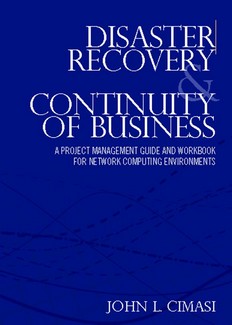
Disaster Recovery & Continuity of Business: A Project Management Guide and Workbook for Network Computing Environments."The book offers a comprehensive guide for businesses on how to develop and implement effective disaster recovery and continuity of business plans that will make it possible for the company to keep working in the face of an event that cripples its information systems."
"Useful charts and helpful bulleted lists are offered for planning teams to customize for their company's needs. It's hard to think of any aspect of continuity planning that is not addressed by the book. Professional, thorough, detail-oriented and knowledgeable, the book is well organized and logically structured. It's clear to readers that the author has "been there, done that" with developing DR/COB plans and has the voice of experience that can help users of this guide prepare for any eventuality."
Professional Reviews
Bill Lin, PhD, Chair, IT, SUNY at Buffalo
Project management activities focus on the end product, understandably so. A project that delivers the end product on time and within budget is considered by some to be a success. Unfortunately, these are not complete indicators of project success. There are many examples of project underutilization, or even project failures, due to inadequate testing, improperly defined business objectives, etc. Insufficient disaster recovery planning is yet another example of a responsibility which frequently suffers from insufficient focus during the PM process. As the author notes, psychological denial of potential failure, insufficient understanding of business needs, inadequate resources, and other factors contribute to the lack of attention to disaster recovery and continuity-of-business planning. The early discussion of impediments is a clear and realistic review of challenges and constraints which are found in all organizations.
Project management life cycle consists of a number of phases, and the author provides considerable details about each step. This depth provides important conceptual and practical guideposts for developing and implementing projects aimed at disaster recovery and continuation of normal business functions in the face of adversity. For example, highlighting the importance of a project sponsor and the project council, describing the benefits of using consultants, delving into details pertaining to communications, and recommendations for conducting effective meetings are all areas where his corporate and organizational background augments theoretical concepts. The material is thus presented at a realistic and fundamental level.
The book focuses on LAN/WAN environments, however the principles, examples, and documents are transferable to many other IT environments. The author notes that the baseline project plan is a living document, revised as a project progresses in order to accommodate changing circumstances. He also addresses many components of projects which are sometimes ignored or given minimal attention. The excitement of completing a project sometimes causes participants to lose sight of critical final phases in the PM life cycle. Proper closure, documentation, and eventual “lessons learned” reflections are essential for ongoing operational tasks. They are also important from the institutional perspective, in that they may inform future projects and decision making.
Feasibility assessments must be undertaken during the early stages of any project. Financial feasibility, while critical, is not the only type of assessment that needs to be performed. The author’s practical experience with the nuts and bolts of project development is reflected in the exhaustive lists of recommendations, suggestions, and warnings. The book may thus serve as a handy guide, a checklist, calling attention to other facets of feasibility. These include assessment of technical resources and skill-sets, pitfalls of organizational politics, legal and contractual constraints, challenges of physical site preparedness, identification of mainstream and non-standard tasks, etc.
Stylistically, the author relies on repetition of important topics. This is an effective method for educational purposes – indeed, the book’s objective is to educate practitioners about an important topic. The author also includes examples of output from a number of software packages, lists of external resources, and various categorized reference sections. The end result is an informative and persuasive discussion, and a potential guide to an action plan.
Editor, CreateSpace
The book offers a comprehensive guide for businesses on how to develop and implement effective disaster recovery and continuity of business plans that will make it possible for the company to keep working in the face of an event that cripples its information systems.
Useful charts and helpful bulleted lists are offered for planning teams to customize for their company’s needs. It’s hard to think of any aspect of continuity planning that is not addressed by the book.
The book is well organized and logically structured. The author asked for feedback on whether the repetition of certain ideas for emphasis perhaps crossed into the realm of redundancy, but the editor noted no such effect. The repeated ideas come across more as reinforcement of important concepts and tasks, rather than a revisiting of ground that’s already been covered.
Professional, thorough, detail-oriented, and knowledgeable. It’s clear to readers that the author has “been there, done that” with developing DR/COB plans and has the voice of experience that can help users of this guide prepare for any eventuality.