Category: Young Adult/Teen Publisher: BookSurge Publishing; First edition
ISBN-10: 1419689665
Type: Fiction
Pages: 370
Copyright: April 30, 2008
ISBN-13: 9781419689666
Price: $2.99 (eBook)
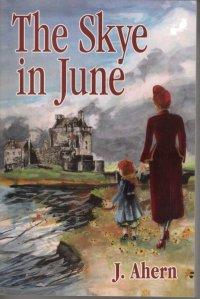
The Skye in June, is a about the Scottish MacDonald family immigrants living in San Francisco, and their youngest child, June, who has an uniqueness that attracts unusual people. The family implodes when June is drawn into the world of mysticism and, along with her three sisters, come of age during the Haight Ashbury 1960's.
The story unfolds in Glasgow, Scotland with Cathy, the mother, on her way to the hospital to deliver yet another bairn (child.) When the baby is born Cathy defies her husband, Jimmy, by naming their newborn daughter June rather than after a saint, as was their Catholic tradition. Jimmy is furious saying the name is a pagan one. The decision sets the MacDonald's on a course that will ultimately threaten the family's very foundation.
Tragedy happens during the chaos of a Protestant Orange Walk and soon after the Catholic MacDonals leave Scotland for a new life in San Francisco, California. There, their struggle to find happiness they are seeking intensifies because of June's visions that are not welcomed in her repressive religious household. To stop her Jimmy sends her, along with her three sisters, to a parochial school in hopes the nuns will stop June's "heathen" ways. The three sisters hatch plans to deter their father from being so controlling. The girls come of age during the social upheaval of the 1960's in San Francisco.
Jimmy and Cathy have their hands full dealing with their teens straying from their religious teachings. "Doomed to hell every last one of you," declares Jimmy as each daughter openly rebel against their parents. To worsen matters, June's psychic abilities uncover her mother's long hidden secret. The family is on the brink of imploding when Cathy must once again defy her husband and hopefully save the family by being truthful about her past.
Excerpt
Cathy looked nervously over her shoulder and down the hallway. The two girls tried to see what was happening, but she eased them out of the way to conceal what the gypsy would say. Balancing the baby on her hip, she held out her free palm. The old gypsy gently cradled it in her hands and moved her fingers across Cathy’s palm as though to smooth out the crisscrossing lines.
Suddenly, baby June reached out to the old woman’s face, touching a deep crease. The ragged gypsy reciprocated and patted a curl of the baby’s flaming red hair. “Aye, this wee lassie, Ah can see she’s a special wean. The seventh child of seven, is she no? That’s good luck. She can see what others canne. She’s fey,” the gypsy declared, nodding her head knowingly.
Cathy was surprised to hear that her youngest child was predicted to have the inner sight.
“And ye, dear,” the gypsy’s dark-brown eyes looked up to the sky-blue eyes of the young woman. “Yer going to move far away from here,” she said and then sighed loudly. “Sorry to say but ye’ll nay find the happiness ye seek there.”
The young mother moaned lightly. The old woman, seeing sadness cross the younger woman’s face, added soothingly, “Sometimes we think that we’ve lost something only to find that it was still there all along. Ye ken?”
No, she didn’t understand the mysterious message. She sharply pulled back her hand and put it on the door behind her. “But this wee one,” the old gypsy nodded to June. “She’ll bring ye the love yer aft’r.”
Granny B’s voice interrupted them. Cathy placed a finger over her lips to quiet the gypsy.
Professional Reviews
Delightful period story with a touch of the mystical
This was a wonderful family story of immigrants, prejudice of the community and even within one's family. I guess I could say it gave me a similar nostalgic attachment to the story that I had with 'As a Tree Grows in Brooklyn'. Every family member is fully fleshed out, as real as washing dishes and will make you feel exactly what they feel! The mystical gifts within the family provided intricate relationship scenarios and personality profiles that not only create fantasy in it's down-to-earth version but also provide us with a history of how these gifts were dealt with within this historical time period. I look forward to more from June Ahern and I congratulate you on a finely honed story.
Highly recommended to teens on up!
Great family saga!
The Skye in June by J. Ahern not only captured my attention from the very beginning, but my heart as well. Ahern lured me in with her introduction to Cathy, Junes mother, when she is giving birth to June, and kept me glued to the story all the way through three generations. Because the culture and times are quite different than what I have known, I found it incredibly interesting to read about things that I had such an emotional reaction to that seemed to be a part of everyday life to the characters in the novel. The family dynamics in the three generations depicted, were complex and ever changing. As the family went through each struggle and event it is evident that much is swayed by the families belief system and tradition.
Ahern has done a phenomenal job of keeping true to the time and the culture. She uses words that are specific to the Scottish, but is mindful enough to include definitions at the bottom of each page. I did find that the more I read, the easier it was to fall into the language of the family as I settled in and felt like I was a part. The writing style reminded me of how a person would tell a story if they were sitting among true friends and sharing the events of their family history. I was sorry to see this one come to an end. I am hoping for a sequel so that I can find out what is next for this family.
The Skye in June is an obviously good choice for historical fiction fans, but is "Let No Genre Be Closed" worthy. Book clubs will love this for its many avenues of discussion topics.
I generally dislike books with occult plotlines but this one is so well handled that I liked it,
This book is about a family, how it changes over the years, how the alterations of society over those years helped drive those changes and how familial love triumphs over all. Two of the mechanisms used to execute this theme are the use of the occult and powers of "witchcraft" and religious bigotry on the part of the Catholic Church.
It begins with the Scottish MacDonald family living in Scotland and the birth of a young daughter. Outwardly devoutly Catholic, each of the girls to date has been given the name of a saint. However, this time mother Cathy defies her husband Jimmy and gives the new girl the pagan name June. After their daughter Helen dies, the family moves to San Francisco and begins a new life.
As soon as her consciousness permits it, June begins to have clairvoyant visions, which brands her as different. Those visions in combination with her independent mindset create problems for her in school as well as with her father Jimmy. While he follows the Catholic tradition, Jimmy is a simple-minded and often cruel man. He belittles June for her trend towards what he considers paganism and the teachers at the Catholic school are even crueler. When a very kind Catholic sister from South Africa befriends June and allows a maypole celebration, the sister is abruptly removed and June loses her only true friend.
As the girls age and become more independent, Jimmy's behavior get even worse, often hitting them harshly and repeatedly with a belt or with his fists. This drives the girls even farther away from him into open rebellion.
The general forces of the sixties, where the younger generation began declaring their freedom and drug use and recreational sex became the norm, further fuel this rebellion. Amidst all of this June is hospitalized as a mental case and given heavy doses of drugs used to treat schizophrenia.
However, at the end, there is a round of revelations about the true nature of the family, how the past unfolded and the circumstances and choices that led to the current conditions. There are hints about this throughout the book, yet the revelations are still unexpected and well executed.
While the occult and what was called witchcraft are the plot devices used, this is fundamentally a story about the difficulties of conformity for people who truly are different from what is considered the social norm. That is what makes it a powerful story because you can read and appreciate it even though you may be a person with strong religious beliefs against paganism. I generally dislike stories that rely on the occult, but it is so well handled here that I felt it improved the story.
It's 1969 and some high school students in a small town decide to oppose a war that makes no sense and promises to set their lives on a different path against their wishes.