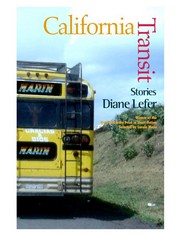
Short stories set in Southern California, a place of dislocation, where law does not mean justice.
Conversational prose and macabre with zero in on a Mexican women detained indefinitely by immigration authorities, isolating her from her American family; a zoo employee charged with transporting the frozen head of a euthanized antelope; a lonely woman riding buses all day who cannot avert the violence building inside her.
Carole Maso, in selecting this collection as winner of the Mary McCarthy Prize, wrote: "From the world that could not be saved, the storyteller salvages small, strange stuff and assembles it into a narrative of alarming beauty and mystery and sadness."
Professional Reviews
Living in Southern California with a finely tuned social consciousness
By Judith Freeman
June 17, 2007
California Transit: Stories
Diane Lefer
Sarabande Books: 238 pp., $15.95 paper
In the title story of Diane Lefer's new collection, "California Transit," Anita, a woman in her early 50s, moves from New York to Los Angeles. En route, the U-Haul she's driving breaks down in the desert and her beloved cat Dinah succumbs to the blistering heat. Distraught, she abandons the dead cat and the U-Haul at a motel in Blythe and takes a bus to L.A., eventually renting a bleak room over a line of boarded-up stores in San Pedro. Anita begins riding buses every day, not because she has any destination in mind but because, as she puts it, she is trying to learn to live in a place rather than in her head.
Like many characters in Lefer's stories, Anita is deeply troubled, but why? We learn that her former husband beat her, that when she was a civil rights activist she spent time in a Mississippi jail and that she later considered adopting a little Mexican girl from Oaxaca until the local priest dissuaded her. ("Why save her," the priest said, "if you're going to leave the conditions that create her problems all unchanged?") Anita, once a lawyer for the poor, is now broke and "living with a heart devoid of charity."
Of the eight stories in this collection, the novella-length "California Transit" is the jewel. It reveals Lefer's full range of talents and a finely tuned social consciousness. The author was involved in the civil rights movement, lived in Mexico, learned Spanish and now volunteers with a program for torture victims and works with an animal behavior observation team at the L.A. Zoo, activities that echo in Anita's life. One day, Anita takes the bus to a federal prison on Terminal Island, where asylum seekers are held under harsh conditions; she also gravitates to a marine sanctuary for damaged sea animals. At the sanctuary, she meets Burton, an old Stalinist with a fondness for drink. (He may be "a bit of a monster," Anita says, but he's "the only one who was kind.")
Lefer, the author of two previous volumes of short stories ("The Circles I Move In" and "Very Much Like Desire") and the novel "Radiant Hunger," won the 2005 Mary McCarthy Prize in Short Fiction for "California Transit" from Sarabande Books, a nonprofit literary press. It's easy to see why a judge would want to honor these stories. They are smart, well written and have that most elusive of qualities: vitality. They take on difficult issues — immigration, racism, torture, animal suffering, environmental degradation. That makes her stories sound humorless; they aren't. A vein of wry wit runs through them. In "Alas, Falada!" a woman working for the L.A. Zoo is driving to San Bernardino with the frozen head of an African antelope on the seat next to her as she debates what to do with it (honored burial or a specimen flensed, stripped of skin and left for insects to pick clean?).
"Naked Chinese People," about a couple with a weekend cabin in Joshua Tree, begins, "We were always finding naked Chinese people in the shower." As improbable as this might sound, Lefer makes you believe it could happen. But the story is really about the narrator's first marriage — to a black man who was mistaken for an intruder and murdered, leaving her shattered.
Again and again, Lefer's characters collide with the "other," with people of different cultures and races in sunny Southern California, a place whose wide, flat vistas are not "open horizon, but violent exposure." Anita finds it all so ugly, yet she thinks, "All over the world, this is the city people dream about." Later, she's assured that there's "good stuff in L.A. and good people. In the margins. In the corners. Kind of hidden."
"At the Site Where Vision Is Most Perfect" deals with the horrors of the federal system that detains immigrants suspected of being in the country illegally. A Mexican woman with the improbable name of Clifford Pearlstein is wrongly arrested and locked up in a holding facility, denied even a phone call. Clifford (or "Cliff," as she's called) is an educated woman, an architect married to a research doctor, with a teenage son named Matt. In letters to Matt, she describes her ordeal with increasing dispassion as hope drains out of her. In the end, she's deported, and as Matt and his father prepare to make a new life with her in Mexico, the father mentions different communities of Americans where they might live. You understand Matt's bitterness when he says, "I don't want to live near Americans."
There's so much anger in these stories, and often it seems appropriately directed at a corrupt society, a diseased world. When one character suggests that things are so bad we're living in a police state, you can't entirely disagree. Yet often there are timorous signs of hope. "My heart is hard," one narrator says. "I'm going to get better." You're not sure you believe her.
Some stories in the collection are stronger than others, markedly so, but even those that feel somewhat slight or incomplete still demonstrate a special talent at work. One thing is certain: Lefer gets L.A. All that time watching animals in the L.A. Zoo has made her a sharp observer of the behavior of all kinds of animals and their environments; to her, looking is what it's all about. As Anita says of L.A. in "California Transit," "I think there's two ways to be happy here. The way the rich do, ignoring everything around them. Or else, to pay very close attention."
There's no mystery about which way Lefer has chosen to live.
Judith Freeman is the author of a story collection and several novels, most recently "Red Water." Her forthcoming nonfiction book, "The Long Embrace: Raymond Chandler and the Woman He Loved," will be released in the fall.
________________________________________
Stories of smart outsiders who have lessons to teach
San Francisco Chronicle
Reviewed by Stephan Clark Sunday, April 22, 2007
California Transit By Diane Lefer SARABANDE BOOKS; 237 PAGES; $15.95 PAPERBACK
On her Web site, Diane Lefer writes that she no longer tries to separate her activism from her creative work. That much is obvious from a reading of "California Transit," the rewarding if occasionally tiring collection of stories that won Lefer the 2005 Mary McCarthy Award for Short Fiction. Lefer's characters, for the most part unnamed white women who speak as first-person narrators, do not explore the territory of bad John Updike, where the worst that might happen is a hangover and an indiscreet marital affair. They are Californians obsessed with social and economic injustice, the welfare of animals, the politics of the body and the Kafkaesque horrors of immigration law. In "At the Site Where Vision Is Most Perfect," the stronger of the collection's two novellas and one that shows the many beauties of the form, a Mexican national married to a U.S. citizen learns how easily her life can be torn apart when she is arrested while attempting to take her citizenship test and whisked off to an INS detention center reminiscent of Guantanamo Bay. "They wanted to hang a man in Washington State, and no one knew how to do it," the woman writes her teenage son while being held indefinitely. "They found a Turkish executioner. That's the kind of immigrant they want in America." Lefer's work is at times reminiscent of that of Don DeLillo and Siri Hustvedt in that she populates her fictions with loners and misfits who are as interesting as they are intelligent. These characters are at their best when they become so overcome with grief or feelings of dispossession they become unpredictable. In "Alas, Falada!" a zoo employee is asked to transport the frozen head of an eland, a spiral-horned antelope, to a natural history museum. But from the wonderful opening lines -- "Humans get cremated. Animals just get burned." -- the reader knows this is one trip that won't end as planned. In "Angle and Grip," one trauma follows another. The storyteller first suffers her husband's freak death -- "a tire came flying off a semi and through the windshield" -- and then discovers multiple deformities in her unborn child, which leads to her seeking "a late-term abortion." ("What you choose to call it tells which side you're on," another of Lefer's narrators says, this time in reference to the "riots/uprising/civil disorder/major street disturbances" that swept Los Angeles in 1992.) "Angle and Grip" is designed to advance the idea that there should be no limits placed on a woman's right to abortion. Only after six months does anyone know that the narrator's baby has "five organs that wouldn't work" and that it could enter the world only "accompanied by brief but total and unimaginable pain." Still, despite such narrative maneuvering, the story is not a direct polemic. Lefer begins "Angle and Grip" shortly after the husband's death and the narrator's abortion, when the woman partners with a neighbor to develop "lifelike life-size Love Dolls" at a warehouse in Van Nuys. The scenes that follow are so rich and absurd that the reader is distracted from the story's underlying message, making the woman's eventual confrontation with her past that much more powerful and rewarding. "Naked Chinese People" is another story that can be reduced to a message, this one concerning the injustice of racial profiling. In it, a Jewish woman becomes "acutely aware" of the privileges of race after her ex-husband, a black man, is shot and killed after knocking on the wrong trailer door in the California desert and having his cell phone mistaken for a gun. But unlike "Angle and Grip," this story falters some because it ends with more rhetoric rather than nuance. "Kill me," the narrator tells a police officer after purposely running a red light and asking to be treated like a black or Latino man. "Why don't you kill me? It's skin privilege, dammit. Kill me." "The Atlas Mountains" suffers a similar deflation. In it, a woman meets a computer repairman who has fled a country that "has towns where people slaughter one another." The encounter is poetic, but the beauty of it is diminished by the narrator's predictable asides about the Patriot Act and the use of American tax dollars to fuel violence overseas. When the woman says near the end, "I feel for you," it's hard not to hear Bill Clinton playing a saxophone in the background. Lefer's book certainly deserves attention. In a time when much of contemporary fiction is apolitical, "California Transit" calls attention to a wide range of issues that might otherwise be ignored or inadequately addressed. But if Lefer's book is that rarity of rarities, a short-story collection of ideas, it is also a book that rarely has any doubts about itself, and so the reader must sit through as many lessons as stories, even if they're lessons he already knows. Stephan Clark is a writer living in Los Angeles. His short fiction can be found in recent and forthcoming issues of the Cincinnati Review, Fourteen Hills and Ninth Letter.
This article appeared on page M - 2 of the San Francisco Chronicle
Pieces of Eight is an eclectic collection of eight imaginative novellas/short stories. Themes represented in the work are science fiction, paranormal, psychological drama, humor, murder/revenge and astrological fulfillment. Pieces of Eight is the com
Determined to confront the hazy memories of his troubled youth, Oliver Matthews, a retired detective and confirmed bachelor, returns to the picturesque town of Henley-on-Thames for the first time in years.
The bulk of the collection is eight short stories that are set in yesteryear. The compilation is filled out with four entertaining fantasy pieces and three poems.