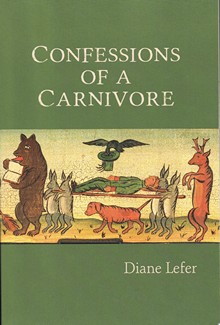
A wild romp through a minefield, a comic novel about animal behavior, endangered species, endangered democracy, and love.
After Rae's ear is shot off by a jittery security guard at the health food store, the insurance settlement allows her to take a year off from teaching. She spends it volunteering at the Los Angeles Zoo. Except for her best friend Jennie, Rae has little use for human beings. She loves cats–lots of cats. The refugee she cares for, airlifted from Afghanistan to safety, is not a person but a mountain goat.
As the US goes to war and baboons fall deeply, tragically, in love, Rae's involvement with Gorilla Theater--street agitators raising awareness of animal rights--leads inexorably to confrontations over human rights. Especially when Jennie is disappeared.
Professional Reviews
Confessions of a Carnivore by JJ Wilson
Wow. Diane Lefer’s new novel is one wild ride. With all the animals involved, I mean that literally. She somehow mixes activism, alcoholism, protest theater, cat-love, animal observation in L.A. Zoo, and race politics in one story and comes out the other end smelling of roses.
This novel is about all of those things and about none of them. It’s all about the voice. The narrator talks directly to us and it soon becomes clear she’s not all there. She’s half-dead with grief, reeling from the fallout of a failed marriage to an alcoholic and now unable to love anything or anyone beyond her cat. She gets mixed up in a protest theater group (based on Augusto Boal’s Theater of the Oppressed) and then involved in a series of increasingly bizarre incidents.
Author and activist Diane Lefer
The novel is by turns hilarious and tragic. A lobotomized woman lives, barely, among hundreds of cats; the theater group lurches from daft stunt to even dafter stunt; and the ‘baddie’, it turns out, is just a naive fool on the wrong side of the political tracks.
To try to summarize the plot would be a fool’s errand, but I found this book terrifically entertaining in an absurd, where’s-she-going-to-take-us-next? kind of way. And just when we’re waiting for the next laugh, the novel surprises us by becoming something altogether more moving.
As a follow-up to the shimmering, award-winning California Transit, Confessions of a Carnivore doesn’t disappoint. It’s full of wild ideas and crazy conceits, and still manages to warm the heart.
Animal Rites by George Ovitt
"I learned long ago that conservation has no victories, that one must retain connections and remain involved with animals and places that have captured the heart, to prevent their destruction." George Schaller
Our relationship with animals is that of rational master to brute creature. Here's Montesquieu:
"Brutes are deprived of the high advantages which we have; but they have some which we have not. They have not our hopes, but they are without our fears; they are subject like us to death, but without knowing it; even most of them are more attentive than we to self-preservation, and do not make so bad a use of their passions."
This sort of language is uncomfortably like the language used by slave-owners to describe their relationship to their species of property:
"[Slaves] enjoy liberty, because they are oppressed neither by care nor labor. The women do little hard work, and are protected from the despotism of their husbands by their masters. The Negro men and stout boys work, on the average, in good weather, not more than nine hours a day. The balance of their time is spent in perfect abandon."
Perfect abandon.
It has struck me more than once in reading Orientalist texts, white accounts of slaves' lives in the Old South, the literature of animal rights (Peter Singer, e.g.), and much post-modern literary criticism that the key subliminal message of Anglo-Saxon, male, white, patriarchal, mammal writers is--a wistful longing for release from Reason. The burdens of rationality loom large in racist tracts purporting to describe the idle promiscuity of great apes and lesser men...if only we were allowed to throw over the responsibilities imposed by our Christian moral conscience. If only we could enjoy a freely libidinal existence--copulate at will, idle about in perfect abandon, muck about in fecal matter. Freud thought--more or less--that we might enjoy such an existence, though we would rue its un-Victorian idleness and pleasures and therefore wallow in the guilt that we wallow in anyway so--why not? If you've read the extensive social Darwinian racist literature of the late 19th century you know what I mean: all that finger wagging at the irrepressible copulations of the "dusky races;" a less wistful version of Passage to India dressed up as biological truth. Beware their rapacious sexuality, their child-like delight in life! Our immortal soul is defended only by our reason, which comes from God (see e.g. Adam Smith, Theory of Moral Sentiments). Is it too reductive to write that the history of the West has been waged not between nations or religious persuasions but over the extent to which we are permitted to enjoy being the irrational animals that we in fact are?
Descartes thought animals were soulless--they were, in his view, automatons. Kant may have ascribed to animals a form of conscious perception--the philosophical jury is still out. In his seminal "What Is It Like to be a Bat," Thomas Nagel admits that he has no idea what it is like to echo-locate, but makes a persuasive argument to the effect that it is like something.*There is a bat way-of-being. I couldn't agree more. It's their being mute (in our view) that damns them: but then, it wouldn't be sufficient if bats merely spoke; they would have to speak English. And have the ability to divide the world up into neat piles for further sorting. What happens, after all, when you are said to have "knowledge of a field"? You've mastered a vocabulary. Mute is brute.
Animals: we share the planet with them, we slaughter them by the billions for our gustatory pleasure**, we domesticate them, become attached to them, even, in some cases, love and worship them. But do we take the trouble to think about them? What is like to be one, to be one of my dogs or one of the primates Diane Lefer's character Rae works with at the Los Angeles Zoo?
“No truth appears to me more evident, than that beasts are endow'd with thought and reason as well as men," wrote David Hume, hardly a soft-headed romantic. And John Searle offered that he assumed the existence of consciousness in animals just as he did so in his fellow persons. But these are the views of eccentrics, outliers in a world dominated by homo sapiens. It seems almost perverse to ask, as Diane Lefer does in many different ways: what's the difference between us and them? Between any us and any them?
Jennie, another of Diane Lefer's characters in her picaresque Confessions of a Carnivore--Lefer, I'm pleased to report, is a true original, a wit in the Boswell/Johnson sense--"won't eat anything with a face." A fine rule, especially if you've visited one of the horrifying farms on which chickens or pigs are bred for cellophane and weird taxonomies of the supermarket's meat section. Rae, the carnivore of Lefer's title, does eat meat, ambivalently. I wonder if it's fair to think of Rae as "picar," as "roguish"? In any case, rather like Tom Jones, she is funny and irreverent, and she appears to have an underdeveloped super-ego, or perhaps her animal love has lowered her threshold for human forms of social shame.
Rae speaks a version of the vernacular that I ascribe to Sterne or Fielding:
"The smile was what you had to see. It was not a dazzling smile. It was not a placating smile. It was not a forced, rehearsed, smile-on-command calculated to guarantee the efficacy of some brand of toothpaste or religion. It was effortless. It matched the mildness in her eyes. She could no more keep her mouth from turning up at the corners than a turtle can. It was a pleasant smile. And this in spite of bad bridgework and a couple of gaps."
Lefer specializes in wise-guys, in women (mostly) who can finish your sentences, look into your soul, dismantle your pretensions. Rae doesn't prefer animals to humans--she levels out the difference, she takes everyone from the mad cat-fancier Weezie to her squeeze David to the gibbons Luke and Lulu with deadly seriousness and dollops of irony. And the plot? I don't do plots, and even if I did, I couldn't begin to summarize this one. I haven't read a novel in ages with so much packed into every sentence--Confessions is romp, satire, stand-up schtick, Restoration comedy. All about: gorilla/guerrilla theater, sex and love, driving in LA, standing up for those who have no one else to bother, Buddhism, the Church of Neoproctology (colonics and LA seem to go, well, hand in glove), vivisection, life on the Rez, murder in Tijuana...Diane Lefer has stories to tell, and she's clearly lived on the edges of things and thoughts that most people only read about.
And there's deep ecology, the possibility of thinking about Luke and Lulu in the same way one thinks about a boyfriend or a best friend. Not anthropomorphizing but the kind of simple caring that's not simple at all. Being as curious about a cat's inner life as your own, turning Montaigne upside down: we are the ones who are living without advantage. Prosthetic gods. Pathetic in our belief that we are masters of the universe. Perfectly abandoned.
Confessions of a Carnivore in LitReactor
Confessions of a Carnivore
Who wrote it?
Diane Lefer, a playwright, activist and author of ‘Nobody Wakes Up Pretty’ and ‘California Transit’ (awarded the Mary McCarthy Prize, Sarabande Books, 2007).
Plot in a Box:
In the lead up to the second Iraq war, retired high school teacher Rae, now a volunteer at the LA Zoo, spends hours observing baboons, chimpanzees, gibbons and various other primates, but spends her free time driving around with her best friend Jennie, drinking margaritas from a flask. Feeling she’s closest to her cat, Molly, Rae drifts, not feeling anything. After a near miss on the freeway, she and Jennie join a theatrical activist group protesting the treatment of animals. In the paranoia of the period after 9/11, a pregnant Jennie disappears, presumably taken by the authorities for possible terrorist activity. Meanwhile the only person who can possibly clear Jennie has become involved in a religious cult fixated on clean colons.
The only person who can clear her friend has become involved in a religious cult fixated on clean colons.
Invent a new title for this book:
I would call it: The Mating Rituals of Drill Baboons Humans
Read this if you liked:
I had trouble deciding on one book. It’s sort of The World According to Garp crossed with Vonnegut’s Hocus Pocus.
Meet the book’s lead:
Rae is a 50 year old retired teacher with suppressed feelings toward anything but her cat. Like many at a mid-life point, she seems to be drifting, falling into situations and wondering how she got there — and always looking for some focus, be it a lover, purpose, or job. Her ex-husband’s an alcoholic and in jail, her best friend has disappeared and she’s not sure how to find her again.
Said lead would be portrayed in a movie by:
Kristen Wiig
Setting: would you want to live there?
LA in the heat and smog — not my idea of a good time.
What was your favorite sentence?
I was arrested once, in 1968. I waited for Des the first time he went to jail. But now? Getting busted was, to use Devon’s turn of phrase, so over.
The Verdict:
To start with, I wasn’t sure how this was going to pan out: the narrative feels like a series of snapshots and reminiscences told in no particular order and was confusing at first. That said, I soon had a handle on the characters and there is a thread tying the various vignettes together, mainly through the person of Rae, a retired teacher now observing the sexual behavior of primates at the zoo.
It soon becomes apparent after she joins Gorilla Theater with her best friend Jennie that the observations of primate sex parallels the relationships of the humans she comes into contact with. Through the theater group, she and Jennie meet new people and Rae meets the father of Devon from the group; David works at a lab with primates, but not observing, doing experiments on them to better understand how they relate to us. Between protest performances, marches, visits to a cult called the “Neo-proctologists” and a local Native American reservation, the book covers a lot of ground, both physically and metaphorically, and spends a lot of time talking about George W. Bush and the actions of the US — and within the US — in the wake of the attacks on the Twin Towers.
This book walks a fine line between preaching/informing the reader about how scary things are in the US for average citizens and telling a story; but it must have worked for me, as I wanted to know what happens at the end. The adventures of Rae and the descriptions of how the various primates behave made for a compelling read and I will be looking for her back catalog.
Soldier's Gap is a non-traditional mystery with literary elements. The high school principal is brutally murdered, but Deputy Sheriff Dave Jenkins's search for meaning and love is a much more significant theme.
"Murder isn't usually this fun
Soldier's Gap is a non-traditional mystery with literary elements. The high school principal is brutally murdered, but Deputy Sheriff Dave Jenkins's search for meaning and love is a much more significant theme.
"Murder isn't usually this fun