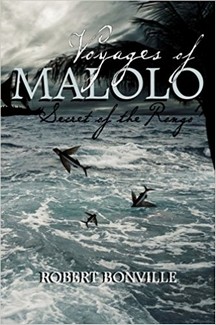
Ancient Polynesian Mariners on a spiritually inspired quest resulting in their circumnavigation of the Pacific over 1000 years ago.
“Voyages of Malolo” By Robert Bonville For thousands of years before documented history chronicled the achievements of the great Asian and European seafaring explorers, the world’s largest geographical attribute, the Pacific Ocean, was being navigated, explored, and colonized by the intrepid and heroic peoples of the South Seas. For millennia, their migrations eastward and northward from their origins in Asia, allowed them to discover and populate most of the 20,000 islands considered to be one of the last and final frontiers of habitable earth. For reasons of famine, religion, overpopulation, war or just the overwhelming human desire for exploration, these passionate and resourceful people set out on perilous voyages in wooden canoes to find new homes and better lives. During this period in Polynesian history, countless adventures, myths and legends of tragedy, conquest, cataclysmic natural disasters and exploration were told and retold through oral tradition by the memory keepers down through the generations. In approximately 1000 AD, one such story details the spiritually guided unparalleled epic voyages of a double hulled deep sea sailing canoe and its crew of sixteen courageous loyal men. Lead by a young western Polynesian mariner/warrior who is inspired by his discovery of a piece of driftwood, a wooden tablet containing undecipherable but somewhat recognizable hieroglyphic script known to these primitive people as “Rongo.“ In order to seek out and discover the meaning of the Rongo, the gods directed the creation of a great seagoing canoe appropriately named “Malolo”, (the Flying Fish). Built with great care and quality by expert craftsmen and artisans, this beautiful sleek craft was special in every way, built to withstand everything known and unknown that it could ultimately experience once it began its journey. With a crew of skilled, handpicked loyal men they set sail eastward on their momentous quest which takes them completely across the South Pacific to the seemingly endless land mass of South America then northward guided by their myths, legends and visions of those they encounter along the way. Their heroic adventures including their escape from sacrifice island, their survival of a Tsunami, the revenge of Pele (the fire goddess) and others, describe in historically based detail the wonders, experiences, tragedies, triumphs and discoveries by the men of Malolo during every phase of their voyage including their long and arduous time at sea. For this intrepid crew of ancient mariners the questions remain; will they ever discover the hidden meaning of the wooden tablet according to the will of their gods, will their journey return them once again to their tiny Western Pacific island, and will their epic adventure be worth all their suffering and loss?
Excerpt
Chapter 1
Late one day, circa 1000 AD, Tikaroa was finding it difficult to see sufficiently to carve the final hieroglyphs into a flat length of reddish colored mahoe wood with his shark tooth tool. The final rays of the setting sun provided waning shards of light into the mouth of his seaside cave and sanctuary as he attempted to complete his work.
Tikaroa a member of the Hanau-momoku or short ears, the oppressed working class, was at one point a much sought after highly skilled stone carver of the monolithic stone statues known as moai. Now a fugitive, he was being hunted by the Hanau-epe the oppressive ruling class known as the long ears.
He was proclaimed guilty of carving sacred prayers into wooden tablets in direct violation of the kapu prohibiting any form of religion or worship other than to the moai, which littered the landscape as a constant reminder to all the people of the island.
The carved wooden tablets known as Rongo contained hieroglyphs, depicting the chants and prayers to the gods of Hawai’iki; Iao the creator, Kane the god of forests and trees, Lono the god of rainfall, agriculture, and music, Ku the god of war, and Tangaroa the god of the sea and others.
Each time a moai was completed; the short ears would make a new Rongo, and secretly distribute it among the other short ears, teaching them and their children about the virtues and kapus of their original deities and not the lifeless stone moai. This practice was proclaimed kapu by the ruling class Hanau-epe and, those committing these crimes were sought out and killed.
This combination cave and workshop was located on a small isolated island located in the southeast Pacific Ocean known to its people as Te-Pito-O-Te-Henua, the island at the navel of the earth also known as Rapa Nui or Easter Island, ruled by Miruta’a, the all powerful head of the long ears.
Professional Reviews
Midwest Book Review
From James A. Cox, the Editor-in-Chief with Midwest Book Review March 15, 2012
One push against the rules gives way to a worldwide journey. "Voyages of
Malolo: Secret of the Rongo" is a novel set in the Polynesian islands before
the influence of Europeans, as a craftsman dares to pushes the limits, and
what he leaves behind sets the Hanau-mo-muku to send out some of its own on a voyage to see what lies beyond. "Voyages of Malolo" is an intriguing
delve of historical fiction and the ancient Polynesian peoples, very much
recommended reading.
Michael Dunford
Reviewer
West Maui Book Club
From the West Maui Book Club – Bonville expertly captures the required strength and courage the men of Malolo needed to have in order to make this incredible journey a success and return to their people…very much what it must have been like for the earliest of Polynesian sailors and warriors! There’s much to be learned in this story about these remote areas and its history.
Elaine Gallant
Green Valley News
Green Valley News – Book Review “Voyages of Malolo” April 29, 2012
By Robert Bonville
Self published 2011
566 pages
If you are into historic fiction, and enjoy Polynesian lore, here is a must-read adventure. Set in A.D. 1000, it describes the adventures of Auka’i and his crew of 13 men who sail the Southern Pacific in a double-hulled canoe named “Malolo” (flying fish). They aim to discover the meaning of a wooden tablet containing an undecipherable hieroglyphic script that may be called “Rongo.” The tablet was found in the surf by Auka’i. It turned out to be the impetus for this great adventure.
Malolo was constructed by order of Auka’i’s gods, who demanded the craft be built with great care and superb quality by the most expert craftsman so that it could withstand any occurrences on the ocean. It is a double-hulled, outrigger craft. The journey is perilous — rough seas, including a tsunami, mixed with hazardous adventures on the South Sea Islands, including an escape from Sacrifice Island. The crew battles disease, cannibals and even headhunters.
This is a piece of historical fiction that will hold the reader’s attention throughout the entire story as the heroic crew searches for the answers hidden in the wood tablet.
From the author: “The tale is fiction, but it is based on archaeological and anthropological evidence and widely accepted theory. It is an epic adventure that speaks to the will of ancient man to discover, learn and survive in the face of the harshest of conditions.”
The author lived in Hawaii and studied ancient cultures. He knows of what he speaks, and he is an excellent storyteller
Encountering danger, romance, heartache and tragedy, Catherine Merit strives to fit into a world filled with prejudice, hatred and violence where she is forced to kill a man in order to save herself. Third book of the Indignities Series.
Ireland 1944.. A young man’s body is pulled from the River Lee. He’s wearing a distinctive silver ring that belonged to Paudy Daly, the eldest son of the notorious Mixer Daly. Why?
Book I of Southern Swallow Series – 12th Century scholar Li K'ai-men takes command of his first official assignments during a time of political unrest and barbarian invasions.