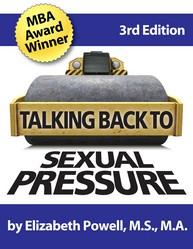
Empowers readers with options of what to say to explain their sexual limits, how to respond to persuasion or harassment, and how to avoid sexually transmitted disease. Helps in recognizing acquaintance rapists and examining their own distortions that may make them sexually vulnerable.
e-Book DOWNLOADS TO ANY MOBILE DEVICE--YOU CAN TAKE IT WITH YOU!
My website has a long list of very positive reviews of this book, which is a practical manual for females and males. It teaches sexual assertiveness skills in everyday language, such as how to explain that you want to use a condom, be abstinent, back someone off in non-forcible situations, get your boss or co-worker to stop harassment, and other skills of what to say under any kind of sexual pressure. It explains how assertiveness can protect against sexually transmitted infections. But it also helps to examine your own attitudes to see if you feel like taking care of yourself, and what gets in your way. It exposes the rape myths that underly the reasons why we blame victims--for drinking, for "wearing that top", etc. It involves the reader with checklists sometimes, to show examine how desensitized we may be to how the media portray sexual pressure and force. It shows people how to stand up for themselves, and ends with how to stand up for changes in society. Gives sources of help in the Appendix.
This book is skill-training, not just opinions. Read the reviews on epowellbooks.com.
Excerpt
EXCERPT FROM CHAPTER ONE
WHAT IS SEXUAL ASSERTIVENESS?
Assertion, or assertiveness, is behavior in which you stand up for your rights and say directly what you believe, want, and feel. Assertive people do this appropriately and honestly while respecting other people’s rights as well. The assertive person speaks up in her own defense, but does so without any effort to harm or put down another person. Let’s listen to Kristin, who has been out with Timothy several times. She’s worried about sexually transmitted diseases, and their relationship has been getting more passionate. One night, after some kissing and petting that they both enjoyed, she decides to bring up her concerns.
Kristin: (Pushes Timothy back and looks at him.) Timothy. (Sigh). I need to stop for a minute. I need to talk.
Timothy: What for?
Kristin: Things are going pretty fast here, and I’m...just worried about going too fast.
Timothy: What’s to worry about if you feel good? (He tries to kiss her on the neck). Come on, Kristin.
Kristin: (Leans back a bit). Tim, you know I like you and I’m very attracted to you, but (she takes a deep breath) I think we need to talk about...protection...before we go any further.
Kristin sticks to the point of what she needs. She expresses her views without putting Timothy down. Since Timothy was not out of line in merely wanting to continue enjoying what they were doing, she does not get angry.
Aggression, on the other hand, is behavior aimed at hurting or dominating. For example, consider Kory and Megan. They’ve been out a few times, and Kory has asked Megan to spend the night at his place.
Kory: I wish you would, Megan. You know how much I want to be with you.
Megan: Cut it out, Kory! You men are the same!
Megan’s response is aggressive. She lashes out at Kory and labels him and all men. She might really prefer that her outburst not escalate into bad feelings between them. She would rather have spared his feelings, since he was just asking for—not forcing what he wanted. But she wanted to postpone further sex and she didn’t know how to be assertive. An assertive response would have been:
Megan: I know you want to, Kory. But I’m just not ready for that yet.
Here she showed she was sensitive to his feelings, but she made it clear what she wanted.
In a non assertive response a person does not stand up for his or her own wants and needs. This behavior usually comes from feeling helpless and threatened. An example is Mia, who is sitting with Jose in the car, kissing. She starts to unbuckle Jose’s belt. Jose takes her hand away.
Mia: Come on, Jose. You know I want you.
Jose: Mia, I don’t know, I...We’ve just met.
Mia: Just stay out here a little longer.
Jose: But, Mia,..you know, you really turn me on, you know you do...but it’s too soon….
Mia: What kind of man are you? Am I ugly or something?
Jose: No, you’re not. (She gives him a very long kiss. He’s aroused and thinking he should prove his manhood.
After awhile they have intercourse, without a condom.)
Jose did not stand up for his rights. Although he was feeling passionate, he also was worried because he knew he was endangering himself as long as he did not talk over sexual protection with Mia. He allowed sex to progress to the point where it was too late to discuss risk. And of course, as sexual attraction distorts his judgment, Mia seems more and more wonderful and problem free. But he’s known her only a week and could not possibly have enough information to justify taking a sexual risk with her.
Books about assertiveness training always give scenarios about what people say when they’re not being assertive. But many nonassertive sexual situations involve few, if any, words! If any words were spoken, the typical nonassertive scenario would go like this:
A: God!
B: (kisses A, rubs body against A.)
A: (Pulls B closer, then pulls away.)
B: What? (Kisses A’s neck.)
A: No, I....
B: Please, just...
A: I—I—(lies down on car seat, pulling B down on top.)
Assertiveness training has become popular all over the country as a way to help Americans learn how to speak up for themselves in a nondefensive, rational way most likely to solve problems. Classes in assertiveness training abound in colleges and other adult education courses. Students are trained to be assertive but not aggressive. Yet in very few of these books or classes is sex ever mentioned! It is really “All but sexual” assertiveness training. Few teachers want to tackle as controversial and emotional a subject as sex and many audiences are self conscious hearing about it. Partly because we avoid crude or distasteful sexual remarks in the interest of being well mannered and polite, we make the entire subject taboo. Many professionals feel embarrassed to treat the subject with their students or clients because they themselves are not at ease discussing such matters. Studies of physicians indicate a widespread inability to discuss sex with their patients.
In a “polite society,” we implicitly agree not to discuss sexual matters. (If I say at a dinner party that I specialize in sexual assertion, an awkward silence follows.) Despite this great silence on the subject, I believe that sexual assertiveness is teachable. You may not be totally comfortable discussing sexual matters. That’s “normal” in that most Americans feel such discomfort. But you deserve better.
Somehow while growing up I realized the absurdity of powerful adults—these people who knew all the answers—being reduced to embarrassed muteness by the mere mention of sex. I hope you, too, see the insanity of allowing a taboo to threaten our society. Twenty years from now, our children will not thank us for saving them from hearing sexual words at the expense of their happiness and perhaps their lives.
EXCERPT FROM CHAPTER TWO
YOUR SEXUAL RIGHTS
Some people think they have no right to ask for what they want. Others feel they do not have a right to refuse, sometimes even in marriage. Some even believe that being made fun of in sexual ways at work, while slightly embarrassing, is something they just have to endure. We need to be able to understand, and to state explicitly, our sexual rights. Only then can we assert our power over our own bodies.
I know a counselor who used the first edition of this book in a sexual assertiveness class. When the term was nearly over, one of the students said to her wistfully, “I wish I’d known I had rights…before.” This poignant remark reflects how confused our society is about sex.
These fundamental rights, to which I believe everyone is entitled, are not legal rights, although some of them are built into our laws. You may want to add to this list with ideas of your own.
1. A person has a right to refuse any type of sexual contact at any time or place, regardless of how aroused the partners might be. There is no such thing as being so aroused that you “owe” anything to your partner. If you are stark naked and change your mind, you still have a right to do so. Now, if you take off your clothes and change your mind on numerous occasions, you still have a right to do this, but there is an element of game playing—and probably anger and manipulation—in it. If you continually confuse your partner, hopefully he’s a stable person, because he will be frustrated and irritated. Your body is still yours, though, and you are the only one who can make decisions about it.
Students in my classes role play how to resist sexual pressure. We set up four chairs and pretend that the “main couple” is alone together. The other two chairs are for “coaches” who help out when the main players get stuck—it gives the main players a bit of courage. Our role plays do not involve touching; the audience has to imagine that. I explain that people of any sexual preference can use these techniques. However, the typical male-female roles in our society are the most highly correlated with sexual assault. First the man verbally pressures the woman. Then they reverse roles and the man refuses the woman’s pressure. Men are sometimes willing to participate in the first situation, but when the women pressure them, younger men are invariably very tense and uneasy. In fact, only a few brave ones volunteer for this exercise. They show signs of anxiety like repeating phrases. They often cop out; instead of resisting pressure, they make up a reason why they cannot have sex: “I have a girlfriend already.” They sometimes sit down and refuse to play the role. Men are highly vulnerable to the fear of appearing unmanly. Saying “Yes” has been ingrained in them as the only position a real man can take. (“Go for it!” “Score!”) This attitude must change, or the rate of sexually transmitted disease (STD) will continue to increase.
Going out with someone, buying dinner or doing other favors does not confer sexual rights to one person over another. This kind of misunderstanding, though, might be one good reason for women to consider paying their own way or making the extent of their sexual availability clear before accepting gifts or favors. Unfortunately, some people feel they deserve something sexual for their money.
Professional Reviews
TALKING BACK TO SEXUAL PRESSURE
I was so happy to learn that "Talking Back to Sexual Pressure" was now available in e-book format. I've used this book in assertiveness training classes--my students always graded it "A+". It would be a helpful book for any person who finds it difficult to talk about sexual issues in a relationship. That would be pretty much everyone! What I most appreciate about this book is the compassion Powell shows for women and men in difficult sexual situations. Surprisingly, it's also a funny and entertaining book, with scripts of role-plays that illustrate some of the challenges we all face when we try to be honest about our sexual needs and boundaries. Great book! Meg Selig, LPC, NBCC, author of CHANGEPOWER.
HOPE FOR COMPULSIVE GAMBLERS!
Now there's a workbook that compulsive gamblers can use to work their way t freedom in Christ.
Do you have a gambling problem?
You can take this workbook and work your way to freedom in Christ.
Do you kno
Through insightful and thought-provoking writing, the author encourages readers to embark on a journey of self-reflection, guiding them to access inner wisdom and cultivate a mindset conducive to a better understanding of our world.
This is your journal, for your writing. An interactive journal with historical tidbits designed to nurture creativity and self-motivation, features one side for drawings, sketches, or pasting personal pictures, and the other side lined for notes or j