
Kindle Edition
Amazon
Even non-readers will relish (and finish) this book
Category:
Memoir
Publisher: Author House
ISBN-10: 1491831480
Type: Non-Fiction
Pages: 158
Copyright: March 8, 2014
ISBN-13: 9781491831489
Price: $9.99 (eBook)
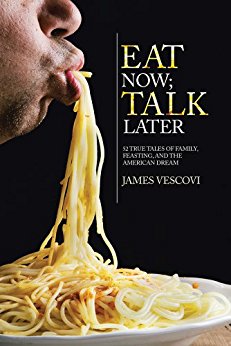
When Tony and Desolina Vescovi came to America, they collided with the 20th century and were stumped by banking, supermarkets, the nuclear family, voice mail and TV wrestling. These 52 stories, a twist on the American immigrant tale, are a testament to love, loyalty, and frequent half-truths.
Eat Now; Talk Later: 52 True Tales of Family, Feasting and the American Dream is a memoir containing stories I collected about my grandparents during the years I cared for them. It is a book consumed in delicious bites: The stories in Eat Now; Talk Later can be read before bed, on a lunch hour, or waiting in line. They can even be shared with friends who complain they have enough to read. Together they ask the question, “How do you make modern life run smoothly for grandparents who grew up when oxen were used for plowing, polenta was eaten twice a day, and the family house was divided between three brothers room by room?
This is not the usual immigrant-made-good tale. Tony and Desolina Vescovi were born on farms where life hadn’t changed for hundreds of years. When they came to America, they passed through a time-tunnel that brought them face-to-face with the 20th century. They found themselves puzzled by banking, supermarkets, college degrees, and the nuclear family. Tony tried to pay hospital bills in cash, and Desolina--when she reached voice mail—cursed into her phone because no one was responding to her questions. The tales in this collection are poignant, hilarious, and bittersweet.
Excerpt
TWO EXCERPTS:
THE DRESS
Before I left for my honeymoon, Desolina told me several times to look for la vesta, the dress. She had left it behind during her last visit in 1958. She gave me the precise location: third floor, first room to the left, oak armoire. The dress itself was green. She emphasized that I had to get up to see it without her sister-in-law, Ermina, knowing about it.
“Do you want me to bring it back?” I asked.“No, no, no!” she said. “Just make sure it’s there.” Leaving the dress was Desolina’s way of asserting her rights: a third of the family house still belonged to Antonio Vescovi, despite the fact that he lived 3,500 miles away.
I wanted to do more for my grandparents than skulk around in search of a dress. I asked my grandfather if there was anyone we should visit for him, or could we perhaps take something over?
No, there were no messages or treasures to deliver, he said. “Just say hello to everybody.”
“E la vesta,” said Desolina. “Non scordarti. Don’t forget.”
When I told my father about the special mission, he said, “Watch out for Ermina. These old peasants have eyes in the back of their heads.”
The most interesting person Gina and I had met on our trip was Elena. She had noticed us lingering around the church one morning. After I identified myself and my origins, she broke into a smile. Of course she knew Tony and Desolina Vescovi, she said. Her own mother—the best cook in the village—had prepared their wedding feast. Elena invited us into her home for espresso and cookies. She was gracious, funny, and very intelligent. What was most intriguing was her gender, which we couldn’t make out.
Elena had the broad shoulders and large hands of a man, as well as a light mustache, but she also possessed slender wrists and delicate calves. Her voice was very deep, but she wore a dress and stockings and identified herself as a woman. She was very evasive when entertaining questions that would hint at her gender. When I asked her if she had children, she responded, “The mountains are my children.”
Ermina and Domenico had turned red-faced when I had mentioned our visit with Elena. They didn’t want to talk about her.
A week after Gina and I arrived back in New York, we went to Astoria to recount the trip. Friends of my grandparents had given us gifts, not to mention countless hugs and greetings. A letter from one of Tony’s childhood friends made him weep like a baby.
“Oh, and by the way, we saw Elena,” I said. “Remember her? Her mother cooked your wedding dinner.”
As soon as they heard her name, my grandparents sat up straight.
At the same time they said, Tony: “She’s a strong woman"; Desolina: “Poor man.”
As Gina and I were leaving, Desolina pulled me aside and whispered, “La vesta, l ’ era la? The dress, was it there?”
It was.
TUTTO ‘FREE’
When Tony and Desolina Vescovi immigrated to the United States in 1930, they passed through a time tunnel. Gone were oxen and plows, the annual excitement of the slaughter of the family pig, and polenta for breakfast, lunch, and supper. My grandparents were creatures of a medieval mindset, born into farming communities where life and technology hadn’t much changed in hundreds of years.
In America, they found themselves living in the modern world, with automobiles, radio, banking, supermarkets, answering machines, and the nuclear family. And they were often baffled. On one occasion, Tony, when admitted to the hospital, brought $1,000 in cash to pay the bill. On another day, it took me 30 minutes to explain a Master’s degree to Desolina; she believed a Bachelor’s degree was as high as a human could study, and besides, what could you possibly learn after four years in college?
My grandparents were like children in a strange, new world, and their misunderstandings made for great stories—funny stories, and stories that said a lot about human nature. This tale recounts the day when my father (their only child) had to convince them to give up their independence and move into an assisted living community. She was 93 and he 94. They had lived independently for a good long time. But still, it wasn’t going to be easy to get them to leave Astoria, Queens, New York, and move 700 miles to Kalamazoo, Michigan, where my father resided. Here is the tale “Tutto Free.”
Even between my father and me and the Colombian lady down the hall doing piecemeal care, my grandparents’ independence couldn’t last forever. Tony and Desolina’s diet was going to pot. Their medical conditions needed supervision. There came a day when allowing them to live alone would have amounted to negligence.
My father decided he had to bring them to an assisted-living facility in Kalamazoo. “Assisted-living” was a concept most Americans didn’t understand at the time, let alone Tony and Desolina. In their eyes, any residence for old people was a nursing home, and this set off fireworks. My grandfather despised such places.
My father had tried to get them to move years earlier, with hurtful consequences. When he’d shown his father photos of a clean, comfortable place, Tony went berserk. He jumped up from the dining table. His eyes were blazing.
“This is where people go to die!” he yelled. “You’re trying to put me and Mama in a place like that?!” He took a menacing step towards my father. “I’ll go in there over my dead body.”
But today was different. The two of them were nearing their mid-nineties.
My father sat them both down at the table. He explained how an assisted-living facility was different from a nursing home. He showed them brochures with photos of an elegant dining room and outdoor garden. He swore to them on a stack of bibles that he had seen the place, and it was clean and well operated.
“No, I’m not going,” Desolina jumped in. “I’m too old to get on a plane and move to Kalamazoo.”
My father was surprised. Desolina would have lived in hell if it brought her closer to her son. But, then again, she had always been unpredictable.
“But Mama, the flight is only two hours long. É un bel posto! And it’s such a beautiful place. Look at the dining room. Hanno il ‘ros bif ’ tutte le Domeniche. They serve prime rib every Sunday. And I live five minutes away.”
Desolina shook her head. He tried to appeal to her love of food.
“There are four meals a day! Breakfast, lunch, dinner, and un spuntino prima di dormire! A snack before bedtime!” he pleaded.
Desolina grunted in the negative. “No, Selvi, it’s time for you to come back here to take care of us.” She folded her arms and sat back in her chair.
My father now tried to work on Tony, who shook his head adamantly. He didn’t want to live under anyone else’s thumb. These places served lousy food. And they were expensive.
As a last resort, my father banked on Tony’s sense out of duty. He pointed out that Desolina really needed help and that he, Tony, could no longer provide it. It behooved him to think of his wife.
Tears came to Tony’s eyes. He knew it was true. It was the end of an era. He had lived in New York for seventy years and on that block in Astoria, watching the world go by from his stoop, for forty. It was time to go. He wept.
My father now had to tip the scale and get Tony to say “yes.” He accomplished this with a rare lie. “And Pa, you’re not going to believe it, but the place is free.” Tony wiped his eyes and looked up.
“E free?”
“Si.”
“Ma, no!” Tony said.
“Si.”
“Ma, chi paga? Who pays for this?”
“My company,” my father replied. “It’s one of the benefits I get. But I don’t need the place now, so my parents are allowed to stay there. For free.”
“E vero?” he asked. “Is this true?”
My father nodded. “Tutto free. Everything is free.”
Tony couldn’t stop shaking his head.
Desolina, who was growing more and more deaf in her old age, leaned forward and asked: “What are you people talking about? E al Papa, perche al pianza? And why is Papa crying?”
“Porco cane, free!” said Tony. “Che compagnia! God bless America!”
“Then you’ll go? It really is a beautiful place, Pa,” my father said.
Tony sighed. “All right,” he said, and the tears came again.
“Selvi, perche piange il Babbo? Why is Papa crying?” Desolina asked again.
“He said he’ll come to Kalamazoo,” my father replied.
“No,” she said. “E vero?”
My father nodded.
“Tony,” she said to him across the table. “At ve a Kalamazoo?
He nodded.
Desolina looked at her son. “Se va il Babbo, vengo anch’io. Well, if he’s going, I’m going, too.”
And so on a hot August day in 1993, Tony and Desolina flew first class with my father to Kalamazoo. My mother met them at the airport and chauffeured them to Director’s Hall, an assisted-living residence for 200 people. Tony and Desolina were not even the oldest couple in the place.
Settling these two old peasants into their new surroundings was touch and go. Accepting scheduled baths and daily nurse visits was not easy. Hard as they tried, the aides could not get them down to the arts and crafts center or to the rec room to do geriatric aerobics.
“What they hell are these people doing?” my grandmother asked. “They look crazy.”
Mostly, Tony and Desolina stayed in their room, watched TV, and waited for daily visits from my mother. They got the routines down. Tony grew fond of the place—the food, the gardens, the nice people.
He would sit in the dining room, his plate heaped with food, and aides serving all the iced tea he wanted. The chairs were soft, the carpet plush.
On my first visit, he looked at me with wonder and said, “Jimmy, chi paga per questa roba? Who pays for all this stuff around here?”
“É free,” I said.
|