Category: Spirituality Publisher: Books of Life Publishing House
ISBN-10: 0991991702
Type: Non-Fiction
Pages: 338
Copyright: Nov 21, 2013
ISBN-13: 9780991991709
Price: $8.98 (eBook)
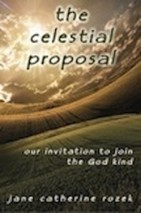
An ancient celestial plan emerges in stunning clarity when trite religious terms are stripped away from traditional Christianity. Our human species is destined to join the ranks of immortal cosmic gods in a mind-rocking, epic drama and the whole planet is the stage!
The Celestial Proposal is a maverick, intriguing expose of an ancient plan for humanity to spiritually advance and become immortal god-beings on earth and into galactic space. The author, Jane Catherine Rozek, strips away trite religious terminology to put forward a stunning new way to look at Christianity.
The book is written for those trying to define God in the contemporary world of space exploration and quantum physics. It speaks to New Age seekers, non-believers, and Christians who dare to think outside the box. It seeks to reconcile the basic questions of life: Who are we, and what are we doing on our planet?
As a Christian apologetic, the book defends the faith yet dares to consider that God might be more than merely one entity. Rozek extracts this notion from many excerpts in the Bible, not only the trinity (Father, Son, and Spirit), but by a plural God declaring: “Let US make man in OUR image.” In the author’s view, this theory of Great Ones does not negate any scriptural truths but reconciles them to the twenty-first century.
Rozek resolutely states that we as humans, have been, and still are being contacted by something far greater than ourselves. While humanity still searches for contact with intergalactic intelligent beings, the author declares that their visitations to our planet have already been documented in the pages of biblical history.
Advancing without boundaries, The Celestial Proposal attempts to prove that we are designed to be gods. A celestial plan is clearly marked and set upon the human timeline for humans to implement god-like characteristics, activate celestial power, and grow into spiritual maturity.
Rozek reveals a proposed alliance with these Great Ones. Cosmic immortality is being offered to those of us who accept celestial ethics and dare to interface with them.
Excerpt
In narrative non-fiction, the author Jane Catherine Rozek, strips away trite religious terminology to put forward a stunning new way to answer the basic questions of life: Who are we and what are we doing on our planet? The Celestial Proposal: Our Invitation to Join the God Kind, reveals a unique meaning and purpose to life. It is a maverick, intriguing exposé of an ancient blueprint for humanity’s spiritual evolution to become god-beings and immortal citizens in the cosmic realm.
Professional Reviews
**Chosen for the Dec. 2013 issue of ForeWord Reviews
"This mash-up of Bible + sci-fi + metaphysics has introduced new lines of thought for meditation and consideration."
Identifying faith as a force for shifting manifest reality, Jane Catherine Rozek untethers Bible verses from their historic, traditional moorings. Calling the Bible an "empowering formula for activating faith as a power source," she reboots scripture to read like a science fiction thriller with God as an extraterrestrial collective of "Great Ones" and Jesus as our "Superhero."
Her metaphor, that humanity is in a game of life, features the Bible as rule book and the author as its interpreter. She asks, "Can we still write this off as just some imaginable science fiction? No, this is twenty-first-century Christianity!" In bringing this fresh perspective to the scriptures, the author's take may step on some toes. She starts, in chapter one, by extracting an updated understanding of spiritual faith from historical Christian doctrine. The literal interpretations of the biblical passages sampled throughout will likely put off the more spiritually (not religious) minded. Traditionalists might resonate with the discussion of Satan and evil ruling the world. Might they take exception to hearing Jesus called "immortal crossbreed"?
The author's inspiration and personal backstory appear late in the book and would have provided beneficial context had they appeared earlier than chapter twelve. When homesteading one hundred miles from the nearest town, she says, "My personal experience while ranching in the wilderness of central British Columbia ... required that I build just this kind of faith to withstand the physical trials and concerns of safety for my children, my husband, and myself ... I desperately needed to be in connection with a higher power of some sort. I developed a deeper understanding of a metaphysical kind of faith and began to see it as a tangible source of power situated just at the edge of my physical reality."
Sci-fi and superheroes aside, some of The Celestial Proposal's concepts are not out of place on a New Age shelf. Glossing Luke 17:21, "the kingdom of God is within us," the author says, "Like a strong electrical current, creative power can be channeled through our lives by our own faith-filled thoughts and words."
Updating humanity's understanding of the Bible is a thankless task, so taking on this particular challenge requires courage. That it falls short of a fully coherent reframing does not reflect badly on the author. This mash-up of Bible + sci fi + metaphysics has introduced new lines of thought for meditation and consideration.
–ForeWord Reviews
Kirkus Review
A passionate rereading of Christianity and the nature of personal faith.
Canadian author Rozek’s debut takes the form of an enthusiastic top-to-bottom re-envisioning of the Christian mythos. Rozek cites such influences as C. S. Lewis’ The Screwtape Letters (1942), Erich von Däniken’s Chariots of the Gods (1970) and the Christian-mystic writings of Zecharia Sitchin as she goes back to the Bible with fresh eyes and reads it anew in search of the answers to basic questions such as “Why am I here?” or “What’s the purpose of life anyway?” She views these questions as central to “the game of life” and tells her readers, “To get to the ultimate level, we must play it seriously with all the skills we have.” The schema of quasi–Judeo-Christian faith she derives from her readings is personal and interactive. She reminds her readers that the Bible is full of references to heavenly interactions with the lives of humans, and in her view, this is a necessary thing. “Our world today still needs celestial intervention desperately.” That intervention comes about at the behest of “the Great Ones”—“a collection of benevolent, celestial God-beings: the Source, the Son and Spirit.” She also spends a good deal of time on forerunners and servants, the supernatural beings known as angels. Rozek’s conceptual revamping of traditional biblical ideas ultimately appeals to the well-known Christian narrative: Jesus died as a sacrifice and as a living key to redemption. “By accepting the death of this Great One as a ransom for our freedom,” Rozek writes, “each of us can belong to something far greater than ourselves.” The book then broadens from this dramatized 21st-century recasting of the Messiah story to include some intriguingly wider suggestions for how the faithful of any denomination can find meaning: “The Great Ones know that in order for us to have abundant lives, we must first learn how to love.” Familiar concepts, sure, but Rozek’s unconventional perspective makes them seem invigoratingly new.
A well-written and welcoming take on the traditional tenets of Western religion.
–Kirkus Reviews
The Writer's Edge
“The author is a seasoned writer. This is one of the more interesting submissions we have seen so far this year. We commend you for thinking ‘outside the box’ as you put it.”
–The Writer’s Edge
Because we have an opportunity to choose our attitude and focus our intentions in the present moment, the world and our own personal lives are a reflection of our thoughts. It is our 360 degree review on how we think. Put simply, our job is to fully