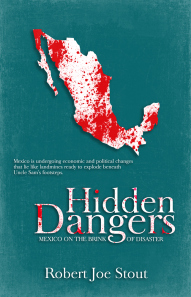
Ruptures in the relationships between the United States and Mexico put the latter country on the brink of disaster. Examined are the realities of immigration, commerce in drugs, corruption, the environement and popular protests.
Former New York Times bureau chief Alan Riding calls Mexico “our distant neighbor.” Distant or not, the neighbor is undergoing economic and political changes that “lie like landmines ready to explode beneath Uncle Sam’s footsteps,” comments a noted Mexican journalist. These landmines include:
·Migration, legal and illegal, exacerbated by profound differences in earnings in the two countries, a rapidly expanding labor pool and more aggressive deportation procedures on the part of U.S. Homeland Security;
·Intrusion by drug cartels into economic and political activities south of the border that include assassinations, payoffs and escalating drug use in Mexico itself;
·Grass roots political movements opposed to globalization, centralized government and unequal distribution of wealth that are being repressed, often violently, by Mexican political forces;
·Government corruption and the failure to invest oil profits in infrastructure, debilitating the industry and putting most of the country’s wealth in the hands of a few politically connected individuals;
·Environmental disasters and the collapse of self-sustaining agriculture have created wastelands, polluted major waterways and triggered rural-to-urban migrations.
Although Mexico’s economy has produced some of the world’s richest individuals, three-fourths of the population lives into poverty, much of it extreme. One-time self-sustaining coffee, corn and poultry producing communities have become ghost towns. Twelve percent of Mexico’s economically active population works in the United States, an estimated seven million of them illegally. The money they send back to Mexico exceeds $23 billion dollars a year, only slightly less than provided by oil exportations. The country’s president, Felipe Calderón, sidled into office after obtaining slightly over one-third of the national vote in an election tainted by widespread allegations of fraud. Drug cartel-connected murders have become everyday events and unsolved feminicides number in the thousands.
Hidden Dangers delves beneath the surface to describe and analyze these landmines that threaten the economies and social and political well-being of “distant neighbors” whose futures inextricable are joined.
Excerpt
Governmental campaigns against corruption have occupied headlines for the past eighty years. So has U.S. condemnation of this same corruption. But throughout this period, those condemning and campaigning have been entwined in the intricate web they purportedly have been trying to break. The United States has strongly supported Mexico’s patriarchal system of government for economic reasons, backing executive control of policymaking, particularly oil exports and arming the federal military to combat drug exports. Simultaneously, the U.S. government has refused to legislate arms sales or deal forcefully with the internal market for cocaine, marijuana, smack, and designer drugs.
The U.S. State Department’s assessments of human rights violations have had more to do with political alignments than with actual events; they annually list countries with left-leaning governments as the principal violators and sugarcoat the apprehensions, assassinations, and impoverishment of dictatorships and pseudo-democracies like Mexico and Colombia. Numerous sources have indicated that the United States financially supported Felipe Calderón’s presidential campaign against López Obrador in 2006. Although hard data about purported support is lacking, U.S. campaign experts participated on Calderón’s behalf, and the United States promptly recognized Calderón’s controversial victory over the “leftist” PRD aspirant.
More damaging to Mexico’s poverty-wracked millions has been profit taking by the U.S. and multi-national firms that assumed control of Mexico’s banks, agriculture, and industry after the passage of NAFTA. Foreign-owned banks in Mexico registered greater profits for their stockholders than those stockholders realized in their countries of origin, largely because the foreign firms enticed those responsible for Mexico’s banking regulations—specifically the executive and legislative branches—to grant enormous concessions and minimize restrictions. Bogus loans of millions of pesos, phantom corporations and financial institutions, and here-today, gone-tomorrow investment firms, both Mexican and foreign, profited as the country’s financial system crashed in the 1990s, taking with it hundreds of thousands of individuals and small industries and businesses.
The green light given by NAFTA to U.S.-backed mega-corporations and agribusiness to “Walmartize” huge swaths of what formerly had been successful (or at least functional) small agriculture and industry, thrust millions into poverty, increasing the outflow of currency that no longer would be available for local investment and reducing labor to a non-unionized temporary (and poorly paid) workforce. In the process (with the cooperation of local caciques and politicos) the NAFTA-backed entrepreneurs polluted wasterways and transformed formerly productive land into flood plains and grazing land.
Their actions—and attitudes—were not that much different from U.S. G.I.s and college students who crossed the border to get drunk, buy drugs, and/or go to whorehouses: “Who gives a damn about the people—or the country—as long as we get what we want?” The doors for corruption were open and foreign investors, principally U.S., Canadian, and Spanish, became major practitioners. Like their Mexican counterparts, they kept most of their dealings debajo del agua while presenting surface morality. The business practices and financial dealings that many foreign investors and entrepreneurs adopted would have netted prison terms if the perpetrators had attempted them in their home countries.
As Ugo Codevilla, Federico Campbell, Miguel Ángel Granados-Chapa, and many others have pointed out, when a country’s business, social, and political leaders visibly engage in corrupt practices, the majority of the citizenry, accepting that such practices are sanctioned, also become corrupt, and no amount of patriotic bluster—either from Mexico City or Washington, D.C.—changes that dynamic.
S
Professional Reviews
Deal Breaker
Author Robert Joe Stout’s book ‘Hidden Dangers: Mexico on the Brink of Disaster’ provides a compelling overview of the country’s political, economic and social changes that have taken place in the years 2000 - 2010. Focussing on the historical and the contemporary relation with its neighbour the United States of America, the author lists five ‘landmines’ that could shred this relationship. Armed with a strong array of first hand reports, observations, interviews with officials and superior analysis; the author exposes the potential downside to the social and political settings of both the countries if the problems are left untreated.
Taking up five main areas of discord and misunderstanding between Mexico and U.S.A, the book presents a multifaceted take on the current state of Mexico’s socio and political environment. It highlights issues like the problem of unchecked production and distribution of drugs because of high demand from U.S. and the ever increasing gang violence. It also looks at how the famed War on Drugs has actually contributed to more deaths than curbing the demand of drugs. It discusses the unchecked migration problem of Mexican youths travelling to U.S. in search of employment and the United States militarized persecution of such illegal workers. It also covers the various uprisings and protest movements that has emerged of late challenging the U.S influence and neo liberal politics of the land. The book also manages to analyze Mexico's economic, political and social settings within the politics of corruption. And how this backlash will affect modern day Mexico and the implications it will have on the Mexico-U.S. relationship.
This book also raises many important questions that are critical to understanding Mexico's current economic and political challenges. Mainly how it continues to drown in debt in spite of opening up trade with NAFTA and export of oil. The reasons why it hasn’t been able to sustain all inclusive economic development is another issue addressed. The failure of repeated governments in not being able to provide for the welfare of its citizens and how it’s affecting the social fabric of the country is also discussed in great detail.
This book is exhaustively researched and told with the journalistic nitty-gritty style that presents both a historical and modern overview of the Mexican society and politics. Tackling various social elements in its endeavour to form opinion and relevant commentary, the book takes into account the voices of different policy makers, organizations, workers and others. The book also delves into detail the strengths and weaknesses of the relationship between Mexico and the United States. And with respect to the issue of migration, trade and criminal activities, a host of policies and processes are addressed to improve the prevailing relationship between the two countries.
Balanced and objective Hidden Dangers: Mexico on the Brink of Disaster provides a different and refreshing approach to understanding the country of Mexico. It presents a comprehensive and nuanced analysis of modern day Mexico that helps in better understanding its position on migration, war on drugs, business & commerce and political uprisings. This scholarly work is highly accessible and anyone who picks this book up is sure to take away something useful from it.
The REAL Story of Modern Mexico
By SouthwestDude on March 17, 2015
Format: Paperback
As a native Southern Californian I have been interested in Mexico and Central America my entire life. In the last 10 years I have made an effort to read and understand as much as I could about the Mexican Revolution and, to some extent, 19th century Mexican history. My wife is a Mexicana and hence, my extended family, are all from Mexico. I enjoy listening to their stories of the old country and what prompted their immigration to the United States.
This book, of recent Mexican events and history, is one of the most fascinating current events books I've read in a very long time. Issues of the real reasons for the development of the "drug cartels" and border problems are addressed in a clear and logical manner. The reasons for, and the true impact of, Mexican immigration are addressed in a compelling fashion. The book examines corruption in Mexico and how it fits, "hand in glove" with American interests- especially as it relates to the "War on Drugs". I was troubled and captured by the relationship between the Mexican government and the Mexican media. It takes profound courage to break from that grasp and speak the truth as a journalist in Mexico.
I can't emphasize enough how much I appreciated this fine work by Robert Joe Stout who actually lives in Mexico and has an extraordinary grasp on the history, culture, and current socio-political milieu of the country. If, like me, you have a hunger for deeper understanding of the real issues in contemporary Mexico you must read this excellent book.
Hidden Dangers: Mexico on the Brink of Disaster
Stout's book is a detailed study of the status quo in Mexico and its relationship with its uber-powerful Northern neighbour. Based in Oaxaca, Robert Joe Stout's writing often reflects detailed local knowledge and overall, his grip on Mexican and Mexican-USA affairs is profound. The book falls into 5 main chapters where various 'landmines' awaiting explosion are discussed. From migration to the cutthroat 'War on Drugs', from the environment to political activism and corruption. The poise of Stout is always of an educated man yet he has a Derridean presence, enough to see the wider picture and to target a worldwide readership. I love the way he interlinks words and phrases from Mexico such a 'Cuatear' and 'debajo el agua'. I found the War on Drugs to be a noteworthy chapter - it is very difficult to see a solution to this militarized situation and with 50000 deaths already and 70% of Mexico's cash being generated by the illegal drug industry, there are no easy solutions to this landmine. The author's work here builds on other detailed studies I have read on this situation such as Joan Grillo's 'El Narco'. I found the chapter on corruption to be where the author was most freeflowing and insightful. The detail in this chapter, combined with direct local knowledge and research gives this book an edge on other contemporary studies on Mexico. Overall, I loved Stout's revelations in 'Hidden Dangers' and as a Translation / Hispanic Studies student at Cardiff University I hope that this book and its contents can be featured on future courses at the institution. Five Star Rating.
This is a Hypertext Book Release of the F. Scott Fitzgerald classic This Side of Paradise on Black April 23, 2016 which is William Shakespeare,s 400th birthday.
A Viconian Cycle/ Babylonian Captivity Memory Silence Re-Founding of Southern history out of Dublin GA and the KBPS7 Trial. In psychology this is a Wounded Pride case.