Jan Maher, click
here to update your pages on AuthorsDen.
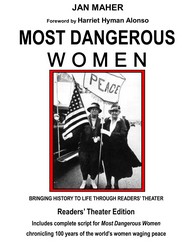
Most Dangerous Women: Bringing History to Life through Readers' Theater/2 e
by Jan Maher Nikki Nojima Louis (play co-author); Harriet Hyman Alonso (Foreword)
Category: History Publisher: Dog Hollow Press
ISBN-10: 1943547009
Type: Non-Fiction
Pages: 144
Copyright: July 1, 2015
ISBN-13: 9781943547005
The history of the international women's peace movement told through documentary drama with music; additional chapters guide teachers and community theater producers and activists in working with and extending the content of the play in classroom and community settings.
From Foreword by Harriet Hyman Alonso
Nikki Nojima Louis and Jan Maher have written a beautiful play which evokes the passion and commitment of various women who have dedicated their lives to achieving world peace. Most Dangerous Women, a combination of emotional music, passionate statements, and a strong sense of social justice, is based on the history of two strands of women’s peace activism—the work of the organization, the Women’s International League for Peace and Freedom (WILPF), and the work of individual women who received the Nobel Peace Prize in honor of their dedication to humankind...
The discussion of teaching methods and materials which appear in this volume makes Most Dangerous Women accessible to children and adults alike. This is a most worthy
project, one which gives to educators historical knowledge, educational instruction, and a lesson in heroism, dedication, and action.
Excerpt
Rosika Schwimmer: We must thunder forth a demand for stopping this war in such a voice as will drown the cannon's roar!
NARR 1: Rosika Schwimmer, born in Budapest to an upper middle class Jewish family, was a forceful personality. She was someone you either loved or hated.
VOICE: No one can be neutral about her.
VOICE: By the standards of the day, she does not always behave in a way in which women are expected to. She smokes and likes the odd glass of wine. Traditionalists do not take to her bright, loose-fitting dresses which, being a follower of the dress reform movement, she wears without a corset or brassiere.
NARR 1: But only Madame Schwimmer can sweep the Congress off its feet. She suggests a minute's silence for those fallen in battle. The delegates rise in union.
Rosika Schwimmer: We have one among us who has learned that her son has been killed - and women who have learned two days ago that their husbands have been killed, and women who have come from belligerent countries full of the unspeakable horror, of the physical horror of war. These women sit here with their anguish and sorrows, quiet, superb, poised, with only one thought: "What can we do to save others from similar sorrow?"
[SINGER moves downstage as piano begins to play accompaniment. Song: I DIDN’T RAISE MY SON TO BE A SOLDIER (Music-Paige Wheeler, Lyrics – adapted from Alfred Bryan, used by permission.)]
SINGER:
I didn't raise my son to be a soldier.
I brought him up to be my pride and joy.
Who dares to put a musket on his shoulder
To kill some other mother's darling boy?
DELEGATE 1: We women, in International Congress assembled, protest against the madness and the horror of war, involving as it does a reckless sacrifice of human life and the destruction of so much that humanity has labored through centuries to build up.
DELEGATE 2: This International Congress of Women protests vehemently against the odious wrongs of which women are the victims in time of war.
DELEGATE 3: ...urges the Governments of the world to put an end to this bloodshed and to begin peace negotiations.
DELEGATE 4: recognizing the right of people to self-government...
DELEGATE 5: ...urges the governments of all nations to refer future disputes to
arbitration and conciliation.
DELEGATE 6: ...urges the governments of all nations to unite in bringing social, moral, and economic pressure to bear upon any country which resorts to arms.
DELEGATE 7: Since war is commonly brought about NOT by the mass of people
who do NOT desire it...
DELEGATE 8: Since the combined influence of women of all countries is one of the strongest forces in the prevention of war...
DELEGATE 9: This Congress advocates universal disarmament...
DELEGATE 10: urges that the organization of the Society of Nations should include a permanent International Court of Justice
DELEGATE 11: and a permanent international Conference...
DELEGATE 12: The people should take part in the conference...
NARR 1: Resolves that an international meeting of women shall be held at the same time as the Conference of Powers which shall frame the terms of the peace settlement.
[SINGERS move forward as piano introduces song: THERE’S A WAY (music and lyrics by Jan Maher, used by permission)]
SINGER 1:
Teddy Roosevelt thought women had no business talking peace.
They are cowards said the Rough Rider; they're silly and they're base.
War's for men, it always has been, always will be; stand aside
While we brave male warriors take the planet for a ride.
TRIO:
They shook their heads.
The ladies said:
There has got to be a better way.
There's a way to build a world based on dignity for all,
We are off to find solutions at the great Hague Hall.
We can eliminate the causes that lead the world to war.
There's a way to Peace and Freedom: that's what we're looking for.
SINGER 2:
Through the war zones these intrepid women made their way,
And they met and they envisioned a glad new day.
They told the world that peace was how we all could gain.
Some said
SINGERS 1,3:
"They're clearly dangerous,
SINGER 2:
Some said
SINGERS 1,3:
"They're just insane."
TRIO:
They shook their heads.
The women said:
Will you join us in a better way?
There's a way to build a world based on dignity for all.
We have met to find solutions at the great Hague Hall.
We can eliminate the causes that lead the world to war.
There's a way to Peace and Freedom: that's what we stand for.
SINGER 3:
Now the women weren't just talkers: they set off to see
all the heads of state.
" Negotiate!" their simple plea.
But the war machine is stubborn and its nature is to grow:
When the U.S.joined, ' mid lonely voices, Rankin voted no.
NARR 2: Jeannette Rankin, Republican from Montana, the first woman to be elected to the United States Congress.
JEANETTE RANKIN: (to audience)
I believe that this first vote I cast is a most significant vote and a most significant act on the part of women, because women are going to have to stop war. I feel that as the first woman in the Congress of the United States, I should take the first stand. That the first time the first woman has a chance to say no to war she should say it.
(to women on stage)
I want to stand by my country, but I cannot vote for war.
(to audience)
I vote "NO."
NARR 1: She's a dagger in the hands of the German propagandists, a dupe of the Kaiser, a member of the Hun army in the United States, and a crying schoolgirl!
NARR 2: Jeannette, you'll lose your seat in Congress.
JEANNETTE RANKIN: Never for one second could I face the idea that I would send young men to be killed for no other reason than to save my seat in Congress!
SINGERS:
She shook her head.
And sadly said
JEANNETTE RANKIN:
I believe there is a better way.
SINGERS:
There's a way to build a world based on dignity for all
And we women found solutions at the great Hague Hall.
We can eliminate the causes that lead the world to war.
There's a way to peace and freedom
That's what we stand for.
ROSIKA SCHWIMMER: Those of you who know what it means to organize, know that to get that first international congress together from February to April, especially in wartime, when you cannot communicate...you will realize what it meant for those splendid women in Holland to get together an international meeting within that short time. People said "all right we see they are coming but they will come and they will fight and not accomplish anything."
But they did not fight. Then the people said that there would be just some talking and nothing will ever happen, and when you realize what did happen, you will realize that this congress was one of the greatest things that women ever achieved.
NARR 1: The War Department must have agreed that something very important
had happened at the Hague. In a postwar atmosphere of repression,
it listed the Women's International League for Peace and Freedom as a Yellow Pacifist Internationalist Pro-German organization.
NARR 2: Three WILPF founders, Jane Addams, Emily Greene Balch and Rosika Schwimmer, were also designated as dangerous subversives. And what made them so dangerous?
JANE ADDAMS: I cannot believe that the wholesale starvation of German children
will lead to a lasting peace!
NARR 1: This woman is the most dangerous woman in America!
EMILY GREENE BALCH: We must transform economic systems in the direction of social justice.
NARR 2: Subversive!
ROSIKA SCHWIMMER: We...
SHE is cut off by NARR 1.
NARR 1: (with utter contempt)
YELLOW PACIFIST INTERNATIONALIST PRO-GERMAN WOMEN!
Professional Reviews
A Unique Gift for Teachers
A unique gift for teachers in the form of a play in which an extraordinary assemblage of women speak about war and peace. They speak in clear and compelling language, often with song and poetry, and what they tell their audience both educates and inspires. If Most Dangerous Women were performed in schools across the country, we might well see a new generation of young people dedicated to ending the scourge of war.
—Howard Zinn, Author of A People’s History of the United States
Should Be Mandatory Reading in Our Schools
If we want a more peaceful world, we have to teach people that such a world is possible and that it is both their right and their responsibility to take action make it happen. Most Dangerous Women contributes to those efforts and should be mandatory reading in our
schools.
—Jody Williams, Nobel Peace Prize Laureate
A work in American history and existentialism Which is an Invitation to connect and create the dots in your life to other revolutions like the Cuban Revolution.
A Viconian Cycle/ Babylonian Captivity Memory Silence Re-Founding of Southern history out of Dublin GA and the KBPS7 Trial. In psychology this is a Wounded Pride case.