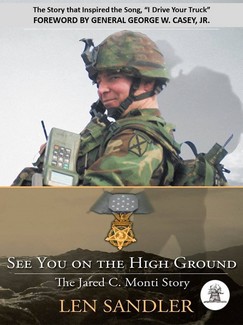
“The actions we honor today were not a passing moment of courage. They were the culmination of a life of character and commitment,” said Barack Obama as he made Jared the first Medal of Honor recipient from MA since the Viet Nam War. The soldier the Afghanis called “The Gift of God” died a heroic death but, more importantly, lived a heroic life. The book tells the story of that life.
Deliberately exposed himself to machine gun and rocket-propelled grenade fire, SFC Monti sacrificed himself attempting not once but three times to rescue one of his squad members from the “kill zone” after his patrol came under attack by insurgents on a mountain in Afghanistan. He declared, “He’s my guy. I’m going to get him.” In doing so, Jared was able to draw fire away from the rest of the Americans and buy time for air support to arrive. After suffering a direct hit from an RPG, the 30-year-old Monti recited the “Lord’s Prayer” as he lay dying. His last words were, “I’ve made peace with God. Tell my family I love them.” Ironically, the name “Monti” comes from the Italian word for “Mountain.”
“I've come to the conclusion, and it's the only way I can deal with it, that it was his destiny. This is what he was meant to do,” says his mother Janet. Paul, a childhood friend of author Len Sandler, has been unable to throw out anything of his son’s. His house is crowded with boxes of his personal belongings and he continues to drive Jared’s Dodge Ram truck. Songwriter Connie Harrington heard a radio interview with Paul inspiring “I Drive Your Truck” which became the #1 country song in America.
Excerpt
The U. S. Army’s 10th Mountain Division has “Climb to Glory” as its proud motto. However, June 21, 2006 was not one of
the glorious days.
Three days earlier, Paul’s phone rang back in Raynham, MA at 7:30 a.m. He picked it up and heard his son Jared, the soldier with the big, wide grin, exclaiming, “Hey, Pop, how you doing? Happy Father’s Day.” Paul told him that there couldn’t be a better Father’s
Day gift than hearing from him. They talked for a while, and then Jared said, “Dad, I have to go now. We’re leaving on a mission.”
Those would be Jared’s last words to his father. At the end of every telephone conversation Paul would say, “Be safe. Keep your head down,” to his son. “For some reason, I forgot to do it that time,” he admits. “I realized it as soon as I put the phone down. It still
bothers me to this day that I didn’t say it.”
In the spring of 2006, the 3rd Squadron, 71st Calvary, 10th Mountain Division had traveled by convoy from FOB Salerno in the Khost Province of Afghanistan to establish FOB Naray in the Nuristan Province of northeast Afghanistan. The two-week trek took place over 250 miles of dangerous dirt trails and mountain
passes. It took the soldiers into an area that had historically been a
safe haven for insurgent and anti-governmental elements operating
in the Hindu Kush mountains and the Afghan-Pakistan FATA (Federally Administered Tribal Areas) cross-over points. “We moved into unknown terrain,” recalls Lieutenant Colonel and
Squadron Operations Officer Jeffrey Abbott.
After being transported by convoy to a mortar firing position at the Gowardesh Bridge, located south of the village of Baz-Gal, sixteen American soldiers embarked on an exhausting climb, moving mostly in the mornings and evenings. They hiked for three days up an uncharted mountain known only as Hill 2610. The military designates mountains based on how many meters above sea level they are. So, Hill 2610 was 2,610 meters or 8,562 feet high. If topographical features have the same height, they are further designated by their compass location.
The patrol members were wearing body armor and carrying packs that ranged in weight from 70 to 110 pounds in 100-degree heat. The thin air and stifling heat sapped their strength.
They rested during the heat of the day. Navigating the rugged terrain was
particularly challenging during the evenings, when night vision goggles were required. They were on constant alert for Taliban snipers and “toe-poppers”, small land mines still scattered around
the countryside from the Soviet invasion of decades ago.
Jared was instrumental in forming “Kill” Teams comprised of three Snipers and three Forward Observers to provide precision fire. He wanted to work with the Kill Teams himself but was kept
busy with other responsibilities. He was a renowned mountain climber and was often chosen to lead Squadron soldiers up to Observation Posts, along with performing other duties, including
being the Forward Observer Platoon Sergeant and Fires NCO for
the Squadron. A cavalry squadron is typically less than 1,000
soldiers, equivalent to an infantry battalion. These were just a few
of Jared’s many job titles. He’d often be involved in negotiations with the Afghanistan military or civilians because he had earned the trust of both. For his part, he just wanted to “stay busy”.
SGT John Hawes and Cunningham learned they would finally get their wish: Jared would be going along on the reconnaissance assignment. Hawes would get a chance to work with Jared on a
Kill Team. The 22-year-old Hawes came from the small town of Brookfield, NY (population of 2,500), which is in Madison County, not far from Syracuse. There is only one school in the
town, the Brookfield Central School, which John attended from kindergarten through high school. He said, “Monti was going to be the Team Leader taking charge of the Forward Observer stuff due
to his greater experience and rank, and I would be Assistant Team Leader taking charge of the Sniper stuff. I looked forward to it. I knew I would do whatever Monti asked of me.”
The patrol consisted of one squad headed by Jared and the other by SSG Chris Cunningham. Jared and Chris were savvy and experienced combat veterans, both having served multiple tours of
duty in Afghanistan. They were considered among the best Non-
Commissioned Officers in the theater of operation. Another small
town product, the 26-year-old Cunningham called Whitingham,Vermont home. With a population of 1,300, it is located about 60 miles northeast of Albany, New York.
An Airborne Ranger, Cunningham was Patrol Leader, the NCO who was over-all in charge. “Cunningham wanted the ‘A’ team for the patrol, the best of the best. He needed people who knew what they were doing and could be counted on,” says SPC Franklin Woods.
Hawes and Jared would frequently play the board game Risk and the computer game Pocket Tanks. Jared was known for being an outstanding Pocket Tanks player. The two friends challenged
each other often and frequently ended up tied, or with Jared having a slight edge. Jared was frustrated, though, that he couldn’t seem to beat John at Risk. Any time Jared beat him at Pocket Tanks, Hawes would rub it in that he couldn’t beat him at Risk. Jared would
respond with his patented wide smile, “Not yet, but I eventually
will.”
According to John, “Monti was always full of helpful information on how to do things in the Army and talked of how
much the Army has changed and how things used to be back when he was a Private. I learned a great deal from Monti on being a good NCO, leader, and friend. I saw that Monti was greatly respected by
all his men. He was firm but not all-controlling. If Monti said to do
something, you didn’t question it. You just did it. He had the knowledge and experience and would never point you in the wrong direction or give you bad advice. He wanted you to be successful
just as much as himself.
Monti shared his knowledge and experience with anyone who was interested in listening. He always had a great way of cracking jokes and putting a humorous twist on serious subjects to keep everything interesting. He had a positive attitude and a contagious smile. You couldn’t help but to be happy
around him and enjoy his company.”
John adds, “In the Army there are NCOs you respect simply because of their rank, and there are others you respect because of the person, regardless of rank. Monti was the latter type.
I e-mailed my wife and told her how excited I was that I was finally going
with Monti on a mission. She had never met him but knew how much I respected the man.”
SGT Ron Haapala waited with Jared for word to come down as to when the mission would begin. Like so many other soldiers, he speaks both of his friendship with Jared and his respect for him: “We were smoking cigars. We had a great conversation about all the things we were going to do when we got back home. I have a lake house and I like to fish. Monti was always out there fishing, so we were talking about his buying a lake house maybe on the same lake. He was my friend and someone I respected. Generally, artillery soldiers, helicopter pilots, and forward observers follow their own Standard Operating Procedures. Sometimes they don’t mesh. He was one of the few who wanted us to work together. He put in the effort to understand what everyone else did in every situation to make the call for fire process a lot smoother.”
There would be a number of firsts on this mission. It was the first time the Kill Teams operated as part of such a large force; the first time the Kill Teams had their own dedicated medic, Specialist Max Noble, along with them; and the first time any American operated in this remote area of Afghanistan.
Soldiers can be superstitious, and firsts usually aren’t regarded as good omens.
Hawes acknowledges, “Being a first on so many things, something just didn’t sit right with us about this mission. We
pushed our worries to the side. We told ourselves that everything had worked out well for us up till that point so there was no need to worry about this one. We convinced ourselves it would just be
another ‘Walk in the Park’ like other missions.”
The day before they were to embark, Jared asked John Hawes if he smoked cigars. It was no secret that Jared enjoyed fine cigars. John didn’t like cigars and, in fact, grew up hating any kind of smoking. He told Jared that if he did smoke he would want to smoke with someone like him. Then Jared said that maybe after this mission’s success they could each have a cigar to celebrate.
Ideally, as a FISTer, Jared would call for fire on the enemy force and a sniper like Hawes would shoot at the enemy from a distance without putting themselves in any real danger. John had sniped an insurgent on an earlier mission, earning the Squadron its first enemy KIA (Killed in Action); and shortly afterwards Jared
had called for fire on three insurgents, completing the first confirmed fire mission in the Squadron. According to John, “I don’t enjoy killing and neither did Monti, but in a weird twisted
way we shared this bond of having been there and successfully completed the jobs we were trained to do, and we respected each other for it.”
“I belonged to a medical platoon and was trained to be a clinical medic. I worked in an aid station and was assigned to
accompany the patrol on the Hill 2610 mission,” explains Max Noble, who was 25 years old at the time. “It’s usually a bad sign if a patrol asks for a medic to accompany them, because it means the
mission is considered dangerous. I heard stories about the Kill Teams that Jared had set up. I knew of his stature. I knew of their mystique and the legends surrounding them. They were the top,
most hard-core soldiers, the guys who get the tough things done.
“I didn’t find out specifically who was going on the mission until the night before,” continues Max. “That’s when Jared dropped by, and I guess he felt like he needed someone to talk to. A lot of times it’s easier to talk to a medic rather than someone in your chain of command, either above you or below you.
He was somber. He wanted to talk about his mortality. It was a very existential and philosophical discussion. I saw a vulnerable side of him. He was talking about how everyone’s time is going to come. You can’t do anything about it. You just don’t know when it is. He
said, ‘You’re given a lifetime which is short for some and long for others. You just have to do your best however long that lifetime is.’ I sensed that the magnitude of this mission was weighing on him. He really opened up to me. I mostly listened.”
As the patrol began the climb, Hawes learned more and more about Jared’s personal life as he spoke about his girlfriend back home, his Harley Davidson motorcycle, Boston, beer, cigars, and fishing off the coast. They even made plans to go fishing together
back in Massachusetts. John loved fishing but had never fished off
the coast like Jared had and looked forward to being able to do that.
Jared described how he used to help out and work on one particular boat back home. He said the clients that fished off the boat were normally high-class, wealthy men, and he got a kick out
of just being an average guy on the boat. He described how he was close friends with the boat’s captain and would get to go out for free fishing with him when he came home on leave from the Army.
“Jared also talked about how much he liked baseball. I don’t particularly like it, but being from New York I had to bust on Monti about the Yankees and Red Sox,” Hawes admits. “Of course
he fiercely defended the Red Sox, and I defended the Yankees, even though I really didn’t care about them. It was just another thing to pick on each other about and get a good laugh. I felt
comfortable and secure around him, knowing inside that if things
got bad and hit the fan, Monti was the guy you wanted around to do the job right and help you out.”
One of the members of the patrol, SSG Josh Renken,remembers Jared kidding around on the trek, telling them how he
wanted his funeral to be like the Vikings – a boat pushed into the
sea and set on fire with a flaming arrow. “Jared was trying to keep
everyone happy, cracking jokes, giving people a hard time, just to keep the mood up, because we had no food, no water,” Josh confesses. “We were hurting.”
SGT Chris Grzecki says, “When we reached our destination to set up our Observation Post on a ridge we were trying to see if anyone had any water left. All of a sudden Jared passed his canteen around for everyone to drink. I couldn’t believe it. He’d hardly
drunk any of his own water. This guy was like superhuman. I didn’t understand how he could have that much water left. That
was his reputation. He’s was the go-to, everything guy. He always had the answer. He always kept his cool.”
The patrol stopped at a plateau on the mountain to begin observing and reporting on the activities of insurgents who were holding up in the Gremen Valley. Of particular interest were the actions taking place at HIG Commander Hadji Usman’s summer
residence, which was a suspected training facility. HIG (Hizb-i-
Islami Gulbuddin) is an Islamic political party that originally fought against the Soviet army and was funded by the U. S. Now its ties were to both the Taliban and al Qaeda.
This was to be the initial phase of Operation Gowardesh Thrust, the full air assault planned by the Third Brigade. If they could destroy some of the infiltration routes from neighboring
Pakistan, it would result in an important strategic victory. There
was bad news, though. Jared received a radio communication that troops and helicopters were being diverted to another front and the larger mission would be delayed by several days. Since they were out of supplies, the team requested a drop by helicopter as soon as possible. It’s a risk to do that when hostile forces may see it, but they knew they were going to be there for a while. They didn’t have a choice.
Two “speedballs” were dropped on the other side of the ridge. One was filled with water and the other with MREs (Meals, Ready-to-Eat). The plan was to then send soldiers on a hike to pick
up the packages. A speedball is an LCLA (Low Cost, Low Altitude) aerial delivery system that was employed throughout
Afghanistan. It was completely disposable. The parachutes were made of sandbag material and the risers out of swing set plastic rope. The cost was less than $100 each. There was no need to backhaul items for reuse. A soldier in the drop zone would simply cut the lashings, take the supplies, and leave the rest of the material behind.
Originally the intent was to have the patrol re-supplied in conjunction with the squadron’s main drive into the area. That way, there would have been significant helicopter traffic and little chance that the patrol’s position would be compromised. But it was
decided back at 3-71 CAV Headquarters that a single UH-60 Black Hawk helicopter would make the speedball drop about 2:30 p.m., since the patrol was critically short of supplies.
Cunningham explains, “There was bad communication between the helicopter and those of us on the mountain. The copter
exposed our position. It flew over the enemy and then it flew right over us.”
About an hour later, two women in burqas were spotted on the trail walking toward the patrol. They appeared innocent enough, as they were carrying bags of wheat. They gave a hand signal, asking
for permission to pass by. “We had a dilemma,” admits Grzecki. “They saw us and where we were positioned. We decided against detaining them. We waved them on. We’ll never know if they were
innocents or insurgent informants.”
“I felt relieved that we didn’t harm them. In warfare you have to make some tough decisions. But even if there was just a slight chance they weren’t informants, I thought the right thing to do would be to let them go,” admits Specialist Noble. “Shortly after
that, the others went to pick up the supplies and I stayed behind to
keep watch through the spotting scope. At that point, I hadn’t had any food, water, or sleep for a whole day. The truth is, I figured I’d just be going along on the mission for the ride. I thought the biggest threat would be toe-poppers. I was freaking oblivious.
What did I know? I hadn’t been in combat before. I thought the big building in the valley was just some elder’s home. I didn’t realize that they were training insurgents there. I suddenly saw one of
them looking up at us through binoculars and said to Hawes when he returned, ‘We’re being watched.’”
John knew what that grim news meant. Their position was definitely revealed and their cover blown. They were in trouble. According to Hawes, “Regular Afghanis don’t have binoculars. There’s no purpose for them. Bird watching is not popular in Afghanistan.”
“It was the worst-case scenario,” says Captain Ross Berkoff, the squadron’s Intelligence Officer, who was monitoring the botched supply drop from the Command Post. “We stirred up a hornet’s nest.’’
The Americans had two options. They could pack up and move, or they could stay and fight. The idea of hurrying down the mountain was dismissed because they would have been in a bad strategic position with the Taliban looking down on them. They would be easy targets to be picked off one by one. Their best
option was to hold their position, seek cover, and fight.
The mountain air was clear and still. Visibility was, unfortunately, not a problem. This was the first day of summer, the longest day of the year, and there were still a good couple of hours
of daylight left. Those next few hours turned out to be anything but good, however.
The Americans took up defensive positions and nervously awaited their fate. It was 6:45 p.m. when the attack
came.
A group of patrol members had started to eat the MREs that had been picked up from the air drop. SSG Patrick Lybert opened his and found some Charms candy inside. That’s considered a bad omen by soldiers. Charms are individually wrapped, assorted fruit-flavored hard square candies that come ten pieces to a pack and are made by a company called Groovy Candies. You might think
they’d be regarded as good luck because of their name. It’s the opposite, though. In the same way, you might think saying, “Good luck” to a dancer or actor before a performance is the right thing to do, but as most people know, saying “Break a leg” is considered more appropriate, so as not to jinx them. There’s reverse logic involved.
“Lybert wanted to get rid of the Charms, but no one would take them. We started throwing them around and playing hot
potato. He wound up being stuck with them,” recalls Noble.
The senior NCOs were huddled together discussing the need to double the guard shift in order to increase security when they were interrupted by the scream of an RPG flying over their heads. A
rocket-propelled grenade is a ferocious shoulder-fired weapon that shoots a missile about a foot and a half long. It is designed to bring down a helicopter or disable a tank within a range of 500 meters. It can easily tear a person apart.
“My first thought was, Who’s the
dumb ass who set off one of the Claymore mines that we had placed around our perimeter?” says Chris Grzecki.
According to Grzecki, “The first RPG was followed almost immediately by the most intense burst of fire I’ve ever witnessed.”
An estimated 50 to 60 Taliban soldiers began shooting with automatic weapons. Chris thought to himself, “Oh, shit, we’re in for it now.” The Americans dove behind rocks for cover as bullets and RPGs impacted all around them. They quickly began to return fire.
“Since my guard shift was up, I had fallen asleep using my first aid bag as a pillow. I remember waking up to what I thought was heavy rain. The dirt was kicking up all around me. Someone yelled
that we were being shot at. I realized it wasn’t rain. It was bullets. I
jumped up and didn’t have a weapon, body armor on, or my first aid bag. Later, I retrieved my bag and saw that it was full of bullet holes,” recounts Max Noble.
“I remember opening my MRE and seeing meat loaf with gravy. I asked Matt Chambers if he wanted to trade with me,”
recalls Woods. “At that moment I heard the explosion, and the battle was on. It was in slow motion, like in the movies. It felt like the longest second, longest minute, longest hour of my life. I took
cover behind a little 8-inch wide tree. I didn’t even have a weapon at first. Lybert called out, ‘Grab your fucking M-4 and shoot. You’re exposed. Get out of there. Get behind cover.’” The fighting got very intense very quickly. Hawes says, “It was, right from the beginning, an incredibly heavy assault with gunfire just pouring down on us. It completely pinned us down.”
The incessant noise was described by the patrol members as being like “thousands of rifles crackling.” Jared spoke into the radio handset, carefully gave his call sign, and cleared the network to
call for fire. “This is Chaos 3-5! Requesting artillery and air
support now! We’re under attack, heavily outnumbered, and at risk of being overrun.” He then gave the co-ordinates for the American response, adding the words, “Danger Close.” That indicated the enemy was in close proximity, so strikes would have to be precise or there would be the possibility of a “Killed by Friendly Fire” accident.
Relief in the way of indirect fire was going to come immediately from 120 mm mortars and 105 mm howitzers from
positions at the Gowardesh Bridge. The soldiers in the patrol knew the air support was going to take a while to get there. They had to stand their ground.
“I’ve been through a lot of fire fights and some pretty serious contact with the enemy, but this was more intense than anything I’d ever experienced,” admits Cunningham.
“I was on the other end of the phone with Monti and there was no panic at all. He was doing what he was trained to do. I asked if he had eyes on the enemy,” recalls SFC Gary Hunsucker. “Are you kidding?” responded Jared, “If I raise my head, I'll get it blown
off.”
“He then laughed,” recalls Hunsucker. “We talked about how we were going to handle the situation based on where they were and where the enemy likely was. He was a pro. We were both doing our job, doing what we were paid to do. Our trust was so strong. I knew he’d give me the information we needed. He knew we’d give him the support they needed. We worked so welltogether we could pretty much read each other’s thoughts.”
Lieutenant Colonel Jeffrey Abbott, who was monitoring the situation from the Command Post, explains, “The enemy had one goal in mind. To overrun and kill everybody in the patrol.”
“RPGs came in fast and furiously, skipping off rocks and exploding in the trees above our heads,” recalls Cunningham, “There was so much machine gun fire that trees were being split by
the bullets all around us and the branches were catching shrapnel like catcher’s mitts. Everything started falling all around us. It’s
like violence was everywhere, enveloping us.”
During the initial assault and just minutes after discovering the Charms in his MRE, 28-year-old Patrick Lybert of Ladysmith, Wisconsin was hit in the head by machine gun fire and blood spurted from his left ear. He was killed instantly. PFC Derek James remembers, “Lybert was behind a large rock but kept popping his head up to see where the insurgents were. Then, all of a sudden, he just stopped.” Patrick was scheduled to go home on leave several weeks later, and he was planning to become officially engaged. He was going to finish his deployment, get married, and become
caretaker for his 19-year-old brother, who had Asperger’s Syndrome.
According to Derek, “An RPG exploded close to my location and I was wounded in the right arm. Immediately after that I was shot in the back with small arms fire. I thought, ‘Shit, I’m going to
die. We’re all going to die.’ We were taking so much fire we couldn’t make out where the mortars landed. It was coming in so close that you could hear it right over your head, just like whizzing
through. The enemy was so close you could hear them talking in Arabic. You could hear them reloading their weapons.”
Jared pulled the pin on a grenade and threw it right into the middle of a group of attackers. It was a perfect toss. Except it didn’t go off. It was a dud. A terrible time for a weapons
malfunction. But it did cause them to pull back.
“I was worried about my back injury because I couldn’t see it. For all I knew, half my back could have been gone,” confesses Derek, who at 18 years old was the youngest and least experienced of the platoon members. He was just a year out of high school.
Grzecki reached out and pulled James back to cover. “I checked him. I saw that he was moving and alert. Chambers, who’s an EMT (Emergency Medical Technician), quickly patched him up. Derek went back to returning fire. He was just awesome. He went back to fighting as a member of the team, even though he had been hit twice.”
Those who have been in battle understand the gripping anxiety that heightens the senses and rushes adrenalin through the body. General William Westmoreland, who served as commander of the troops in the Viet Nam war and subsequently as Army Chief of Staff, explained it simply as, “War is fear cloaked in courage.”
Grzecki was unable to reach out to grab his M-16 rifle that was just a foot away due to the intense machine gun fire. “I had a choice of either diving to my left and trying for my weapon or diving to my right and seeking cover,” he remembers. “I knew I couldn’t do both. I chose to seek cover.”
Specialist John Garner says, “Two bullets flew by my face. I reached out for my weapon, and when my hand touched it, it got shot right out of my hand.” Amazingly, he was uninjured. The
bullets hit the stock of his rifle but missed him. Over the deafening noise, John called out to Specialist Daniel Linnihan to reach under Lybert’s body and throw him his rifle.
SPC Sean Smith looked at his watch on his wrist, as if to record his time of death. Even today he admits, “I don't know why I did that. I instantly forgot what the time was anyhow. Less than a
year earlier, I had been in Basic Training and was called into the Senior Drill Instructor’s office one evening. Before I entered, I tried as hard as I could to remember what I could have fucked up to get in trouble and to mentally prepare myself for the ass-chewing I thought I was about to receive. When I walked into the office, there he was: my father, who had been stationed in Iraq, who I hadn't seen in over a year. It was the last thing on earth I expected. He gave me a gift of a watch. So I really don't know whether I looked at the watch to record when ‘my time’ was going to be, or because I was trying to connect with my Dad. He retired out of the Army's 1st Squadron Special Forces, or Delta Force as it’s called, as a Master Sergeant. I always dreamed of being just like him – tall, strong, and proud to wear that uniform – emulating everything that I thought he was. Maybe I was just looking for the
strength to fight, or some sort of guidance, like, ‘What do I do
now, Dad?’”
Sean then said to Grzecki, “Move your foot. It’s going to get shot.” Chris recalls, “I could feel the dirt around it getting kicked up. I moved my foot and there was an outline of bullets around where it had been.” SPC Brian Gonterman admits, “All I could think about is them coming over the stone wall and killing all of us.”
SPC Shawn Heistand and PFC Brian Bradbury were together when the enemy first opened fire. Both hit the ground and began to return fire. However, they recognized that their fire was drawing
enemy attention to their dangerously exposed position. Shawn urged Brian to seek cover by falling back to the large rocks. Brian was directly behind him as they sprinted. Shawn made it safely, but
Brian was hit by an RPG about twenty meters or 66 feet from the American position. His left arm was partially severed from his shoulder as he fell into a shallow depression which afforded him virtually no protection.
Members of the patrol saw that 22-year-old Bradbury from St. Joseph, Missouri was in serious trouble. Despite losing use of an arm, the PFC was somehow able to continue firing his M249
automatic weapon with the other arm until his ammunition ran out. As the SAW (Squad Automatic Weapon) gunner, Brian had already won the respect of the team by being the smallest man carrying the
heaviest weapon without ever complaining. He won additional respect that day on the mountain.
James acknowledges, “Bradbury was out there in the death zone.” Renken adds, “He was slowly slipping away.” Someone had to do something fast. SSG Cunningham volunteered to try to rescue him. Jared refused, because Brian was from his squad. He insisted, “That’s my guy. I’m going to get him.”
“We all heard that Monti was going to try to get Bradbury out of the kill zone. SGT Hawes gave me his 9 mm pistol and 203 Grenade Launcher to fire a 40mm grenade to help provide cover. I launched a grenade and we all coordinated the best we could. I began returning fire with the pistol while Hawes threw grenades,”remembers Gonterman.
John says, “Jared knew what he was going to have to go through. He had to do it. He knew what he was going into and it
was just a mad wall of hell. As soon as he recognized that Bradbury was out there exposed and the enemy was getting close and we had to get to Bradbury, he did it without hesitation.”
Jared gave Grzecki his radio set and said simply, “You’re Chaos 3-5 now!” And then he ran. “Monti was hunched over and moving pretty fast,” says Cunningham.
With Bradbury in “no man’s land”, the enemy was focusing on him. Jared knew that if he ran out to try to get him, it would draw fire away from not only Brian but from the rest of the patrol. When
soldiers on the mountain would later speak of Jared having saved their lives, they were referring to the fact that he literally “put himself out there” not only for Brian but for all of them.
Help would be coming in the form of air support, but no one knew how long it would take. The patrol had to hold out as long as it could. Jared was able to buy them the one thing they critically needed – time.
“I was talking to Jared on the phone, and then suddenly there was silence. Another voice came on and he identified himself as Chaos 3-5. I knew something was wrong. It wasn’t Jared anymore,” recalls Hunsucker.
“He just threw the radio at me,” says Grzecki. “There was no plan. I didn’t know what Jared had already called in. I just wanted to keep up what he had started. Neither John Garner nor I had body armor on. He did an incredibly brave thing by physically shielding
me with his body to protect me from enemy fire while I tried to work the radio and grab the map to plot grids. It’s crazy to put yourself at risk like that, but John did it.”
During the trek up the mountain, Garner had been the first in line taking the point position. He obviously was willing to put himself in danger.
Gzecki started to go through a mental check list of what needed to be done. “I knew we had a serious fight on our hands. I didn’t want to be ‘that guy’ in a friendly fire incident who gets everyone killed. The key was to put that ordnance close enough to kill the
enemy but not us. We were seriously outnumbered. It was our only chance.”
“After Monti threw his radio to Grzecki, he didn’t miss a beat. Chris was just amazing,” praises Cunningham.“In effect, Jared said to him, ‘You’re me now.’ You know what? He was. It’s a testimony
to Grzecki, but also to how well Jared trained his guys. Every one of them could step in and be just as effective as him.”
As the patrol provided covering fire, Jared left the protection of the stone wall to check on Lybert to make sure that he was in fact dead, and then ran straight for Bradbury. Cunningham says,
“Because of the intensity of the fire, one meter was like a mile.”
Jared got to within three feet of Brian. He was agonizingly just out of reach when he ran into a hail of Taliban machine gun fire and had to turn back.
The enemy was using all its firepower on Jared. He didn’t quit. He tried a second time and could manage just a couple of steps before being driven back by the torrent of bullets. He still didn’t
quit. He was not going to let Bradbury stay out there, wounded and
exposed. He was going to try a third time. “That was Jared. He never gave up on anything, no matter what it was,” says Paul.
He said to the members of his patrol, “I’ve gotta get him! I’m going to go again!” Jared called for more cover fire. He coordinated with Hawes to fire 40mm grenades from his M203 launcher onto the enemy position. Timing his movement to the sound of the exploding rounds, Jared rose from his covered
position and moved into the open, knowing he once again would become the focus of insurgent fire.
Cunningham calls Jared’s repeated attempts, “The bravest thing I’ve ever seen a soldier do,” and adds, “It’s expected for a guy to go out there and try to rescue someone. But to go out a second time is unheard of. To go a third time? Either you’re getting him or
there’s no coming back.”
Hawes echoes Cunningham’s sentiments: “What Monti did trying to save Bradbury was the most courageous, inspiring, and
selfless act I have ever seen, and I’ll never forget it.”
SPC Gonterman recalls, “We were always trained that if someone was injured in the kill zone to talk to them and keep them awake, but not go after them because it takes another person out of
the fight. I could tell Monti was the type of guy that would go out of his way for any soldier, though, and he truly lived up to that.”
The insurgents retaliated, setting the air aglow with explosives. Jared suffered a direct hit from an RPG. “The enemy was amazed that he was running again. We were shooting with everything we had to give him cover. He threw another grenade and went out a third time. But this time they had a bead on him. They were ready.
They hit him with an RPG,” says Cunningham.“It was pretty horrible.”
Hawes recalls, “Just as he was about to reach Bradbury I ran out of ammo, and as I dropped behind the rock to change
magazines, I heard an RPG explode. Monti screamed that he had been hit.”
The horrifying cry was like nothing they had ever heard before. According to Grzecki, “I remember thinking, I can’t believe he’s fooling around. Only Monti would make a joke at a time like this.”
After all, Jared was supposed to be invincible. Everyone knew that.
“I thought he was letting out a battle cry, like something out of Braveheart,” recalls James.
“When we realized he was really hurt, we didn’t know how we could get him. It wouldn’t make sense to have casualty after casualty,” says Grzecki.
“My legs are gone!” Jared cried out. Actually, they were split open and embedded with shrapnel, but he had lost feeling in his legs. He also suffered wounds to the side of his body. He was
bleeding profusely. Even after that, he was still in the fight. “After being hit, he warned us that they were flanking left,” recalls Gonterman.
Jared tried to gather up the strength to crawl back to his unit. He couldn’t move, though, and called out, “Cunny, come get me.”
“I said, ‘All right. Roger that,’ and told the guys to cover me. I started crawling over there, but the enemy fire was too heavy,” recounts Cunningham.
Gasping for air, Jared still was able to recite The Lord’s Prayer, like he had done so many times before. He began with “Our Father, Who art in heaven”, and finished with “But deliver us from
evil. For thine is the kingdom, and the power, and the glory for ever and ever.” This time it had special meaning.
Jared’s last words to the patrol were, “I’ve made peace with God. Tell my family I love them.” He continued to bleed until he had no more blood left to spill. “It was definitely pure courage and love for his soldier,” says Cunningham.
Hawes recounts, “We told Monti that he would be telling his parents himself, but he was soon quiet. Later in the fight I was the first to reach him, where I confirmed for myself that my friend was, indeed, dead. I was devastated. When he ran out to try and
save Bradbury, he did it fully knowing the tremendous danger involved but did so anyway for a fellow soldier and friend. He died the most honorable and noble way a man can: trying to save
someone else’s life.”
Ironically, the name “Monti” comes from the Italian word for “Mountain.” Paul understands why Jared ran through machine gun and RPG fire three times. He says of his son, “He wasn’t looking
for glory. He didn’t want to be a hero. But part of the soldier's creed is that you never leave anyone behind. He wouldn’t. He couldn’t. Jared would want to be remembered as the guy who did
the right thing. Period.” In terms of Jared’s final words being about
his family, Paul insists, “That’s the most meaningful thing that there is. That he thought of us in his last moments.”
According to Garner, “I might have been there with Monti when he passed away, but I wasn’t able to shed one single tear or feel it. It was a battle, a moment, and we would not lose. It is still like a dream of a friend being taken away. But we tried and I tried.
We did everything we could. I know Paul Monti knows we did.”
“We all started running black on ammo. I had packed a few extra magazines in my assault pack before the mission,” says
Gonterman. “I had to come out from the protection of the rock half-way up to get it. I was able to grab the assault pack and hand out extra ammo to SGT Hawes who asked, ‘How much more do
you have?’ I said, ‘That’s it. But SGT Lybert has more on his vest.’ Hawes jumped to my side, asking for cover fire. He low-crawled to Lybert’s body, took his ammo and gave it to me. I
passed it around to everyone else.”
Would Jared have had regrets about what he did that day? His sister Niccole answers empathically, “I know he wouldn’t change anything. I know he would do it again. If he could come back and he were given a choice, he would do it exactly the same. He would change nothing.” According to his mother Janet, “His boys came first. He died doing what he loved. He wouldn’t have been able to live with himself if he didn’t try to save Bradbury.”
“Jared knew the chances of his surviving were low,” asserts Grzecki. “It didn’t stop him.” Captain Joe Hansen says, “He was a soldier who committed himself to something. We all continually asked ourselves if we could have done the same.” Sergeant Major of the Army Kenneth Preston offers, “It was his sense of responsibility there on the battlefield that drove him to risk his life. He was bound and determined to get that soldier back to safety, no
matter what.”
“There were fifty things that went wrong on the mountain,” muses Paul. Certainly at the top of the list were the botched supply drop and the grenade that failed to explode. The Apache attack helicopters arrived shortly after Jared died. If he had just stopped after two tries at rescuing Bradbury, he probably would be alive today.
“At this point, someone called for everyone to get down and get low because the bombs were about to be dropped danger close to us. That’s the moment I was able to catch my breath. Before I
had been going through the motions that kick in with training,” says Gonterman. “I looked up just after the first bomb was dropped and saw some sort of shrapnel cutting through the tree near me. We then had to find where it was dropped to adjust fire. The bomb
landed on my side of the mountain and I looked to try to see the smoke from where it landed the best I could without getting hit.”
It turned out to be a precision strike, right on target. Attack helicopters swarmed like angry bees. Mortars continued to be lobbed in from the Gowardesh Bridge. Ordnance filled the air. Twenty-two Taliban were killed and the rest driven off.
Renken describes the terrifying attack this way: “Trees are falling over, you can hear the shrapnel whizzing over your head. Your teeth are rattling, about to fall right out of your head.”
War stories in real life often have tragic endings. This one did. “I remember hearing the flight medic they dropped down say, ‘Hey, don’t worry. I am gonna get you guys out of here,’” recalls Smith. The medic was 28-year-old SSG Heathe Craig from Severn, Maryland, from the 159th Air Ambulance Medical Company.
Earlier, he had been on a computer Skyping with his wife Judy, his
11-month-old daughter Leona, and four-year-old son Jonas, who were at off-base housing in Wiesbaden, Germany.
Heathe had to cut the session short because he got word that he was needed on the emergency rescue mission.
The badly wounded Derek James was lifted out of the battle zone first and secured by straps in the helicopter. Bradbury had a tourniquet applied by Noble and was given morphine. He was too badly hurt to hold on to the cable, so Heathe rode it with him until the unthinkable happened.
“Bradbury was hurt pretty bad. He was leaning back and catching wind,” recalls Woods. “He and Craig started to swing
back and forth. The cable was oscillating uncontrollably. Then I saw it snap. I said, ‘Oh, shit. It broke. It broke.” Both Bradbury and Craig plummeted to their deaths. They dropped 100 feet onto
bare rocks.
Smith will forever be haunted by the sound. “I heard a thump, like a ship anchor dropped to the ground,” he says. “The steel cable snapped, and that killed Bradbury. It also killed the flight medic that had just told us we would be OK.”
Judy Craig later posted this message to Brian’s family: “I am very sorry for your loss. I know that Heathe tried everything to save Brian’s life. I wish there would have been a better outcome
for the both of us.”
After hearing of the cable breaking, Captain Berkoff stood in front of the field hospital with surgeons waiting inside to operate on Bradbury and thought, Could anything possibly go right today?
“I was really pissed when I found out about the cable,” admits Hunsucker. “I had never heard of one breaking before. No one else had, either.”
James was successfully flown to the aid station and recovered from his wounds. He was back in action just two months later.
The surviving members of the patrol nervously remained in position for
the rest of the night. “We’d call for fire every time a twig snapped or an insect landed on our shoulders,” Smith says. “Things were lighting up all night long.”
As the sun began to bake the mountain air the next morning, they went out to search for Taliban bodies and leftover equipment. The ground was covered with blood trails. “It looked like a nuke
had hit,” Sean claims. “All the trees were cut in half. Branches were all over.” There was an eerie stillness on the battlefield accompanied by the stench of death and gunpowder.
“I called in the names of our killed in action along with the last four digits of their roster numbers. They kept asking me to say it again. They asked me five times,” recalls Grzecki. “They couldn’t believe that such an iconic guy had been killed. Jared was a larger
than life personality, someone everyone knew and looked up to.”
Now he was lying on that mountain, his body covered by a poncho. “I replay the events of that night in my head, trying to think if there was anything else that I could have done to save my friend. I’m afraid I will never know,” confesses Hawes. “I am lucky to have shared many personal moments with Monti in the last days of his life, and I cherish those moments.”
Two more speedballs, one with ammunition and the other with batteries and other supplies, were dropped during the night. “SSG Cunningham called over the radio to ask what the plan was for the next morning,” recounts Gonterman. “I walked around and realized that there were still bodies left behind. I asked Garner why the bodies were still on the mountain if they evacuated them the
previous night. That’s when I learned about the cable snapping and that the helicopters were going to come back.”
“SSG Cunny told me he needed help getting the bodies consolidated. He and I lined up the four of them so they’d be ready for the helicopters to pick up. A few months later, I asked him why
he wanted me and not someone else to help him. It ate at me,” confesses Woods. Cunningham told him, “Because I knew you could handle it. I knew you’d be strong enough.”
Medevac helicopters returned and dropped four 17-pound rigid plastic Olive Drab Green “Skedco” stretchers for the bodies to be loaded and hoisted.
We know the fate of the four Americans who lost their lives that night. Fallen soldiers have to be in heaven. They’ve already been through hell.
Cunningham asked the surviving members of the patrol if they wanted to walk down right away or wait to be evacuated by helicopters. They unanimously agreed to walk down. Smith realized he had lost his flak jacket, so they searched around for it.
“I found it covering SGT Lybert. I carefully removed it and will never forget just staring at his lifeless body while waiting for the Medevac copter. Once the four casualties were safely on board, we quickly gathered what little stuff we had left and began our descent
down the mountain,” recalls Gonterman.
Cunningham wanted the patrol to move as quickly as possible down to the Gowardesh bridge. “If there were going to be insurgents coming after us, I knew they would have the high ground advantage,” he says. “I can’t tell you what a relief it was to have our bombers fly over, tip their wings to us, and watch them drop their payload on the enemy positions in the valley. They made
that mountain shake. What a welcomed show of force!” Bombs weighing as much as 2,000 pounds were dropped on the enemy compound. “A little bit of retribution for what happened the
previous night,” says Paul.
“When the bombers came, I knew we were going to make it out,” admits Woods. “The knot in my stomach untied. I wasn’t
worried that we were going to be hit again. It was a good feeling. When we got to the bottom of the mountain, some guys from Bravo Company met us and asked if we wanted Humvee rides to the Gowardesh Bridge. We were exhausted but said, ‘No, thanks.’ We were going to finish this together. We wanted to take it on in. Complete the job walking back together.”
Garner offers this tribute to Jared: “Most won’t know or understand the significance of what you did that day in
Gowardesh. The few of us men that were there are the ones who will carry the truth. I saw your true colors when you went to get Bradbury, your soldier. You died trying to save him and us. Your
selflessness has inspired me ever since. We said our goodbyes on the mountain and then we brought you home.”
SSG Renken knew Jared’s death would have a profound impact. He said, “We’ll go home and tell stories about him to our
families. We’ll tell of the bravery we’ve seen. We can only hope to be half as good as he was.”
During the battle, Jared was simultaneously calling for fire,
directing his troops, and firing his rifle. “We listened as Chaos 3-5
called round after round on a seemingly endless enemy,” recalls
SSG Matthew Wolfganger. “I knew it was bad from what they were saying, but it didn’t really go through my mind that my
friends were out there and could actually be hurt. But at the end of
it, they said they had wounded and soldiers killed in action. When
the team returned, they gave us the details of what happened.”
He adds, “Monti had not only devastated the enemy with a mix of coolness and precision but he had also made the ultimate sacrifice. He had given his life to save one of his own. He was a
real hard-nosed NCO. He really demanded a lot out of his guys, but in the end we loved him for it, because he took us from soldiers who were kinda just going through the motions doing our jobs to
guys who were passionate about what we were doing. He brought the best out of us. We wanted to be the best because of him. He absolutely loved what he did, and he loved us, his soldiers.”
“We kept shooting artillery rounds all night long to let the enemy know we were still there. I heard there were casualties, but I didn’t know who they were. I was worrying about doing my job,
which was trying to get the rest of the guys home safely. You’ve got to stay focused on the mission. I was worried about mortars, artillery, rotary wings, and resupply,” says Hunsucker. “Later I
found out that Monti was killed. Guys were in shock. I was in shock. The soldiers just loved him. He was everything to his guys and to any soldier he came in contact with.”
The following posting to the legacy.com “Jared Monti Guest Book” by Stephanie Bradbury meant a great deal to Paul and Janet. In it she refers to the two young daughters, Jasmine and Jailynn,
whom Brian left behind: This is PFC Brian Bradbury’s wife. I felt that I needed to thank you for Sgt. Monti’s action that day on the mountain. I recently got a letter from Brian’s section leader. He stated that Sgt. Monti ran through machine gun fire and rockets to try and pull Brian back to them. I wanted you to know that I am forever indebted to you. Sgt. Monti gave his life trying to save my husband. That
is the ultimate sacrifice. It shows a kind of brotherhood that can only be dreamed about over here. Your son was a
courageous man and will be remembered forever. One day I will tell my girls about Sgt. Monti and what he did
on the mountain.
Paul concludes, “Jared always gave things away to other
people. In the end, he gave away his life.”
The story of Ron Hull, paralyzed in a surgical accident back in the dreaded polio epidemic days, was able to overcome most of the stigma and stereotypes and "pass for normal" for 30 years. As Ron's paralysis increased gradually through the next 20