
Kindle Edition
Download to your Nook (eBook)
Amazon
Barnes & Noble.com
GreedPowerandPolitics
Category:
History
Publisher: Daniel Cameron
ISBN-10: 1973628583
Type: Non-Fiction
Pages: 146
Copyright: May, 2018
ISBN-13: 9781973628583
Price: $3.99 (eBook)
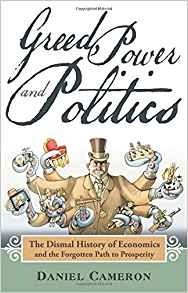
Greed, Power and Politics, The Dismal History of Economics and the Forgotten Path To Prosperity is both a history lesson and a critique of the economics profession throughout history.
Why is economics important? Is capitalism bad? Do stimulus plans and low interest rates help in an economic downturn? What really caused the Great Depression and the Great Recession? Do tariffs and other protectionist policies help or hurt an economy? What is the true path to prosperity? This fast-paced, easy to understand guide not only answers these questions but includes a wide array of interesting topics while providing clear and illuminating explanations for each one.
Daniel Cameron explains the benefits of the free enterprise system, while advocating a robust role for government to enhance prosperity. Drawing from over forty years of experience, he proposes economic reform based on value, not as determined by politicians, special interests or policy wonks, but by us, the citizens and true owners of the United States of America. If implemented, these ideas can lead to prosperity for all countries of the world.
In his book Greed, Power and Politics, The Dismal History of Economics and the Forgotten Path to Prosperity, Cameron takes on the pseudo-wisdom of modern economics, big banks, the Federal Reserve, lobbyists, Congress, several U.S. Presidents (both Democrat and Republican), Marx, Keynes, Greenspan and even Louis the IV. His arguments rise above the rancor of today’s political environment; instead, ending in a positive message of hope for all nations of the world.
Excerpt
Under the old European system of international finance, trade deficits were paid in actual shipments of gold or silver. If your country didn’t have enough gold in its treasury to cover the deficit, then you could try to borrow enough gold from an international “Merchant Banker” to cover your deficit. If you were unsuccessful, then no other country would accept your currency.
Under the current system, trade deficits are different than fiscal deficits in that trade deficits are not debt, they never have to be repaid. Hypothetically, however, if the United States had no imports, then there would be no dollars in international circulation. Therefore, if a U.S. company wanted to import products from abroad, then the U.S. importer would have to trade something of equivalent value or; if the foreign exporter were willing, accept dollars in payment, then come to the United States and purchase something of equivalent value.
Propping-up the Dollar
U.S. politicians concerned with American jobs love exports and hate imports but become particularly vocal against countries with whom we carry a balance of trade deficit. In the cases of China and the EU, in 2016 alone, we carried combined balance of trade deficits of $494 billion. If both countries suddenly stopped buying U.S. assets and sold all their U.S. dollars on the international currencies exchange, the market would suddenly be flooded with dollars, which would dramatically lower the dollar’s FOREX exchange rate value, relative to the Renminbi and Euro, making their exports to the U.S. far costlier for American consumers. This is obviously not a good thing for countries that want to export lots of stuff to us. Therefore, it is in the best interests of all our trading partners to keep the dollar strong; in fact, the stronger our economy the better for them. If in the process, they artificially prop up the value of the U.S. dollar, then it is okay with them. In our case, U.S. banks and U.S. treasury notes are still considered among the safest in the world — which is a terrible indictment of the ability of the world’s governments to manage their finances.
Foreign Trade Statistics
In 2012, we imported about $2.74 trillion worth of goods and services and exported about $2.2 trillion, creating a trade deficit of about $540 billion. In that same year, $5.5 trillion or 34% of our $16 trillion federal debt was held by foreign nations.
Now, let’s take a minute to examine this enormous foreign debt and can ask two questions: First, if we had no federal debt, would the $5.5 trillion instead be invested in U.S. assets, which would translate into an increase in American jobs? The answer is yes, at least a good chunk of it. And second, why do these countries loan us so much money? To answer the second question — consider the countries in which we carry a balance of trade deficit as creditor nations when they purchase U.S. Treasury bonds. Then let’s compare these creditor nations to a manufacturer whose best customer, in our hypothetical example, is developing financial problems. The manufacturer wants to keep selling him products, but is starting to get a little nervous about his ability to pay down his line of credit, which continues to grow beyond any reasonable expectation of repayment. You could force him into bankruptcy and get perhaps pennies on the dollar for your debt — but, the customer continues to pay you interest and keeps buying your products, so in spite of your better judgment you decide to carry his debt indefinitely.
It is important to note that we have the world’s most powerful military, which gives us a lot of clout in international finance. No foreign power is able to come along and bully the United States into accepting a disadvantageous trade agreement. We, on the other hand can force international or unilateral sanctions against any disagreeable nation we choose. Our powerful military is in the background to act as a club if necessary. In fact, currently we have trade sanctions against a total of seventeen countries, and trade is absolutely prohibited with Belarus, Cuba, Eritrea, Iran, North Korea, Syria, and Venezuela; unless of course, our government decides to make specific exceptions.
Currency Confusion
There currently are 164 different national currencies and each one of these nations would prefer to receive payment for their exports in their local currency. China would rather have all payments made in the Renminbi and the EU countries would like to be paid with Euro. In fact, international finance would be greatly simplified if there were only one currency in use by all countries; however, who would be willing to back such a currency? A singular worldwide currency would require a one-world governing body to back it; and of course, the coordination of 197 independent nations would be a political and fiscal nightmare! The other option is to revert to a system where all currencies would be backed by commodities like gold or silver, but as we have seen throughout history, a system of commodity-backed currencies is less than perfect.
Interdependent or Codependent
In international finance, there is the additional complication of economic interdependence. Any given country may have millions of jobs dependent on exports to the United States. Let’s assume hypothetically that you are the Prime Minister of Canada and your country’s corporations have millions of parts manufactured in America. They may have, in aggregate, trillions of dollars of investments in this country and trillions of dollars invested by U.S. companies in Canada. Your Canadian banks may have invested trillions in U.S. bonds, securities, inter-bank participations, branches, and accounts. The bottom line is that if the United States goes down, Canada goes down and so does the rest of the world! The problem isn’t our balance of trade deficit, it’s the soundness of our currency that is used as an unsecured loan in international transactions; which relates directly to the strength of the issuing entity — the U.S. federal government.
|