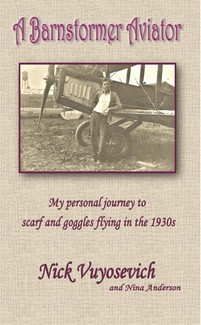
This is the true story of Nina Anderson's father who in his own words tells his journey into early aviation in the 1930s. From his first flight off the roof of an orphanage to barnstorming and air show tricks, this book will delight any aviation historian or wanna be pilot.
In 1980 when I was flying jets for Philip Morris I asked Nick to write down his memories of flying back in the twenties and thirties. This book is what he put together – single spaced on a typewriter with all the type corrections overlaid in ink (no white out back then)! Upon reading it, I realized what a miraculous thing it was for an immigrant’s son with nary a nickel in his pocket to realize his dream of flying back in the days of early flight.
Dad collected a myriad of newspaper clippings from aviation events back then and I have included many of them in this book. He also took photos – few of the family – mostly of airplanes and pilots. His story is unique from an aviation history perspective. We have heard about the war heroes, the record setters and the early aircraft designers. But rarely do you read about the young kids who looked skyward and struggled to reach their dream of being a pilot, especially when there were few flight schools and fewer instructors. What they went through, what they flew and how they achieved their dream is what this story tells.
"Living in the 1930s, with nary a nickel in his pocket an im-migrant’s son learned to fly. This was Nick’s story written by him 50 years after that first solo. Come back to the time when crashes were common, navigation was “I follow roads”, scarf and goggles were standard pilot gear and barnstorming was the way to get folks out to the airport for a ride."
Excerpt
Introduction.
In 1924 I was 15 years old and a high school stu-dent in Hoboken, New Jersey. Most every week-end I would start off on a long trek by hanging on the rear end of a trolley car that ran from Hobo-ken to Paterson via the Paterson Plank Road westward. As it slowed down at the railroad track at East Rutherford, I would jump off. Then I had a long walk along the railroad north about five or six miles to the Teterboro airport and the Gates Flying Circus with its renown pilots of the era in their colorful Standards OX5 with Hispano-Suiza engines.
The weekly show drew crowds from all over and with a couple of dollars crumpled up in my hands, I was constantly trying to sell the barker on letting me go up for a ride for two dollars instead of the five they were charging. It was a long afternoon, and nobody paid much attention to my two dol-lars. Toward the end of the day a pilot named Smitty waived me over. He took pity on me and allowed me to ride with him in a Hisso Standard for the measly two bucks. I was flying! I have nev-er forgotten the thrill of looking down on my world from above and back at my hero behind the goggles who was responsible for transporting my body and soul in the sky. I had always dreamed that some day I would fly and here I was.
Some of the pilots of the day who all flew for Gates were Bill Diehl and Clarence Chamberlin (prior to his trip in the Columbia to Germany). Al-so flying for Gates were Tony Fokker (who was building a four-engine biplane at the field), Eddie Allen, Slim West and others of the “old timers” that I was later to have more than a nodding ac-quaintance with.
My first-hand experience at Teterboro fired me up to some day fly as a pilot myself, own an airplane and maybe an airport – all which eventually tran-spired. This was a glamorous period in aviation with flamboyant personalities abounding to carry aviation forward. Some didn’t make it, but those who did made aviation history for our new breed of pilots to fly the incredible aircraft of today. For the next few years this was my spare time pattern – beg, walk, train, fly!
Professional Reviews
What a fun read!
Only thirty years after Kitty Hawk a high school boy is dream-ing of flight; first solo in the 1930s; and buying his first airplane for $189.00. This true story written by a New Jersey biplane pilot, is filled with names, places, aircraft and adventures from the golden era of aviation! What a fun read. -- James P. Adams, ATP, Gold Seal Flight Instructor, Retired FAA Operations Inspector, FAASTeam Program Manager
I loved the misadventures
My grandfather, Don Hall, was the designer of Lindbergh’s air-plane, the Spirit of St. Louis, so I have a vested interest in early aviation. This book gave me insight to the circuitous path most pilot wannabees, who were just part of the general population, had to follow to learn to fly. I loved the misadventures, calamities and comradery depicted among the early aviators that Nick described. While reading it I was transported back to the 1930s and got an in-person glimpse of the era my grandfather lived through. - Nova Hall, author of Spirit and Creator, The Mysterious Man Behind Lindbergh’s Flight to Paris. [Safe Goods Publishing]
An archival treasure of New Jersey flying in the golden age of aviation
General aviation pilots from the 1920s and 30s are at times overlooked especially those from New Jersey. As the industry grew in New Jersey, few chronicled the struggle to provide flight schools, airports and flying clubs for would-be aviators seeking to fly those incredible scarf and goggles machines. This book describes the trials and tribulations, adventures and misadventures, and the insider stories of early aviators such as Clarence Chamberlin, Eddie Gorski, Chet Coons and George Stone. Documented with original photos, this book is an archival treasure of New Jersey flying in the golden age of aviation. - Ralph Villecca, Executive Director, Aviation Hall of Fame & Museum Of New Jersey
Want to review or comment on this book?
Need a FREE Reader Membership?
Reviews for "A Barnstormer Aviator"
Reviewed by Laura H.
1/27/2020
Wow! This is an amazing first-hand account of a time long past. To say the people who lived and enjoyed this passion were an adventerous bunch would be an understatement.
The format used to write this important work makes for easy reading and an easy understanding of the sequence of events.
While I am not an aviation buff, I can see how this hobby can reach into the hearts of the people who love the feeling of flying and the people who are as avid as they.
It was interesting to read the lengths a person would go to in order to achieve the goal of flying and being able to achieve what seemed liked lofty flying goals.
I sincerely hope the author has been able to share this publication with your family and your father's friends. This would be an important addition to their history.
Thank you to the author for taking the time to put this amazing story to print.
I'm so glad you were able to bring your father's story to print. It is so important to have history from the viewpoint of those who lived it. Those were heady times when personal safety and machine efficiency were thrown to the winds for the adventure and excitement that flying brought.
My uncle, who just turned 100, entered the Air Force in 1942, and although he didn't fly for the Air Force during his 20 year career there, rented a Piper Cub and took me up for my first flight in 1948. The only connection I have with New Jersey is the photograph that my friend and neighbor, Herb Morrison, gave me to give to my younger brother of the Hindenburg that he took at the airport in Newark prior to flying down to record the arrival of the German airship for WLS Chicago on its second flight to the United States. My recollection of him is in this article that I've posted with the photograph:
Rosetta was born in 1909 as the youngest of ten children. The family had more laughter than money and neighbors would knock on their door to ask, "Can we come in and laugh, too?"