Category: Technology Type: Non-Fiction
Copyright: September 5, 2025
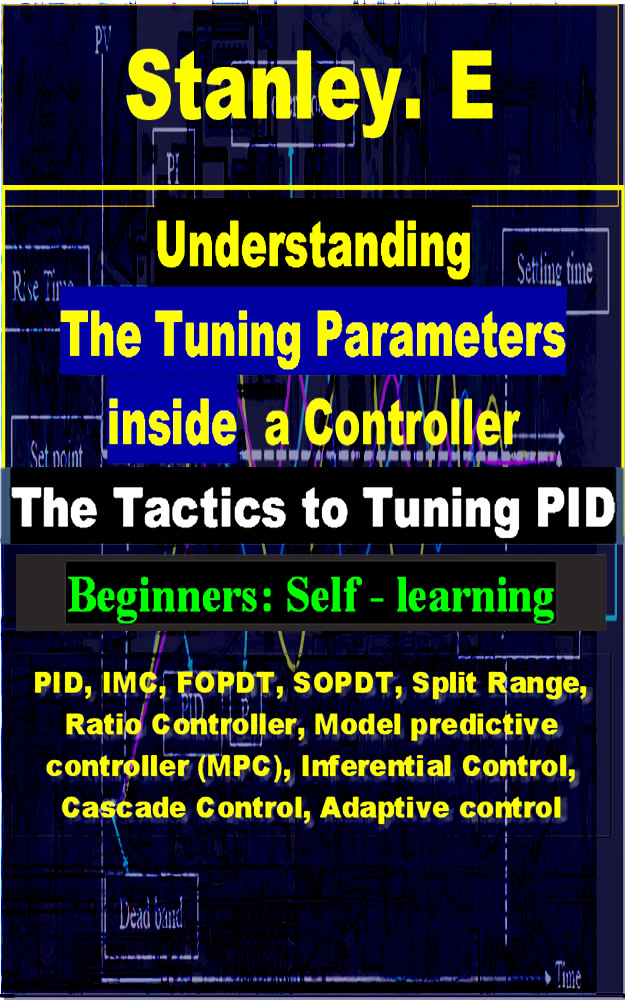
Understanding the Tuning Parameters inside a Controller. Self-study manual for Engineers.
"Understanding the Tuning Parameters inside a Controller" is a self-study manual for beginners; it explains how to adjust the controller's tuning parameters in process plant industries to maximize process line performance. It is intended to assist novices in understanding the methodical techniques of parameter tuning.
The book is written under the presumption that readers are completely ignorant of tuning. You will understand the principles of PID optimization during the course. For those working in a variety of organizations and sectors where PID optimization is important for effective process line management, the book has been simplified.
Note that P (or Kp), Ti (or Ki), and Td (or KD) can be used interchangeably.
As automation is becoming increasingly in demand, the uses of PID controllers in the industries are on the increase. Most of the controllers used today are computer-based digital signals, unlike in the past, when analog controllers were mostly used. When a system's mathematical model is provided, it is possible to explicitly determine the controller's parameters. Nevertheless, where mathematical models are not available, the parameters can be determined experimentally.
As described in the book, participants will learn about P, I, D, PI, PD, and PID as well as FOPDT, SOPDT, Internal Model Control (IMC), Split Range, Ratio Control, Model Predictive Control (MPC), Inferential Control, Cascade Control, Adaptive Control, Auto Tune Variation (Closed Loop Method), Integral plus dead time (IPDT), a nonlinear system, and using digital computer approaches. The participants will learn the mathematical formulations of the process parameters and the step by step methods of controller tuning using different models.
Each chapter concludes with tasks designed to assess the participant's comprehension of the material.
After finishing the self-learning material, participants will have a solid understanding of PID and the tuning parameters inside a controller, and feel extremely proud for having learned the essential tools, techniques, and working knowledge of tuning. Participants should benefit from the skills they have learned here, but there is much more to learn about tuning.