A few years ago I received a book from a thoughtful woman who lives in the United Arab Emirates, an illustrated version of the Sufi tale Mojud: The Man with the Inexplicable Life. Mojud starts out as an inspector of weights and measures but then receives several visits from the spirit guide Khidr. Each time his life settles, the spirit appears with a new adventure. Everyone thinks Mojud is mad, but with a sacred simple-mindedness he empties his will and follows directions. Finally, the story says, "Clerics, philosophers and others visited him and asked, 'Under whom did you study?' 'It is difficult to say,' said Mojud."
I think Khidr must have visited Jerry Wennstrom a few times, too. His many beautifully told stories show that Jerry has Mojud's open-hearted faith, the intelligent willingness to read the signs life offers of what to do next and where to turn. As Jerry himself realizes, it is the way of the Holy Fool, the one who grasps the simple idea that being open to life is ultimately more rewarding that trying to control it.
Joseph Campbell once wrote that Aphrodite can be seen today standing on the corner of 42nd Street and Fifth Avenue. The timeless spirits and the timeless truths are ever-present, if disguised in ordinary clothes and personalities. Jerry's insights show all the traces of the world's ancient wisdom, though he uses his own hand-crafted images and phrases. This is another example of what happens when you open yourself to people and events without self-protective judgments.
Reading Jerry's own tale within his many vivid stories, I am also visited by Perceval, who found his way through the forests and the wasteland with a simplicity of mind and an egolessness that was magical. As I was reading how Jerry consistently appreciates the holiness in his many troubled acquaintances, I also thought of R. D. Laing, that brave soul who was ridiculed for his own wayward life. Jerry's attitude echoes Laing's insight that psychological problems are actually spiritual in nature and deserve to be treated as such.
I don't share Jerry's enthusiasm for "wholeness," but I like his description of it as coming full circle. My favorite image for this is the ancient ouroboros, the snake that bites its tail. We humans are not evolving but circling, and that the stuff of our souls keeps coming back for more attention and more living. I appreciate the form of Jerry's book, a series of stories that circle around. I like the fact that they aren't entirely chronological and that each one is a beginning. I imagine Alexander Calder mobiles spinning all around me as I read, and I trust that view of life, one that gets nowhere, no, not even spiraling toward a better end.
While Jerry's stories will remain with me for a long time as lessons in being open to life's paradoxes, I am also taking note of powerful phrases that conjure up ancient wisdom: "Seasoning sanctifies. Insanity, that too is God. The power of the bloodline. Our dualistic package. Form is death. I have to leave this perfection. We do not make good gods. The whispering God. Enlightenment is surrender."
I'm sure that many people will find comfort and inspiration in this book. Jerry is able to describe a spiritual journey outside of any ancient tradition or modern system, and I trust that originality. He avoids the many hollow words sometimes enter contemporary spiritual thought and embodies the idea that you can be fully spiritual and fully secular at the same time.
Jerry's experience shows that simply by being receptive to deep intuition and living intelligently from the heart, you can achieve a degree of holiness. In the old Sufi story people were amazed that Mojud, an untutored wanderer, developed the power to heal. I expect Jerry's book to be a source of healing, and so I can ask him the question put to Mojud: "Under whom did you study?" I would expect him to answer, "It is difficult to say."
Thomas Moore is the author of Care of the Soul; The Soul of Sex and The Reenchantment of Everyday Life.
Introduction to "The Inspired Heart"
In 1979, I destroyed all the art I had created, gave everything I owned away, and began a new life. I sensed an inner and outer world in perfect order. I sensed that I could become a willing participant in that order, and that it allowed for my individual expression and unique contribution. I know now that my participation was conditional on how well I learned to listen and to see the inherent patterns within the natural order I sensed. The return of a physical creative expression came later, after I learned what was required by the inner life. The new life that I gave myself to required unconditional trust and noninterference. I asked for nothing from any human being. I needed to know if there was a God and I risked my life to find that out. I know now that we risk far more when we attempt to create a life devoid of a personal relationship with our God.
I ate when I had food and I fasted when I did not. I accepted whatever came into my life. It was that simple. I was familiar with fasting; I had done it once a week since I was twenty years old. Now, eating became a miracle. At first, I had something of a small following as an artist, and people were still interested in what I did, so they gave to me. Soon it became apparent that I was not going back into art, and many of these people faded from my life. I had a close circle of friends of the spirit who understood what I had given myself to, to some extent. They had their doubts, and so did I. My life was just too much for our modern western mind to consider. Eventually I saw the ways in which the miracle carried my life. I could never have continued this strange and lonely journey if I had not seen that. My joy and my ability to help others were gifts of that miracle and were my only tools for disarming the fears that were inevitably projected onto me. Fielding the fears of others was probably the most difficult task of the new life. I had to confront the fears within myself first. I had to give to others unconditionally and expect nothing in return. This is a society where everything is not enough.
On the surface, I looked like what most of us put all of our energies into avoiding. I became nothing. I had chosen to make an intuitive and conscious leap into the void so I did not have the luxury of asking for sympathy when the journey became frightening or impossible. Even the least intelligent among us would have suggested that I get a job and feed myself. I knew that I did not have that choice. I knew that once I jumped into the vast and empty ocean I saw before me, there was no measure in between that could save me. I would swim or drown. In water up to my neck, no choices and no turning back would be possible. I knew this was real.
In the cyclical rhythm of life, we eventually come up against a profound moment in which we must decide how much faith and courage we are willing to give ourselves to. Most often, in deciding this, we also establish how much courage we will live with for the rest of our lives. This crucial point usually comes to us at around the age of 30. The opportunities at that time are like no other. Only the rare human being can leap into a deeper faith beyond that opportune stage in their life. Usually, if we have not done it under the best of circumstances, when the physical and spiritual winds are at our back, then we rarely find courage or reason enough to do it later in life. However, grace has no limits, and this is not written in stone. Only we know what we do with that moment once it arrives in our life, or where we may have set it to rest. Have we chosen the safe life, its foundation rooted in fear? Or have we chosen the Mystery, in which all may be lost or gained? We have only our inner knowing, and as an external indicator, the miracle, which informs us of the power of our choice. No one can judge, yet everyone intuits our choice by the ways in which it resembles their own.
I tell mostly stories here. The stories lead up to the leap of faith that changed the way I lived my life, and they go beyond into the magic that carried and continues to carry my life. It is the story of the journey full circle, of leaving and returning to the world and to art. I also share what I have discovered and the thought processes involved. The particular point of view from which the stories are told and lived is that of a spiritual seeker and an artist. However detached I may have become from the label “artist,” I never lost sight of art’s essential heartland, and I held a creative vision throughout my journey. My detachment from any particular religious affiliation did not preclude the essential spirituality of the journey. I hold true that the path lived attentively is a sacred path, and that the fundamental spirit of art is alive, well, and deeply esoteric. As does any spiritual path, art has the potential to deliver us into our own true becoming, which is identical to our world’s becoming. Art expresses and defines the deep and collective spirit of our time.
These stories are true. They are based on my attempts to learn the ways of the new life to which I so radically gave myself. I could only sense the form the new life would take. I did not know how to live this life, or if it were even possible. I was inspired by the lives of many great souls about whom I had read, and this helped me. I found courage enough in their stories to initiate and fully accept the challenge of my own calling. However, I did not know their gods; I had only just met my own. I knew very little about how to communicate with these gods or where the communication would take me. I trusted a higher good that I sensed was much better equipped to inform my choices than anything I had available in the limited range of will and intelligence.
These are stories from an edge of reality where I confronted weakness, doubt, and the very good possibility that the human psyche has its limits. Living this way brought fear to the surface, but it also brought the elimination of fear by a kind of Grace. Reason was of very little use in informing the vital decisions I made and ineffective in producing hoped-for results.
Just as I wandered and discovered my way along an unreasonable and unpredictable path, I have wandered and discovered in the amazing process of writing this book—the first I’ve written. As I step into the worldly arena with my story and attempt to put something so ineffable into words, I realize I am fair game. I ask for no mercy. I only pray that my words remain true to the essential source that guides the journey and that they may enliven your own journey. As for the particulars, the shortcomings, and the dross of this creation, I claim them as my own.
Excerpt
It holds true that the path lived attentively is a sacred path, and the fundamental spirit of art is alive, well, and deeply esoteric. As does any spiritual path, art has the potential to deliver us into our own true becoming, which is identical to our world’s becoming. Art expresses and defines the deep and collective spirit of our time.
Professional Reviews
Rebecca Reads
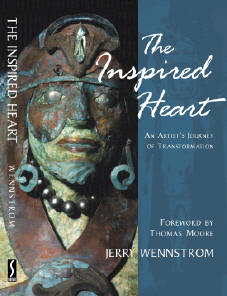
"Artist Jerry Wennstrom shocked the New York art community in 1979 when he destroyed his paintings at the pinnacle of his illustrious career. Guided by an inner passion to connect directly to divine consciousness, Jerry Wennstrom gave away his possessions & began a journey based on complete surrender to life experience. The Inspired Heart shares his journal of how he lived for years in a state of grace & faith, discovering divine intelligence & inspiration in a wide breadth of experiences.
The Inspired Heart tells the true story of how one man's trust in even the most seemingly random & chaotic events lead to a deeper sense of wonder & connectedness. Jerry Wennstrom at various times fasted, experienced the sublime joys of sharing special moments with neighborhood children, & faced potential muggers with loving kindness ... to receive loving kindness in return.
Every encounter described in The Inspired Heart shows us how, “Enlightenment is not a grand finale that leaves us blissfully risen, Buddha-like, above the suffering of the world. It is a deep and unconditional surrender to what already exists and total trust in the larger inherent intelligence, which is willing to lead the way.”
I love the color pictures of Jerry Wennstrom's art in the middle of his book, & the way his autobiographical short stories weave themselves in dreamy fashion through the places & times of his fascinating life.
The Inspired Heart shares the raw & simple beauty of one man's pure heart as it shows us how miraculous, magnificent & rich our lives can be when we let go of everything & allow ourselves to be fully present in this moment, now.
Jerry Wennstrom now lives on Whidbey Island in Washington State & has re-emerged with his wildly inventive sculptures."
Jung Institute Review
Jung Institute Review
of The Inspired Heart: An Artist's Journey of Transformation
Without hesitation, I can say that The Inspired Heart describes in content, style and intention, everything that is near and dear to my heart. It is, indeed, beautifully written, magically intimate and readily available to all who might pick it up. If we could somehow put it into a form that would dissolve, I think it should be put into public drinking water! An odorless and colorless substance that could protect the soul from calcification and nurture it into deep-rootedness in all aspects of life.
The very attitudes and courage required of you in making this extraordinary pilgrimage are the same required...nay, demanded...by any soul worker - counselor, analyst, therapist, or otherwise. How few really understand this when wanting to be present for another. Being truly present for another requires a ferocious trust: It requires the ability of the ego to completely step aside and to remain steadfast and committed to the Unknown. It is this trust that can heal, that can foster a capacity to love when one can find nothing to love.
What is described in this book is the very thing that is needed at this time in the world, for this understanding is in danger of being forgotten, or hidden. Stories such as these are absolutely critical, both as inspiration and as documentation.
Thank you so very much for writing this book, and gratitude also to the publisher for making it available to so many of us.
Cedrus Monte, PhD dipl.
Diplomate Jungian Analyst
C. G. Jung Institute-Zurich
The Moonlit Path: Reflections on the Dark Feminine
Issues Magazine Review
The Inspired Heart: An Artist's Journey of Transformation (and the video In the Hands of Alchemy)
It is probably tempting for many to resort to psychology or judgment on reading Jerry Wennstrom's story in the press release: he realized he was becoming too attached to his identity as an artist, destroyed his works of art and gave away all he owned. For fifteen years he lived on practically nothing. His is an extraordinary journey, and on reading the book and viewing the video, you may find you are able to scrap the psychology and heartily crush your judgmental inclinations.
Jerry is not only an artist, he is a storyteller, and is as skilled with words as he is with paint and the material of his sculptures. His explanation for the decision to destroy his work is simple, profound, and strangely acceptable. If you were still to feel the urge to lament the destruction then remind yourself that those paintings were his to destroy as much as to create, as much a part of the artist as his own body and spirit. They were deeply beautiful, sometimes haunting, always essentially personal. Thanks to video and photographs, are they any more lost to us than the Old Masters jealously guarded in private collections or obscure museums? Jerry quotes Albert Einstein, "Matter never dies, it just changes form." For him, his destroyed art had become an empowering life force.
Jerry's story is one of faith and courage; he believes that we each arrive at a time in our lives when we choose how much faith and courage we are willing to give ourselves to.....do we choose the safe life or do we choose the Mystery? The book leads up to Jerry's leap of faith and continues full circle to his returning to the world and to art. It is a spiritual journey, a series of stories told effortlessly in which everything matters. His topics are various. Referring to sex, he talks about "carefully and reverently exploring the territory.....with innocent openness and trust in an attentive stage of diffuse awareness.....The only alternatives to this exploration are reckless, destructive behavior or adherence to religious and moral rules that promise safe, unlived lives." A choice which we may apply to aspects of our lives other than sex and art, both of which are pieces of the puzzle rather than the puzzle itself.
Many people will be greatly inspired by Jerry Wennstrom, and that inspiration may not lead to great leaps, but small steps of courage, faith and trust towards a truer self in a truer world.
Jamie was a healthy, active 12-year old who loved to skate and played hockey as well as any boy. Then one afternoon during a game, she suffered a stroke that changed her world. Her memoir takes the reader through her ordeal and her journey out of the
The true story of Cheryl Pierson Cuccio who made headlines in 1986 and her husband Rob Cuccio. Cheryl was abused sexually and physically and Rob died for 43 minutes on Cheryl's 43rd birthday.