|
Hanrow Press--Publisher
Brook of Life, Inc.
Category:
Business/Investing
Publisher: Hanrow Press
ISBN-10: 0970354983
Type: Non-Fiction
Pages: 280
Copyright: Feb 1 2001
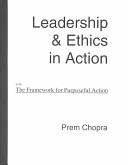
This book teaches leadership and ethics in a simple way that can be readily put to practice. Readers can apply the lessons learned immediately--to live purposeful and ethical lives and achieve both success and fulfillment. This implies change--for change is central to leadership.
This book should help all readers--regardless of how they wish to live and act
"Prem Chopra describes, perhaps for the first time in such clear and comprehensible words, a Purposeful Leader as a person who brings about change to help others in an enduring way. In Leadership and Ethics in Action, he goes further and demonstrates the intricate balance between the conflicting forces intertwined with the thoughts and actions we contemplate-whether or not we pursue them. The chapters on the Framework for Purposeful Action and Travelers in the Waters could well make this book the de rigueur for practical management training in organizations looking for success and fulfillment for all stakeholders.
On the heels of his exceptional book--The Purpose and Meaning of Life--Prem Chopra has come up with another inspiring winner in Leadership…Students of management as well as managers at all levels in government and corporate organizations should place this book on top of their reading lists." Jim Hall, Former Chairman, National Transportation Safety Board, Washington, DC.
"Chopra demystifies leadership and ethics. For most of us, leadership is a confusing concept—Chopra makes it clear. Similarly, ethics are ambiguous because they are relative with respect to time and culture—Chopra makes them lucid and universal.
He accomplishes this first by dissecting action with the precision and finality of an accomplished surgeon. He then presents the results in a simple way that is easy to understand and apply. Another important contribution of the author is the integration of ethics into the fabric of action. Finally, he shows, by examples, a simple way to learn and apply principles of leadership and ethics in everyday life.
For those who like to follow systematic frameworks, Chopra provides one, explaining it with simple metaphors and a contemporary life devoid of the trappings of the deep philosophy upon which it is based." Surjeet Malhan, PhD, Dean Emeritus, Baroda and Delhi Universities, India
Excerpt
The significance of leadership and ethics...
Leadership is simply, “the process of transforming dreams into reality.” When actions of leadership are performed in an ethical manner, they are called “purposeful actions.” Of course there is more to action and ethics. For instance, some purposeful actions might not be considered acts of leadership. They might be acts of management, entrepreneurship, consulting, trusteeship or even intellectual and artistic expression.
Ethics is simply, "the concept of good and evil expressed through a set of values." Ethics vary with time, place and circumstances. Thus, ethical actions here and now might be considered unethical someplace else now or even here sometime in the future. This certainly is true of the past. For evidence of this one need not travel beyond this land, or any land for that matter, on which natives once walked freely, sharing its bounties and striving to fulfill their needs and desires--without notions of ownership.
The desirability of learning and applying principles of leadership and ethics in our lives remains unquestioned. Students at all stages of life are exposed to inspiring and motivational speeches on these two related subjects. Such exposure might be in the form of lectures in academic courses, graduation speeches, or talks by visiting dignitaries. Hardly does a speech of this nature cross the medium between a student’s ears without addressing the importance of leadership and ethics, whether it is in the guise of national pride or family values. Leadership and ethics play pivotal roles in life and are among the implied, if not stated, goals of higher education. Parents, employers, community leaders and politicians share this belief. Here is a textbook that addresses this need directly.
Academic courses and textbooks provide the stones and bricks on which the edifice of a student’s knowledge is built. Lectures, notes, ancillary reading and research provide the missing links or mortar, so to say, with which the structure of a solid education is constructed. Links and mortar also are gathered through interactions between students and others outside classrooms and campuses. It is practically impossible to erect a strong and enduring building, no matter how small or unpretentious it may be, without these essential ingredients, the Inca stonemasons being rare exceptions.
|