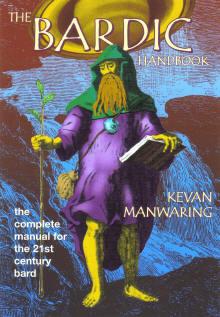
The Complete Manual for the 21st Century Bard -
a ground-breaking book!
Imbolc: the Poet’s Festival
Imbolc, falling on the first of February, is one of the four main Celtic Fire Festivals and is sacred to Brighid (pronounced breed), Goddess of poetry, smithcraft and healing. The name comes from ‘ewe’s milk’ (oi melc in Gaelic) for the festival was designed to coincide with the birth of the spring lambs and the lactating of the ewes. White is the colour of Imbolc, in the ewes’ milk, in the thawing snow and frost that lingers, and in the snowdrops – the first flowers of the year, that make a welcome appearance – the first signs of life, or rebirth, after the dead of winter.
Although winter can often maintain a stubborn grip upon the land for weeks to come, Imbolc heralds the first inklings of Spring, which will have manifested fully (depending on Climate Change) by the Spring Equinox (21st March) and be in its glory by May Day. Before those exuberant joys to come, Imbolc is a quieter, more ‘introvert’ festival: a time for us to peacefully light the candle of the year, listen to the Silence, and envision what the Awen (‘flowing spirit’: inspiration) wants us to manifest in the coming months.
It is a good time for beginnings, for initiating things and for initiations. If you are interested in embarking upon the Bardic Path, then you could pick no better time than Imbolc, for you have the blessing of Brighid and the energy of the year behind you. If you are serious then compose and take a Bardic Vow (making a commitment of your choosing in your own words to what you deem sacred, i.e. ‘to write 12 poems over the coming year in honour of the Goddess’) choose a Bardic Name and begin your journey along the Way of Awen in earnest (The Bardic Handbook goes into this process of self-initiation in detail). For now, it is not the details which are important, but the intent, to make your first tentative steps along the Way. Imbolc is an appropriate time of year for this, not only because it marks the rebirth of Spring, (an auspicious time to become ‘twice-born’) but because mythopæically it is connected with Ceridwen and the tale of Taliesin: for Ceridwen is a kind of Welsh Brighid and Taliesin is the greatest Celtic poet – a 6th Century Welsh bard, whose poems are still extant. In his own Creation Myth he undergoes a series of ritual transformations in a shape-changing chase with Ceridwen before being devoured by her and reborn as Taliesin, which means ‘radiant brow’.
Brighid is connected to springs, and she manifests in subtly different forms around the country. Clues can be found in place names or street names. Bridewell Lane is a giveaway. In Dorset, above Bridport, there are the verdant moist valleys of Little Bredy and Long Bredy, overlooked by the long barrow of Long Meg and her Daughter nearby. Not far away is the Abbotsbury Swannery, swans being sacred to Brighid, and a ruined chapel dedicated to St Catherine, of the burning wheel (flame also being connected with her), is situated on a hill with fine views over Chesil Beach. St Catherine, whose feast day is 25th November, happens to be the patron saint of Bath, Somerset: St Catherine’s Chapel is the ‘mother church’, and has one of the many sacred springs in the area. But most famous of all are the geothermal springs of the so-called Roman Baths. The hot springs which emerge in the centre of Bath from a 4 km fault in the Cotswold limestone (Aquae Sulis: waters of the gap) are sacred to the Celtic Goddess Sulis – her cult was assimilated by the invading Romans who established their temple-city there, and she became known as Sulis-Minerva. The hot springs were believed to be heated by an undying flame, rather like the Flame of Brighid in her temple at Kildare, tended by the priestesses. The hot springs of Sulis were also said to be heated by ‘brass tuns’ beneath the water – an echo of the cauldron of Ceridwen tended for a year and a day by Morvran, and stirred by Gwion Bach, who, of course, splashes three drops of the potion of inspiration on his fingers and receives the distilled wisdom of the world meant for Afagddu. After the culprit is caught and ‘devoured’ by Ceridwen he is twice-born with a shining brow and given the name Taliesin – in this tale we have a brilliant example of a Bardic initiation and naming.
So, Imbolc, being sacred to poets and associated with these legends is the ideal time for a poetic initiation – more than, I would argue, Samhain, the Celtic New Year and traditional time associated with death and rebirth. I feel the Bard’s year begins at Imbolc, for after the busy autumn-winter circuit (Harvest, Halloween, Yuletide) it is time to replenish the Awen and rededicate oneself to one’s path. Therefore, even if you have already been initiated and named, I would suggest you use Imbolc to ‘renew your vows’ to the Goddess – for this is a kind of sacred marriage, with you as the Goddess’ (or Horned God’s) consort on earth.
A mild echo of this is found in the medieval courts, with the winning of a woman’s ‘favour’. A troubadour would have his Lady, to whom he would compose and sing songs – she would be his earthly muse. And the idea of the Muse is a direct legacy of this notion of divine patronage. In Greece, poets actually received their inspiration from the Nine Muses, who lived on Mount Parnassus above Delphi. The fabled Cauldron of Plenty that King Arthur plunders in the ancient Welsh epic Preiddu Annwn was ‘warmed by the breath of muses.’ Taliesin PenBeirdd himself accompanied Arthur Pendragon and was said to be one of only seven survivors to return.
Imbolc is the festival to ask for inspiration from the Goddess herself, to receive her favour for the coming year, in exchange for your loyal service. The main thing is to serve something bigger than your self (i.e. Gaia, Mother Earth) and to realise the Awen is not to be taken for granted: it is a boon that can be withdrawn if you are deemed unworthy (writer’s block, losing your voice, etc). Imbolc is the taper that lights you.
The equivalent to the Muse is ‘the Daemon Lover’, the incubus/animus opposite of the men’s succubus/anima – the idealised ‘other’. He crops up in numerous ballads, poems, stories, paintings and novels (Dion Fortune’s The Demon Lover, and Caitlin Matthews nonfiction book on the subject). Perhaps the stereotype of the ‘tall, dark, handsome stranger’ comes from this – if he is an archetypal figure that haunts women’s dreams. Is the popularity of elven Orlando Bloom-types, especially with younger women, because they are feminised ‘non-threatening’ males: the classic Prince Charming fantasy figure, the stuff that girls’ dreams are made of?
And, in the similar way, perhaps the Muse is so common a figure with male poets because she is his female half…Yet the Goddess is, generally speaking, the idealised feminine, for both males and females – in her gentler aspects at least. Of course, she has many faces, and seems to become darker and fiercer as the year progresses, so that by the time the wheel has turned to Samhain, she has become the Hag, Cailleach. But for now, we can enjoy her Maiden aspects, although Brighid is no ‘foolish virgin’! She is the most important Goddess of the Celtic world – worshipped across the lands of the Celt, changing form like the cloak of seasons over the landscape. She seems to embody the Triple-aspect Goddess herself, being the Celtic goddess of poetry, healing and smithcraft: an interesting combination echoing the Greek Athena/Roman Minerva – Goddess of poetry and warfare. She is indeed a double-edged sword, not to be dealt with disrespectfully. She is no ‘bimbo’ of male fantasy, although many poets have written about her, trying to capture her ethereal beauty. As befitting a Goddess, she alters her shape and guise – her very elusiveness maddening poets. Robert Graves calls her ‘the White Goddess’: ‘with leper pale brow, rowan berry lips, hair, honey-coloured to white hips’. Yet she is certainly not all ‘sweetness and light’. Graves warns, perhaps prejudiced by his own encounters, that ‘jaw bones and entrails of poets litter her lair’, the Mare’s Nest. She is Keats’ ‘La Belle Dame Sans Merci’, leaving unwary knights ‘alone and palely loitering’. The Wandering Aengus of WB Yeats’ famous poem, caught a glimpse of ‘a glimmering girl’ with apple blossom in her hair’ and spent the rest of his life looking for her: ‘Though I am old with wandering through hilly lands and hollow lands I will find out where she has gone…’ The Muse is elusive and seemingly fickle, although actually only bestowing her favours on those worthy to receive – she is sister to the Goddess Sovereignty, who can make – and break – Kings.
She appeared in my life when I first started writing poetry – no coincidence I feel. I believe I found my Muse when I visited Ireland for the first time in 1991 on a Lughnasadh pilgrimage to Croagh Patrick, Newgrange and other sites, including Thoor Ballylee and Coole Park, Yeats’ old haunts. She has changed Her face many times but has been with me ever since.
I think it is important to renew this ‘pact’ with the Muse-Goddess every year, like the renewal of hand-fasting vows. It is an interesting coincidence that only a fortnight later than Imbolc we have St Valentine’s Day, when we are ‘encouraged’ by the media and expected by our partners to do the same. We express our love to our beloved with poetry (or the stuff that passes for it in cards) floral tributes and a ritual meal. However spurious this tradition, it serves a healthy purpose if it makes us think about our feelings, the object of desire and our commitment to them. And in this respect, as well as it superficial trappings, it echoes the older Fire Festival. Imbolc is especially focussed on feminine mysteries, but should not be seen as a ‘woman only’ festival. It has a lot to offer men (and ultimately it is about the dance and the balance of both). So Imbolc is a very ‘feminine’ festival (a term I use in respect of generic character traits, rather than gender), one which is of especial resonance to Bards dedicated to honouring the Goddess, but it has wider significance for all of us. It is time to clear and bless our own springs of creativity; to nurture the tender shoots of our dreams seeded in deepest winter; and to celebrate the renewal of life.
Copyright Kevan Manwaring 2005
Main Sources:
Stations of the Sun, Ronald Hutton, OUP, 1997
Celtic Rituals, Alexei Kondratiev, New Celtic Publishing 1999
The White Goddess, Robert Graves, Faber & Faber 1961
Natural Magic, Paddy Slade, Hamlyn 1990
Pagan Celtic Britain, Dr Anne Ross, Cardinal 1974
Edited extract from The Bardic Handbook: the complete manual for the 21st Century Bard by Kevan Manwaring
Excerpt
AWAKEN THE BARD WITHIN!
This complete manual for the Twenty-First-Century Bard contains all you need to know to start you on the Bardic Path. Here you will find inspiration and instruction, whether you want to dedicate yourself to the Way of Awen, or simply wish to improve your public-speaking skills and be able to express yourself with confidence. Learn how to enchant an audience with gramarye, through poetry, storytelling and songcraft, and how to use the magic of words to bless, honour, heal and celebrate your identity, community and heritage.
With an easy-to-follow 12 month self-study programme and week-by-week exercises and mini-lessons about bardic lore, this book will lead you along the Way of Awen. For ease of understanding and to invoke inspiration, the book is divided into five parts corresponding to the elements of the Western Magical Tradition: Spirit, Air, Fire, Water and Earth.
Kevan Manwaring, whose Bardic name is Tallyessin, is a novelist, poet, storyteller and teacher. He has been performing his poetry and stories for over a decade in venues across Britain and North America (solo and with Fire Springs). In 1998 he was awarded the Bardic Chair of Caer Badon in Bath. His first novel, The Long Woman, was published in 2004. He founded The Silver Branch Bardic Network, teaches creative writing for the Open University and freelance workshops in the Bardic Arts. He lives in the city of Bath, Somerset.
An inspiring handbook of creative wisdom, The Bardic Handbook also includes ‘The Dialogue of the Two Sages’ by Robin Williamson (master harper, storyteller, and author of The Craneskin Bag and co-author of Celtic Bards, Celtic Druids) and features a foreword by Emma Restall Orr, author of Druid Priestess, Ritual and Living Druidry:
“…This is why Kevan’s Bardic Handbook is such an important publication. The tradition of the Bard is far too broad for any book to be comprehensive, yet this one is a beautiful wide basket filled with nourishment, with the apples and hazelnuts so abundant in the landscape of our heritage…“It is accessible, easy to read, doesn’t require much education or previous knowledge, and yet still contains moments of history, mythology, philosophy and mysticism, interspersed with the challenge to practical commitment.”
Professional Reviews
The Druid Network, 2006
The Druid Network Review
Reviewed by Damh the Bard
Kevan Manwaring will be known to many festival-goers as a fabulous storyteller, poet and Bardic workshop facilitator. He now adds to his ever-growing portfolio a wonderful, and inspiring book that takes the reader through a year long course, guiding them ever closer to the grail of becoming a performing Bard.
There is magic held within these pages. Crammed full of exercises, tips and methods to enflame the Bardic ‘Fire in the Head’, and bring more ‘Awen’ into our lives. Poetry, storytelling, art, music and lyric writing are all covered – it really is an amazingly comprehensive work. There have been attempts made by other writers over the years to put together books like this, but none have managed to do it with such skill and depth, but what I really like about it is that it is firmly rooted in the ancient Bardic tradition, taking much of its course material from the old stories and poems from the ‘Celtic’ world. Here you feel like you are really following in the footsteps of those old poets, listening for the sound of the harp calling you deeper into the Sacred Grove of the Bards.
Later on in the book, once the student has followed the course for almost a year, there are further tips on performance style, confidence building, finding a Bardic persona, and even getting bookings for events...
This book is a delight for the experienced and novice alike, and I thoroughly recommend it. In a world where intellect seems so much higher valued than creativity, this book will, I hope, go some way towards restoring a balance, and also help bring the Bardic tradition back to its more hardcore Shamanistic roots.
Merry Meet, Autumn 2006
The Bardic handbook
By Kevan Manwaring
Gothic Image 320 pages £14.99
Kevan Manwaring, a.k.a. Tallyessin, is a novelist, poet, storyteller and teacher. In 1998 he was awarded the Bardic Chair of Caer Badon in Bath. In 1999 he won the Writers' New Ghost Story Competition. He runs Silver Branch Bardic Training and teaches fiction writing for the Open University. His second novel is released next month.
In the Bardic Handbook he shares some of his extensive knowledge of the Bardic arts, particularly poetry and storytelling, in an easy to follow and well thought out course of instruction, which the reader is invited to follow over a year and a day, thereby attaining the Hare Grade of the Silver Branch. It is structured in five sections: Spirit, Air, Fire, Water and Earth across twelve months, a system based on John Matthews' 'Shamans Ladder'. One of the central themes running through the book is the importance of the arts to personal balance and growth.
The book is an inspirational read and the author's enthusiasm is infectious. It is also good to be reminded of the huge part which storytelling has played in our history and culture As Kevan puts it "We make sense of the world through stories: we are all habitual storytellers and are always telling stories — whether it be a joke, an anecdote, a traveller's tale, a shaggy dog story, involvement in a recent tragedy, a personal triumph, an urban myth, a white lie or a home truth."
The reader benefits from the author's experience in the many and interesting exercises designed to develop the student's skills, particularly in the way in which he 'deconstructs' a story in order to memorise its structure and retell it in a fresh and original way with each retelling. His brief study of W B Yeats' 'Song of the Wandering Aengus' is as fine a piece of literary analysis as I have read, and does not suffer from the condescending use of jargon which tends to infect many essays on poetic composition. There are also a great many practical tips on recording performances, dealing with audiences, choosing venues, self-promotion and remuneration, all of which grounds the book in a down-to-earth common sense approach to what, in the hands of more theoretical writers, could have been just another self-development manual with an artistic bent
A highly useful and entertaining book, profusely illustrated.
JERRY BIRD, MERRY MEET, #26, AUTUMN 2006
White Dragon
THE BARDIC HANDBOOK: The Complete Manual for the Twenty-First Century Bard
(Reviewed by Blackbird Hollins)
This excellent book is a treasure trove of information. It is accessible and nicely laid out with full colour illustrations and detailed contents and index pages.
The book is structured as a twelve month course designed to take someone from total beginner to a basic level of understanding and ability. As someone quite familiar with bardic lore, I've enjoyed dipping in and out of this book - the short sections lend themselves to this approach. Regardless of your skill and experience, you will find something of interest here.
In a work of this scope, only an overview of each subject is possible. The short sections provide general information and are a good starting point for further research and inspiration. Extensive resource lists are given for those wishing to pursue topics in more depth.
The Handbook contains a good balance between information and bardic material. Most of the classics are within, including the Dialogue of the Two Sages and the ubiquitous Tale of Taliesin. But there are also dozens of lesser known tales, songs and poems which would form a solid foundation to the repertoire of a budding bard.
The author emphasises that higher levels of bardic craft take decades of study to achieve, and that being a bard is as much about performance skills as poetic talent. To this end, there are excellent sections on how to begin performing, from how to market yourself to dealing with heckling.
So what's not to like? Not much. Being a miserable old git, I can find lots to nitpick about, but given the vast range of this book, it's understandable that the necessary generalisations lead to a few glib statements and inaccuracies.
That - and assorted other nitpicks -aside, this is a useful resource for anyone interested in bardic skills. Anyone completing the course would find themselves well equipped for most aspects of bardic life.
The vivid front cover alone makes me want to order this book! The sample writing is also well-researched and eases the reader into a complex, fascinating world of magic, inspiration, history, mysticism etc. The Bardic heritage of the Celts is a wide, deep river with many tributaries. Like Kevan I've been fascinated for many years by figures like Brigid and Cerridwen and the ways in which they remain important to contemporary artists/writers etc. I'm looking forward to reading his particular take on these remarkable entities of the 'deep psyche', of the wilds and of the cosmological intricacies of time.
Grief, from Darkness to Light: A Faith-Based Journey is a transformative guide for anyone seeking comfort, healing, and spiritual renewal after the pain of loss. With compassion and faith as its foundation, this book explores the unique, non-linear j
ebook Version
Learn how someone can go from never gambling to the point where they are about to give up, get arrested, or commit suicide.
Learn how to lead someone out of the depts of compulsive gambling to freedom in Christ.