Category: History Publisher: Thomas/Wright, Inc.
ISBN-10: 0975485407
Type: Non-Fiction
Pages: 168
Copyright: May 2004
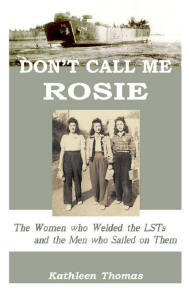
"Don't Call Me Rosie, The Women who Welded the LSTs and the Men who Sailed on Them" relates the stories, remembered 60 years later, of the women welders who built the LSTs and the men who sailed on them.
“If these vessels are produced in the time required, the war will be one year shorter than it will be if we fail.” - Rear Admiral Samuel Robinson to Dravo Corp. Chairman John Berg and Dravo Corp. President Vere Edwards, January 8, 1942.
The vessels Rear Admiral Robinson was referring to were the Landing Ship, Tanks or LSTs. They were built in the time required and we celebrate the 60th anniversary of the end of World War II this year instead of in 2006. The surrender of Germany was on May 8, 1945 and the surrender of Japan was on August 15, 1945.
It was the women who went to the shipyards during World War II and learned how to weld that made it possible to produce the LSTs in the time required. The LST was a new type of ship specifically designed to land on the beaches of Africa and Europe. After the British evacuation of Dunkirk in 1940, Winston Churchill recognized the need for the ship that became known as the LST.
Inspired by her mother and two aunts who worked as welders at Dravo, Neville Island in Pittsburgh, Kathleen Thomas has collected the stories, remembered 60 years later, of the women welders who built the LSTs and the men who sailed on them. Their stories are in the book, “Don’t Call Me Rosie, the Women who Welded the LSTs and the Men who Sailed on Them.”
In addition to her mother’s and aunts’ stories, the book includes the stories of women welders who worked in the shipyards in Pittsburgh; Evansville; Hingham; Jeffersonville; Seneca; Vancouver, WA; and Portland, OR.
Interwoven with the stories of women in a specific shipyard are stories of men who served on LSTs from that specific shipyard. The men's stories include eyewitness accounts of Pearl Harbor, Exercise Tiger, the West Loch tragedy, Leyte, and kamikaze attacks. Although most of the stories are about World War II, one chapter includes the stories from three men who served in the Korean War.
Excerpt
"No. We were not Rosie the Riveter. We welded ships. Rosie got all of the attention. No one even gave us a name." - Ann Jurjevic Thomas
A work in American history and existentialism Which is an Invitation to connect and create the dots in your life to other revolutions like the Cuban Revolution.
This is the story of the author’s great great grandparents, Edward Lewis and Sarah Crosby, who were convicts transported to Van Diemen’s Land in the 1840s. It is told from the perspective of a detective agency searching for what happened to Edward, w