How often do you use the word don’t? Think about it. It’s a word we use just about every day, so what affect does it have on us?
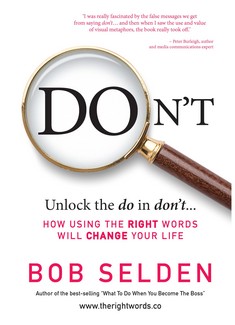
In his new book DON'T Bob Selden has tapped into the zeitgeist of the importance of positive language, and explains how words impact the brain giving us a more positive or negative outlook. Positive people use positive language and see opportunities that others miss.
In DON'T Bob sets out negative words and phrases to avoid - the ones that create negative thinking, and then suggests some words and phrases that do just the opposite, activating the positive parts of your brain and resulting in positive behaviour.
Bob uses relatable examples when dissecting day to day language. Having worked with experienced coaches of sporting teams throughout his career, Bob has seen the clear results of changing our linguistic behaviours. He suggests that “coaches who use positive language, always seem to get the best out of their athletes – firstly on the training field and subsequently during competition.”
The title DON'T comes from the problems which arise when all of us - parents, partners, teachers, managers, whatever our role or relationship - try to tell others ‘Don't do…’. Bob delves into everyday situations (which often he has experienced himself) and by simply changing our words there is direct behavioural change.
Many parents have said ‘Don’t touch anything’ to their children when entering a shop. By using an instruction such as ‘Don’t touch anything’ the only visual image the children receive is ‘touch anything’, as there is no visual image for the word ‘don’t’. Left with the image of the act of touching anything (and everything), this is generally what children will do. Instead of saying ‘Don’t’, Bob suggests a positive and clear instruction would be ‘Keep your hands in your pockets until we get back outside this shop’.
Using the advice in DON’T will enable you to use the right words in every day difficult conversations, such as parents talking to teenagers or young children, a job interview, giving a friend critical feedback, or a tricky conversation with an aging parent.
Excerpt
I remember standing in a gift store in Canberra, Australia some years ago when a mother with two young boys entered the shop. At their age of about three or four the only thing children want to do is to touch and feel things – to explore. The store was stacked full of open shelves with many delicate and breakable items such as glass and chinaware. If you were the boys’ parent, what would be your natural instruction to your children?
In those days my instructions would probably have been, “Don’t touch anything”. I’m pretty sure your instructions might have been quite similar.
By using an instruction such as “Don’t touch anything” the only visual image the boys receive is ‘touch anything’. Although we put the word ‘don’t’ in front of ‘touch anything’, there is absolutely no visual image for the word ‘don’t’. The boys are left with the image of the act of touching anything (and knowing boys of that age, probably touching everything).
Not only is there no image for ‘don’t’, it creates a further problem. People, and particularly children, have to double-process. The child has to think “What does she NOT want me to do?” as well as “What does she want me TO DO instead?” This can be very confusing, especially for young children as they may not know or understand the ‘to do’ part or have difficulty accessing it in memory.
Those of you who are parents will probably remember the many necessary corrective actions or commands which have to follow the instruction of “Don’t touch anything” (it rarely works).
You could surmise that this is simply ‘children being children’, or ‘boys will be boys’. I believe there’s another reason.
Let’s return to the mother and her boys. Instead of saying “Don’t touch anything” to my surprise she actually said " ...
Professional Reviews
Unlock the do in don't
I’m sure all of us have gotten the lyrics to a song stuck in our heads and find ourselves incessantly humming or singing it. When I’m aware I’m doing it I try to stop before I drive myself crazy. (e.g. the Barney song. You’re welcome.) That’s similar to what I do now that I’ve read this book—catch myself as the word don’t is about to trickle off my tongue. I’m learning to search for alternative ways to say (or write) my statement to infer a more positive feel or outcome. In essence, I’m reprogramming my brain.
“When we use positive words they strengthen areas in our frontal lobes and promote the brain’s cognitive functioning, making us more cognitively healthy.” (excerpt)
I’m a positive person, a picker-upper. In seeking for the positive in even the most tragic or unfortunate circumstances we influence others (knowingly or not) to do the same. This book’s message does something similar—showing us how using the right words not only influence our behavior and thoughts, but those of others as well.
“…the average child hears 432 negative comments or words per day, versus 32 positive ones.” (excerpt)
The bottom line is WORDS HAVE POWER. If you’ve ever received a backhanded compliment, then you understand how particular words and phrases project negative connotations. This is true even when the words are said with the best intentions. (Don’t touch the hot stove! Don’t give up!) Words like don’t automatically put our brains in a defensive or negative mode. Motivational speeches encourage and inspire people by using positive words and an affirmative approach. Therefore… need I say more?
DON’T, by Bob Selden, is an interesting book, written with authority, and humble, easy to understand language. (I especially enjoyed the sections dealing with creating images with your speech and using metaphors.) A truly inspiring read.
5 Stars!
Cover Lover Book Review
How using the right words will change your life
Bob’s background includes training coaches and people in organizations. A driving theme of the book is the idea that we can in fact change the locus of control of our lives and of others. That is, we can learn to take more responsibility for the things that happen, and don’t happen, rather than looking for external factors to blame.
And a key insight into this approach is to avoid using a negative framework to suggest a behavioral change. Don’t say “Don’t do this…” but say instead what the right thing would look like. An example is to change “Don’t touch anything in this shop” to “Put your hands in your pockets until we leave this shop.” Or change “Don’t run across the road” to “Stop. Walk slowly.”
The book argues that eliminating this one don’t word can make substantial change and Bob did this himself 15 years ago. He then goes on to show how the use of more positive words can also affect the outcome of group tasks. He has some great examples of negative self-talk we have fallen into: “I’m stuck in this rut…” I found these very helpful. Bob is an Australian and a wonderful Australian movie “The Dressmaker” takes the theme of someone feeling cursed into deep places. (The idea of framing problems as challenges is now thoroughly into the mainstream and once politicians are all over this we know the idea is in danger of becoming clichéd.)
I loved the implications of Keith Chen’s insights on how different world languages emphasize different approaches to the future. This may impact large cultural attitudes and outcomes. This chapter is a highlight for me as it has very large implications and yet is very subtle.
Bob’s work on metaphors is an extension of a classic set of studies by Lakoff and I have also used metaphors for helping groups describe their current and future states. Bob does a good job of giving credit to the people who have made some breakthroughs in the area of positive communication, and the book overlaps more and more into the techniques and ideas of assertiveness training.
Bob goes deeper into more specific examples as the book progresses and it becomes a hands-on manual for increasingly specific occasions, which many people really love. There are very tightly written concluding examples of handling a range of situations and one can dip into this book by topic as a reference text. The stages of a conversation (opening the channels, committing to engage, constructing meaning and converging on agreement) are classics we may need to brush up on. One feels these could be reprinted in high school classes and they would also be welcome in many work situations.
The book is well laid out with the needed pieces of theory and research handled very concisely. The volume becomes increasingly practical and there are great small exercises to keep the reader engaged. This is a very clear, well-written and tightly edited text. Highly recommended.
David Cawood Phd.
Change your life
This is not a book, but a very well thought out, evidence based instruction program on positivity. As a person with a PhD in psychology, I know that the communication strategies it teaches work, but you don’t have to take my word for it. Bob Selden references his sources as meticulously as for any academic writing. Fortunately, though, this is the opposite of typical academic writing: easy to read and simple to follow.
Learning is through doing. Reading a book about tennis won’t teach you to play. Appropriately, this book is full of exercises. Follow the instructions, and watch your life improve.
ebook Version
Too many people attempt or commit suicide while those around them didn't realize they were suicidal. This book will teach you what you need to know so that will never happen to you. It can also give hope to the suicidal person
Stress is everywhere! We don't have to do anything to find it. It will usually find us. How we handle that stress is the key factor in determining our wellbeing, both emotionally and physically.
Even though stress is so common, too many peop
#1 International Best Seller,multiple award-winner, Deep Living with the Enneagram: Recovering Your True Nature, is like getting 3-books-in-one with a focus on what it means to live deeply.
In this book you’ll find:
*A radically compassionat