
Kindle Edition
Amazon
Illusions of Magic
Category:
History
Publisher: Impressit Press
ISBN-10: 0996836340
Type: Non-Fiction
Pages: 279
ISBN-13: 9780996836340
Price: $4.95 (eBook)
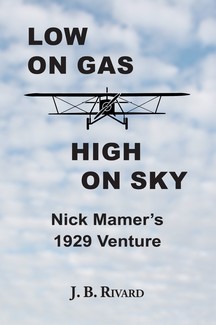
Before jet planes, even before widespread air travel, a biplane called the Sun God flew 6,200 miles—without landing. This book relates the exciting story of the 1929 flight that put Nick Mamer into the record books, proving nonstop flight to anywhere on earth realistic using air-to-air refueling. Finalist, 2 national book awards.
In the velvet black of night over Rock Springs, Wyoming, Nick Mamer aims his airplane at the glowing exhaust above him. Nudging stick and feathering throttle, he pulls ever closer to the plane overhead.
Out of the inky sky, a hose dangles. Inches below its flailing nozzle, the 31-year old Mamer tames the turbulence while artfully sustaining a precise spacing so his partner behind him can capture the hose. Art Walker signals ‘okay’ to the supply plane, and gasoline gushes into the tank of Mamer’s aircraft.
Without warning, Mamer’s propeller slices through the hose. Walker is drenched. A cloud of gasoline cloaks the plane. If a spark from the planes’ hot motors ignites the explosive mixture, planes and men will roast.
Mamer is attempting a world distance record by crisscrossing the American continent and back—without landing. It requires many aerial refuelings and thus many repeats of this dangerous waltz with a supply plane.
During the 6,200-mile-flight, the airmen survive this crisis, plus a fierce electrical storm, an unplanned refueling with 5-gallon creamery cans, treacherous passages through the Rockies, and more. Stress and near exhaustion during their five days aloft means only imaginative actions, extraordinary determination, and consummate flying skill will yield success.
Fame seeks the lone aviator—one who, isolated, flies higher, farther or faster. On an August day in 1929, Nick Mamer contrives a new geometry of fame. Low on Gas - High on Sky tells the true story of this unparalleled adventure. With exclusive access to the massive archives of the Mamer family, J.B. Rivard melds the gripping history of the flight of the Spokane Sun God with the vibrant life of the man who led it.
Excerpt
They’re flying west toward Kylertown. Everything outside is velvet black. The big motor up front churns with nine-cylinder vigor, allaying fear. But the pilots tug at their parachute straps.
In a split-second, a streak of jagged, cloud-to-cloud lightning reveals towering thunderheads—everywhere ahead. As low to the ground as he dares, Nick Mamer seeks a path between the bulges of vapor, as great rushes of rain blot his vision.
Close by, a bolt of white-hot lightning flashes. The sudden explosion of superheated air rocks the airplane sideways. Nick corrects. The two men are almost deafened by the roar.
Recalling that night over the Allegheny Mountains, Nick Mamer later writes, “...we encountered one of the severest electrical storms I have ever seen...” “We were ready to jump any minute.”
It all began when Nick Mamer, a thirty-one-year old aviator, considered the flight of four military men in a Fokker tri-motor named Question Mark. During the first week of January, 1929, that three-motored airplane took off at 7:26 a.m. and stayed aloft for more than six days over an airfield at Van Nuys, California. It was a major demonstration of aerial refueling, in which Question Mark was refueled in the air forty-three times by supply planes.
What intrigued Nick Mamer was the idea that refueling afforded an opportunity to extend the distance flown beyond what the on-board supply of gas allowed. With aerial refueling, an airplane could “reduce gasoline loads [and] increase payloads,” he said. In other words, he believed aerial refueling was a key to extending an airplane’s range.
To provide a demonstration, he, the Buhl Aircraft Company, Texaco, and the businessmen and citizens of Spokane, Washington, planned a flight across the U.S. continent and return, without landing. Specially-equipped airplanes with extra fuel would be stationed at locations along the flight path from which they could launch and refuel the long-range airplane’s tanks.
The idea seemed straightforward enough, and on August 15, 1929, the just-named airplane, the single-engined Spokane Sun God, with Nick Mamer piloting and Art Walker assisting, took off from Felts Field in Spokane, to attempt the transcontinental, non-stop, round trip.
|