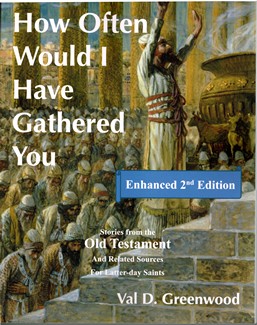
How Often Would I Have Gathered You
The stories in How Often Would I Have Gathered You are based primarily on the King James Version (KJV) of the Bible. And, insofar as it is possible to determine, they are arranged in chronolocial sequence, beginning with the Grand Council in Heaven and continuing down through the return of the Jews from their Babylonian captivity and their rebuilding of the temple and the city of Jerusalem. Some books of the Old Testament--notably the literary writings and the books of many of the prophets--are not included within the scope of these stories merely because those books contain no stories.
Most stories are quite short (with some notable exceptons, such as the stories relating to Job and Esther). In some cases, such as with the life of Samson, I took what could have been one very long story and created two or three shorter stories. Every effort has been made to keep the stories simple, straightforward, and free from fictionalizing and embellishment. I have also tried to tell each story as the scriptures tell it while, at the same time, eliminating redundancy, cumbersome (and sometimes sordid) details, and awkward wording. The idea was to make the stories simple without being simplistic.
Some people have suggested that How Often Would I Have Gathered You is another translation of the Old Testament. However, I assure you that such is not the case. A translation must go verse by verse and include everything--something that I have not done.
The stories employ dialogue as much as possible, striving to be faithful to the scriptural accounts. I have also attempted to use modern expressions rather than the cryptic language of the seventeenth-century KJV translators. The old-style pronouns (thee, thy, thou, and thine) as they relate to people are replaced with modern equivalents. Note, however, that I have retained the old-style pronouns (and have capitalized them) when they relate to Deity. I haved also retained the old-style verbs (wilt, shalt, canst, dost, goest, sayest, couldest, etc.) to match these pronouns when they relate to Deity.
After careful and agonizing deliberation, I made the choise not to capitalize the pronouns he, him, and his as they related to Deity. I made this decision early on when I discovered that trying to do was very confusing. No disrespect is intended.
The book has important additional features, including maps, two indexes (to names and subjects), and extensive footnotes to enhance the book's usefulness.
I hope you will be inspired by my book and that it will help you better understand the Old Testament and learn to love it.
The Old Testament: Understand it, Love it!