Category: Political Science Publisher: Tayen Lane
ISBN-10: 0996418431
Type: Non-Fiction
Pages: 358
Copyright: June 1, 2015
ISBN-13: 9780996418430
Price: $9.99 (eBook)
The unsustainability of the American economy is as familiar as the newscycle. There is no money for social programs, no money to run the government, no money to cut taxes, and above all, we have to cut, cut, cut. But, what if it's not true?
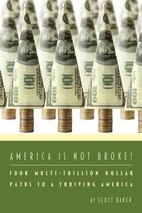
AMERICA IS NOT BROKE!
The unsustainability of the American economy is as familiar as the newscycle. There is no money for social programs, no money to run the government, no money to cut taxes, and above all, we have to cut, cut, cut. But, what if it's not true?
Instead of familiar complaints about the national debt, leading to just slicing a shrinking economic pie differently, or worse, to Austerity Economics, the reality is that we already have all the wealth we could ever need. The tried and proven proposals in America Is Not Broke would guarantee America's prosperity, fairness, democracy, and economic and ecological sustainability. Four multi-trillion dollar reforms: Sovereign Money, Georgism, Public Banking, and Ending Government Financial Asset Hoarding, plus a few other major reforms, show how we can have it all, if we only learn where to look.
Excerpt
"Now, simply producing debt-free money and putting people to work with it will only get you so far. Yes, it will bring down unemployment and create millions of jobs in public works, as it did in Franklin D. Roosevelt's time, only this time, without debt to the top 1% in the form of Economic Rent.168 However, to fully end the monopolies and speculation that lead to such vast wealth inequality in the first place, one must also tax the Land...
A major solution to excessive inequality and poverty, which will also improve productivity, stir innovation, and create a sustainable and eco-friendly economy, is the Land Value Tax. In a recent video by financial journalist Fred Harrison, Georgist economics professor Mason Gaffney calculates that $5.3 trillion currently collected in taxes at all levels could, if untaxed, be collected from economic rent instead. Professor Nicolaus Tideman, who also appears in that video, reports to me in an email that in his view the rent readily available through taxation is at least $1.5 trillion, compared to about $175 billion in rent collected today. Whatever the exact number of trillions, this untaxed rent could be taxed and returned to the public whose demand created it in the first place without damaging the economy, and in fact spurring it.
The basic problem is that a few monopolists own the Land, while charging the rest of us rent for our necessary use of it. Without Land, people cannot live. However, the value of it comes from our collective demand.
Professional Reviews
A stimulating tour of economic reform ideas and movements
Scott Baker's new book, America Is Not Broke!, focuses on 4 radical and (if fully implemented) multi-trillion dollar economic solutions. True sovereign money comes first. The others are public banking, ending government financial asset hoarding, and Land Tax Valuation (aka Georgism).
The perspective is that of a vigorous and broad economic activist, who has worked hard to promote all of the economic fronts he presents. Besides establishment opposition, Scott has run into most schools of thought in each area of economic reform, some of which are at odds with each other. Scott has either worked with and/or butted heads against each school, and his strong personal and intellectual encounters are naturally interesting and enlightening. As a result, Scott has produced a book that takes one on a tour of economic reform movements, full of diverse perspectives and studded with telling references to online resources that you won’t find in any other place, let alone spun into a single text.
Everybody interested in the human freedom of economic choices should ...
Everybody interested in the human freedom of economic choices should study the narratives and facts of this optimistic learning report; pages: 101-105 are the heart & brain of the publication message (on jobs and money) while pages 296-299 give 5 economic reform tools into our hands. America is not broke, if it will listen to the 'prophetic voice' of Scott Baker who does his job very well, i.e. pointing to the right direction of the future economic path (and not only for the US, but for the global economy). Very well done, Mr. Baker ! Stephen I. Ternyik; social science economist (-1985/Techno-Logos, Inc.).
Baker nails the Austerians
Baker’s book is both refreshing and enlightening in a world hooked on the toxic medicine of austerity. In the first part, he examines the effect of Congress using its legal authority to produce debt-free cash, as it did during the Civil War, to pay for infrastructure improvements. Such cash distributions would not be inflationary, because the increase in productivity would exceed the cash spent. In fact he cites several studies that show how even Social Security payments, which are not direct payments for productive labor, still increase productivity by 1.8 to 2.0 times. This is due to demand-driven economic expansion, what I like to call bubble-up economics.
Baker describes our current fractional reserve banking system, where money is not created by Congress, but rather anytime a bank makes a loan. Few people realize that except for coins, our entire monetary system is controlled by the banks, not government.
In the second section, Baker talks about Georgism, and the land value tax. This is the tax Milton Friedman called “the least bad tax” since it does not interfere with productivity, and land won’t go away if it is taxed. He quotes Mason Gaffney, a leading Georgist, who has calculated that, the $5.6 trillion currently collected in taxes at all levels could be raised from a land value tax. That is $1.6 trillion higher than my own calculations, but included is the interesting taxation of such monopoly resources as time-slots at airline gates. Baker goes on to say, “Whatever the exact number of trillions, this untaxed rent could be taxed and returned to the public whose demand created it in the first place without damaging the economy, and in fact spurring it on.” That is the crux of Georgism, that land value is created by the community and should be returned to the community, and Baker gives a nice introduction to the ideas.
Another interesting “land” tax is one on monopolies in virtual space, huge internet sites like Facebook or Google. I would agree that sites should be taxed in proportion to the bandwidth used. Facebook value is created by the social networking community, just as physical world land value is created by the community. However, Baker’s argument that virtual land is time-constrained, that the site should pay a tax for the time I spend on the site, as opposed to just the bandwidth I utilize, strikes me as unfair and non-Georgist.
Baker succinctly expresses a concept that I have been trying to put into simple words for some time on the exploitation of natural resources, particularly in third world countries. “Whenever labor needed to develop land is the least, the human suffering will be the most.” This harkens to the Georgist concept of wealth creation being a product of labor acting on land. Baker further enlightens by expressing a correlation between the degree of wealth and the degree of labor.
Due to the power of the Chinese Communist Party in shaping the Chinese economy, along with their newfound fondness for free markets, some Georgists, me included, have hoped China would follow the path of Sun Yat-Sen and be the proving ground for a land value tax. Baker includes compelling letters from associates sent to the Chinese leadership. These are more than ordinary letters, in as much as they were accompanied by high-level meetings with Chinese officials.
Baker’s discussion of “The new neo-slavery” is a compelling account of the violence caused by Reaganomics and all that followed. Requiring “volunteered” servitude for $2.50/hour to receive public assistance is nothing short of codified slavery, and a great hardship to the public service organizations that must accommodate these “volunteers”. Massive denial of public assistance and massive fraud are the two logical outcomes. Baker calls for a minimum living wage or a Basic Income Guarantee, but to me those two are in different leagues. Raising the minimum wage will end up increasing land rents, while a BIG, paid for from land rents and/or the debt-free cash Baker eloquently describes, will truly end poverty.
Baker ends the book with some technical essays on how much assets cities and states have on their books, even when they claim to be broke. Actuarial data is manipulated to increase required return and assets are considered untouchable in determining return. Thus low interest rates like we have now make all returns inadequate even though there are billions on the books.
The book is a good introduction to monetary theory and Georgism. I strongly recommend it.
From the land of the milked and honeyed here’s a few political faux pas and a bit of attitude exposed to the harsh light of a Canadian who actually has their own opinion.