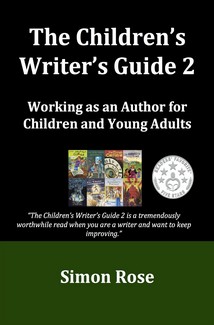
This book further explores the writing process, examining topics such as developing memorable characters, creating effective dialogue, the importance of book covers, the value of blogging, age levels and appropriate content for books for children and young adults, networking, and the process of submitting your work to publishing houses.
The Children’s Writer’s Guide 2 is ideal for writers not just of books for children and young adults, but also features information that’s applicable to writers in all genres. The first installment of The Children’s Writer’s Guide has a wealth of tips and advice, including suggestions regarding how to get started as a writer, dealing with writer's block, conducting research, choosing appropriate names for your characters, the editing and revision process, as well as the world of marketing and promotion.
This second book further explores the writing process, examining topics such as developing memorable characters, creating effective dialogue, the importance of book covers, the value of blogging, age levels and appropriate content for books for children and young adults, networking, and the process of submitting your work to publishing houses.
In combination with The Children’s Writer’s Guide, this second book provides invaluable advice and support for both established and aspiring authors of books for children and young adults.
Excerpt
Chapter One: Writing What You Know
In terms of writing and publishing trends, even though the height of the Harry Potter phenomenon is now long gone, there doesn’t seem to be any shortage of books with similar fantasy themes. I’m in bookstores in Calgary conducting signings on a regular basis and a large percentage of the books that children and young adults seem to enjoy are in the fantasy genre. These stories don’t always involve wizards and dragons and that kind of thing but magic is usually part of the story. This appears to be an ongoing trend although vampires, elves, and zombies seem to be less popular than they used to be. Steampunk mostly appears in adult novels but there have been books published in this genre for teens and YA in recent years. The paranormal is also quite popular these days, but how long that trend lasts is unknown, of course.
As an author it’s really up to you what you decide to write about, but I always find it’s best to write about what you know or at least about something that you’re interested in. It’s much harder to write a novel to satisfy a current trend if you dislike or are uninterested in the topic or genre. For example, my own books cover such areas as fantasy, science fiction, the paranormal, time travel, superheroes, parallel universes, alternate realities, historical fiction, and a few other themes. These are the things I’m interested in writing about so that makes it easier to develop the story ideas but also to actually create the novels.
I do write lots of nonfiction books on topics that may not always be my favourites and which involve considerable research but that’s a little different, more like writing magazine articles or being a business writer or journalist. I probably wouldn’t write a book about fishing, sailing, mountain climbing, farming, most sports, horses, and several other topics, although these things might crop up in a book as part of the plot. I prefer to stick with what interests and inspires me, which makes the writing process much more enjoyable.
I should clarify that this doesn’t mean that you have to pigeonhole yourself. If you come from a small town does that mean you can never write about life in a big city? If you live on a farm in a rural area, can you never compose a gritty crime drama set in New York? You should always strive to stretch yourself creatively. Everyone develops as a writer as they work on their stories and most writers usually become more proficient at their craft as they continue to create new work.
Writing what you know refers to what interests or intrigues you rather than what you’re qualified to do. As I mentioned, my nonfiction work has often been on topics with which I’m less familiar and involved considerable research, similar to that conducted by journalists when completing an article for a magazine or an online publication. Yet research also has to be completed for most books that aren’t merely very simple stories, even if it only involves creating a plausible character by studying someone’s profession, the type of clothing they might wear, or their general outlook on life.
Some people become slightly confused by the idea of writing what you know, particularly in the science fiction and fantasy genre. After all, these types of stories are fantastical and no one has ever really done the things that are mentioned in the story, such as traveling in time or experiencing a journey into another dimension and so on. If this doesn’t interest you then the writing will seem a lot more like work. It should be a fun experience although obviously there is work involved in the editing and revision process, the research, and when you get stuck on a plot point or when you’re trying to flesh out a character or a scene.
You could also take the route of writing what’s trending at the moment in an attempt to create something popular. This doesn’t mean that you should copy something else that’s been successful but you might decide to emulate another author by writing about witches or wizards, vampire lovers, a dystopian universe, or something else that’s been a talking point in the last few years. Yet if you’re not interested in the topic it will be more of a struggle unless you can really turn your hand to anything and it’s always possible that your lack of enthusiasm will be evident when people read the finished product. You might be able to conceal this to some degree by employing a good editor but you probably won’t enjoy the creative process. You’d probably also write a book about a subject that you love far more quickly and effectively, which might even encourage you to do even more writing. Most genre writers seem to stay in a particular genre although a few might diverge into different areas and this is usually for a reason. They write what they know and what they’re comfortable with and even if they do try something new for a change, it’s usually
Professional Reviews
Readers' Favorite
"The Children's Writer's Guide 2 by Simon Rose is a writing/publishing book and is part of a series. It is a succinct and short guide. Simon Rose writes about writing while being a well-established and recognized author, which means that his advice and remarks are all relevant, sound and directly usable by would-be authors. However, some of the chapters are bound to be useful to authors in their own right too. They range from blogging to improving one’s trade in any way possible. Each chapter in Simon Rose’s book encourages writers in an engaging fashion to be better writers. Indeed, Simon often refers to his own wide experience and provides extremely valuable examples of what to do or not to do!
The Children's Writer's Guide 2 by Simon Rose is a tremendously worthwhile read when you are a writer and want to keep improving, as I am. (Yes… I read the part about adverbs and adjectives, even if I use too many in this review!) This book is truly inspiring, probably because it tackles such topics as inspiration, creativity, developing as a writer, fleshing out characters or scenes, the creative process, plot, everything a writer ought to think about really ranging from the initial stages of the story to synopsis writing, the book cover, tenses… in a straightforward fashion. I have been writing for years and am a literature teacher, but this book gave me valuable ideas such as writing a study guide for my books, for instance.
Thank you so much! That is why I highly recommend this book!"
Amazon
"Rose’s second Children’s Writer’s Guide provides tips and examples of how to make writing more, interesting, effective and age appropriate – while ensuring that you continue to enjoy the whole experience. In this edition, he provides a guideline to help you align an appropriate word count for books aimed at different age groups along with ideas of how to work with sensitive topics (i.e.: swearing, violence) when writing for different audiences.
As Rose points out, one of the critical success factors in writing a successful novel is to create the right balance between narrative and dialogue, all while keeping the characters realistic and lively. Tips on what to avoid when writing dialogue and how to communicate effectively with multiple characters are provided. Of course, your customers first have to want to pick the book up so that you can draw them in - an effective book cover will increase interest and entice readers. Rose provides ideas on how to help you achieve this.
But what do you do when you are finished your manuscript? Today’s world of technology provides you with tools and options to self- publish, or you can pursue the more traditional publishing house path. Rose provides an explanation of each and guides you through the process. Many examples are provided. Finally, Rose reminds us that it is up the writer to define his or her professional reputation – he openly shares his thoughts on this, allowing you to benefit from his personal experience.
Overall, this book offers tremendous insight into how you can create interesting and captivating stories for different age groups, and what you need to do to move towards publication. It’s a great book to get you on the path to becoming published and engaged with others in the industry."
Ashley Howland
"This is the second writer’s guide by Simon Rose. It’s an informative read. Simon uses his own books as examples throughout this guide and gives some great advice for aspiring writers. This installment discusses appropriate word counts, how to address issues like language (swearing), your book cover, marketing and lots more.
The Children’s Writer’s Guide 2 offers some good advice that would enable any writer to improve their craft. It’s certainly worth looking at if you want to write books for children. Simon Rose is a very experienced writer, with a wealth of knowledge. The answers to your writing questions may just lie in this book. Check it out!"
Through insightful and thought-provoking writing, the author encourages readers to embark on a journey of self-reflection, guiding them to access inner wisdom and cultivate a mindset conducive to a better understanding of our world.
Do you want a Godly marriage?
Here is a guide for couples to be able to get their marriages on track with God's will and keep it there. This is accomplished by looking at every aspect of the marriage relationship and showing by using numero