Kindle Edition
Amazon
Category:
Essays
Publisher: Ansar Books
ISBN-10: 1515116352
Type: Non-Fiction
Pages: 236
Copyright: July 20, 2015
ISBN-13: 9781515116356
Price: $8.95 (eBook)
Traditional essays on a variety of everyday topics such as love, trust, silence, death, nature.
This collection of traditional essays explores the meaning of the human condition as we live in today’s post-modern world. The ten essays explore such commonplace ideas as trust, love, time, silence, death. We take these words for granted without really ever coming to terms with their true meaning and import into our lives. What does the idea of trust, love, and silence really mean and how do we apply these terms to our lives in a manner than is meaningful and significant. In the first Chapter on Trust, the author writes: “Locked within the experience of the world there lies the secret of some final emotion that begins to emerge every time we reach beyond ourselves and experience the world in all its true reality, through the intelligence of the mind and the love of the heart.”
Excerpt
Preface
The Mystery of the Human Condition
People travel to wonder at the height of mountains, at the huge waves of the sea, at the long courses of rivers, at the vast compass of the ocean, at the circular motion of the stars; and they pass by themselves without wondering. (St. Augustine)
The collection of traditional essays gathered within this small volume all have one primary motive in common, namely exploring in words the wild and whimsical wonder of imagining, dreaming, remembering, and reflecting upon ourselves and our lives within the mystery that we commonly refer to as the human condition. In today’s modern, frantic, and fast-moving world, with the ever-changing technologies beckoning at our doorstep and with a limitless array of gadgets and electronic devices at our disposal to draw us into virtual worlds that can be manipulated with our fingertips and thrill us with their addictive delights, we have little time for self reflection, much less additional room in our lives to speculate on the true nature of ourselves within the human condition we identify with and represent. We have some idea of our capacity to wonder; but it sleeps within us like a seed in winter. As a result, we live our lives as if we have no true understanding of the mysteries and miracles that are scattered across the universe like pebbles on the shore of some vast ocean whose sacred presence surrounds us every day of our lives.
As St. Augustine wrote in his Confessions over 1500 years ago, in exploring everything from the height of the mountains to the depth of the sea, we probe the universe for black holes and parallel universes and dig deep down into the world of invisible particles that we “see” through rarified machines in order to sort out the quantum mechanics that govern the physical universe, without wondering who we really are and what we need to accomplish in the life that is given us. The best minds working in modern science today are in search of a unified theory of knowledge that would bring together the Newtonian theory of gravity and motion with the quantum world of physics and Einstein’s theory of general relativity. Yet, for all of our scientific discoveries and technological advances, our humanity is slipping through our fingers like desert sand. We still have no idea what forms the deep well of the human mind, the mirror of human consciousness, the paradox of free will, the forces (and implications) of individual destiny, the miracle of love, the mystery of death, and the elusive shadow of time moving us toward a destiny we are not sure we have the courage to meet with dignity and presence of mind. As St. Augustine suggests with insight, we pass ourselves by “without wondering”.
The goal is to see God everywhere and in seeing, to remember the Divinity and to have faith. Climb a tree and feel its good tidings. Put your feet into the river and feel the strength of its current. Look to the heavens and see reflected in the night sky the city of God. Allow the peace of Nature and its sublime tranquility to flow into you as sunshine flows through trees and moonlight reflects across the waters. There is an ancient message that lies in waiting in every created object within nature; with knowledge that answers every question, cures every illness, and solves every problem that we encounter along the way. This ancient vision lies within us if only we could open the inner eye to behold and witness it. We need to understand that the symbols of nature are a part of us and that we are a part of them, that nothing is disconnected and that the sense of interconnectedness is the product of an ancient mode of being that finds its origin within the “unmoved Center” that, radiating outward, is the “ancestor from which all things come.”
One question worth asking, and worth writing about as well, is this: How do we make the unseen mystery that surrounds us a living reality as well as a message of transcendence with the power to transform our lives in this world? When our time has come and we have to take leave of all that we value and hold dear, what we have taken for granted and used to shape our lives as a sincere premonition and as a natural sympathy will be recognized as an overwhelming reality where we feel at home. In coming to realize that “you can’t take it with you”, you end up acknowledging the fact that the world of the spirit, the world of dreams and the world of higher consciousness are actually second nature to us and serve as sources of intuition and instinct about our true purpose on earth, revealing knowledge when we need to know something and providing guidance when we are not sure how to act or what decision to take. We have a rare capacity within us to perceive and appreciate the unseen quality that lies at the heart of this world and is reflected within the universal heart of nature as a premonition of a higher reality.
The sacred journey inward in pursuit of a practical spirituality, which reflects outwardly as the primary motivation of our lives, commences with the human confrontation with the mystery of the Unseen Reality. As point of departure on a voyage that will never end, the idea of mystery commences the ascending journey through the byways of this world in search of an essence that will resolve the questions that, though often not consciously articulated, lay sequestered deep within human consciousness. The greatest of life’s challenges is to lift the veil that separates the manifested world of forms from the unseen world of the spirit, in order to have a conscious experience of higher levels of perception about the true nature of Reality. Embedded within the external world of forms lies a passageway to the internal world of spirituality, which, when experienced, comes alive and breathes spirit and life within human consciousness. To give oneself up to this ancient presence is to begin the process of transcending human limitations; to seek answers to the universal enigma we are confronted with in life is to set the heart on fire with the vision of the Spirit of God as the Origin, Source, Center, and End of all spirituality.
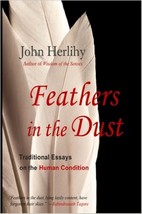
Our title, Feathers in the Dust, is taken from a line of poetry written by Rabindranath Tagore (1861–1941), the Bengali writer, poet, and philosopher who was the first non-European Nobel laureate to win the Nobel Prize in 1913. In one of his poems, he makes reference to a symbolic image that strikes at the heart of the modern-day dilemma. “Feathers in the dust, lying lazily content, have forgotten their skies.” The image of bird feathers—exquisite and unique—that have not only fallen to the ground, disconnected from the source of their wonder, but also having forgotten their skies in the illusion of their contentment, captures perfectly the true nature of the human condition, particularly during these progressive, secular, materialistic, science-driven, and technologically-enlightened times. The plumage of birds has traditional symbolic value that can be found in many varied conventions down through history in terms of its utilitarian, cultural, and even spiritual value by virtue of the religious uses that feathers have been employed for. But nothing is as simple and poignant as the image of a feather lying in the dust, bereft of the purpose and meaning for which it was created.
We all know that feathers, because of their thermal capacity for trapping heat, not to mention their comfort value, are used as stuffing in quality bedding, including pillows, blankets, duvets, and even mattresses. Bird feathers have long been used in the production of arrows and darts because of their capacity for aerodynamic stabilization. Colorful feathers such as those belonging to pheasants have often been used to decorate fishing lures because of their unique capacity to attract fish. The feathers of large birds, most often geese, with swan feathers being considered premium, have been used to make quill pens down through history from the 6th to the 19th centuries, before the arrival of the first metal pens patented in America in 1810. The word pen itself is derived from the Latin word penna which means feather. In French, not surprisingly, plume means both feather and by extension pen. In addition, feathers have had great cultural and spiritual value for American Indians whose use of the single feather attached to a headband, or the great feathered headdresses of the Red Indian chiefs, represented headgear of great distinction and nobility. Therefore, the image of feathers lying in the dust is a truly distinctive one that may well serve as a spiritual reminder of what we have lost and what we may yet regain.
Perhaps the symbolic image of humanity as rarefied feathers of great utilitarian, cultural and spiritual value is a suitable one in today’s era of indifference and neglect. Consider the profile of modern humanity. Are we merely feathers in the dust and blown by every wind, having surrendered the beatitude of levitation that allows the birds of paradise to soar on high in defiance to the laws of gravity? Have we forgotten “our skies” and fallen down to the ground, not in desperation of the loss we have suffered; but to lie content with our own perceptions, bereft of the freedom and spirit that characterizes the mystery of the bird in flight as it flies through the air defying the laws of gravity? The image recalls the Qur’anic verse that captures the image of humanity created “in the best of forms” by the Creator, before being cast down as the “lowest of the low” (95:4) by virtue of the disastrous fall from Paradise.
Are we gazing up at the stars waiting for salvation with a patience that is infinite, while the moon emerges from behind a cloud to enlighten every leaf and blade of grass with its pale reflected light? We can fall no lower and we can blind our eyes no further, if we give up our faith in the higher realities and forget the forms of spirituality available to us that will open our consciousness to higher dimensions of spiritual experience. The vast blue of the heavens continues to beckon us with its mystery and its infinitude in spite of our faithlessness and forgetfulness. We have nothing to lose by pursuing the life of spirituality that is still available to us as a merciful compensation to the human condition, and everything to gain in coming to realize that our true destiny as spiritual entities lies in our capacity to soar on high, lifted off the ground once again and given feathered wings, by the experience of the Divinity that lies as a sacred presence within the heart of humanity.
In reflecting upon certain key concepts that we live with every day without fully understanding them, we have written the ten essays contained within this volume because they touch upon universal questions that lie at the heart of the human condition in search of answers. In a word, they explore the significance of a variety of key, noble themes, including the sacred trust, the in-depth psychology of human identity, the sound of silence, divine love, the finality of death and the shadow of time, not to forget to mention “the forgotten spirituality” that lies as a sub-text within each of the essays.
Written in light of the traditional perspective that understands a core spirituality to exists within all the religious traditions, we explore the meaning of the sacred trust that exists between the Divine and the human from time immemorial, the sacred psychology of humanity and its accompanying spiritual identity, the beauty of words and their ability to articulate, through forms of communication, art, and worship, what lies in the innermost mind, the power and eerie majesty of silence that according to the 19th century American essayist Ralph Waldo Emerson come from a “heavenly mind” that contains “a thousand silences”, the elusive quality of love as the first and final emotion, the symbolism of weaving and its significance in creating a tapestry of life that is woven into the very fabric of humanity and the world, the possibility that the spectre of death can serve as a source of remembrance for “the one thing needful”, and finally the continuum of time, whose moving shadow follows us all the days of our lives.
When we contemplate the meaning and significance of life, we usually do so in the broadest possible terms. We think of existence as a rope thrown down haphazardly onto the ground of our destiny, twisting and turning into a half-formed question mark before being swallowed into the final endpoint like the drop of an afterthought. We think of life as a flatland prairie that becomes hills and valleys creating the varied topography of a complicated and moody life, even if we secretly find ourselves groping in the dark most of the time, without a clear understanding of life’s purpose or consequence. We envision life as a long-awaited journey toward an exotic destination, at least in our dreams, or we see life as an epic book full of adventure and mystery, with a beginning, middle, and ending. And we know that our life runs its own course, that we die and leave it all behind, including the infamous question: What happened that we no longer know or care?
In whatever way we might envision life’s progression through time, it is a truism that most of us do not have a clear grip on the answers to the universal questions that our lives confront us with, and we are faced with a number of mysteries that need to be put into context and come to terms with, in order to successfully meet the demands of our destiny. Perhaps a more accurate symbol for life’s true character and quality lies in the image of a patchwork quilt, our lives being sewn together from the fragments of our days with the colored threads of white and black and gold that eventually form the pattern and texture of our experiences, interweaving a mesh of varied events that bring together into a unified whole the various seasons of our lives and the hidden message the changing seasons contain.
There is compelling forward movement to infancy, childhood, adolescence, adulthood, and finally old age that complements the totality of life’s progressive continuum; that much we know for sure and cannot deny. The old metronome of time beats its way through our lives like a second heart and eventually brings with it feelings of inevitability and loss, the inevitability of death and the loss of all that we have accumulated and all that we have achieved in life. What happens to us beyond the grave is as mysterious and elusive as what may have happened to us before we were born, amounting to an eternal darkness that illuminates the world with its midnight sun and an eternal dance that will never stop until we are drawn back into that unity of Spirit and Truth that binds all things together into a single Reality.
It is as if we have been thrust down into the envelope of earthly life and the human condition between two eternities that find their ground in the hope and aspiration of terrestrial earthlings such as ourselves who wish to pass beyond the horizon of “this world” into the beatitude and promise of an alternative world that may bear resemblance to what we experience in the here and now, but that in turning itself inside out, this alternative world will exhibit the reality of the Spirit for what it truly is, namely the one God and the one true Friend. Is it luck, chance, or destiny that takes us by the hand beyond the horizon of the known world? When we come near the end of our time here on earth, will the rusty hinge of our mind remember the door it once held wide open to the approaching future of our lives?
Similarly, in addition to the obvious mysteries that we are confronted with, there are other lesser known riddles about our lives that do not make sense at first blush. We are impressed with the certitude of the physical world. We hit our head against the wall or put a finger to the fire and we feel the physical reaction with a poignancy that cannot be denied. But what do we really think about that which may exist beyond the purely physical plane of existence? Who can forget Prospero’s casual remark that “we are such stuff that dreams are made on; and our little life is rounded with a sleep.” Are we nothing more than the imaginings of a sleepy head on a feather pillow? In more traditional times, the religions reminded people that there was an alternative world that lies fused within the physical order, a timeless world that will outlast anything we could ever imagine here on earth on our own, to the extent that Shakespeare added in a further refrain that all the actors on the stage of life are nothing but spirits, in his words “all spirits, and are melted into air, into thin air.”
Let our dreams of a forgotten spirituality become once again a living reality, something that we can call our own because we have lived and experienced them in the waking hours of our lives. Let us dream once again of forgotten promises and abandoned hopes, so that in awakening, we are not surprised to recognize the Reality for what it truly is. The essays in this volume are like first steps on the journey of return, baby steps if you will, that when taken with conviction and pursued with determination will lead to a passageway beyond the stars in the firmament that we witness every night “without wondering”.
I’ll keep silence from now on;
For in my silence, truth and error separate,
Just like wheat from chaff.
(Rumi)
|