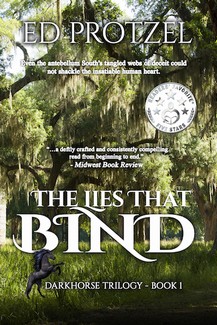
The Lies That Bind: DarkHorse Trilogy, Book 1. Long-buried secrets in a Mississippi hamlet dominated by a reclusive widow are uncovered when a scheming drifter returns and, with the help of a dozen fugitive slaves, builds a competing plantation.
Broke and despondent, trickster Durksen Hurst returns to Mississippi seeking redemption for his disreputable past — and maybe some glory. When he encounters a dozen hungry slaves hiding in the wilds, he persuades them to build a plantation with him — a scheme that will threaten the town’s dominant family: the brilliant, mad Widow French and her tortured son, Devereau.
When Antoinette DuVallier, a mysterious woman from New Orleans with unknown ties to the Frenches, arrives desperately seeking her missing boy, long-buried secrets are exposed that tear asunder the once-sleepy hamlet.
As the tangled webs of deceit unravel, each startling revelation shines a fresh light on what it means to be a man or a woman, free or enslaved — indeed, on what it means to be human.
Excerpt
Chapter One
1859, Turkle, Mississippi
The setting sun recoiled from the shadows descending upon the Mississippi swamp. Glancing desperately over his shoulder, Durksen Hurst urged his roan mare on through a foreboding stand of weeping willow draped with Spanish moss. Nearby, a barred owl cried out and flapped away, its wings echoing through silent slough and backwash, through tangled vine and creeper. Day creatures slunk to hidden dens; hungry night creatures began their prowl.
If the mob chasing Hurst captured him in this desolate place, the fact that he was innocent would do him no good. His former friends and business partners might be convinced to give him a hearing. But they’d been joined by a host of ragged scum with no stake in the outcome, whose sole purpose was to humiliate him in the most savage manner their twisted imaginations could devise, to gloat and taunt him as he writhed and cried out in his death throes.
In the pervading dusk, Hurst drew rein to give the roan a badly needed blow. After three days of ramshackle escape, Hurst’s Memphis-bought suit was now mud-splattered and torn, his body and mind past exhaustion. He took a deep breath in the chill evening, trying to relax away the painful knot his scrambling flight had worried into his empty stomach. When he exhaled, a cloud hung in the air like lazy fog over the nearby bayou.
I must sleep.
By a sympathetic stretch of a lonely woman’s imagination, Durksen Hurst could be considered handsome. Forty years old, hungry slim, and of above average height, he had a square jaw, a strong face. Yet the feeling that he was different was always with him. Part Seminole on his mother’s side, he had her high cheekbones, thick black hair, and brown, sparkling eyes. Looking neither Indian nor white, his quick glances often caught people staring at him, trying to figure out “what” he was. Even the Chickasaws who raised him from the age of ten never fully accepted him. No matter how hard he tried to act like the locals in any given town across the South, he always had to overcome people’s sense that he was foreign, as if there was some disharmonious odor about him.
He dismounted, noting the twisted lay of nearby swamp. A Tupelo gum tree, hollowed out by termites, obscured an elevated patch of dry land just ahead of the dead end where he stood. To Hurst, the thought of a clear spot of grass-covered earth promised more comfort than a boarding house pillow.
Must sleep.
He led the roan through ankle-deep water onto solid ground. Continuing on, he passed a fallen black gum, not stopping until he and the roan were concealed in the dappled shadows of a mature cypress.
Sleep.
He paused to listen. In the distance, over two hundred yards away, his trained ear detected urgent shouts. Horses and mules crashed through the brier and scrub behind him and up ahead; he was surrounded. His only hope was that his pursuers would not accidentally stumble upon him.
Two hours earlier he’d plunged into this familiar stretch of Chickasaw wilderness like a fish diving for safety into deep waters. Night, and the Indian Territory could—again—provide refuge. There might even be old acquaintances at the Chickasaw village a few miles further south who still remembered him. If he made it that far.
Sleep. Must.
***
“He on foot now. Over by the big cypress, straight ahead,” a frantic, wilds-wise Isaac whispered, shrinking back into the shadows where the eleven other black faces crouched among the foliage, fear suffocating them like quicksand.
“What we gonna do?” Bammer whispered.
“We gots to bury him in the swamp,” Isaac said, “befo’ he turn us in for that reward money they give for ‘scaped slaves.”
“Bury him... You mean, kill a white man?” Long Lou asked, horrified.
“W-we ain’t gonna do nothing of the sort,” Big Josh said authoritatively, his natural stutter becoming pronounced. “Ain’t we already in it b-bad enough?”
“Maybe we should turn ourself over to him and get us out of this swamp, away from that killer Chickasaw, anyhow,” Little Turby suggested.
“And get ourself hung?” Long Lou objected. There were many grunts of approval for that sentiment.
“Sh-h-h,” ragged Isaac cautioned. He put a hand to his ear, listening hard. “They’s more comin’! All over the swamp, ahead, behind, on all sides.
Must be chasin’ the man.”
“Wh-where can we hide?” Big Josh asked, hot blood rising in his ears. He turned to Isaac for the answer, but Isaac had already disappeared into the tangle.
“He gone,” Bammer said. “Nobody gonna see that swamp rat till he want.”
“Then w-we on our own,” Big Josh concluded. “Just hide down all night. Lay over in that brush yonder. And be quiet. We s-see what we do in the morning, if we ain’t caught tonight.”
***
By chance or fate, Hurst knew he was just a half day’s ride from Turkle, Mississippi, and too weary to resist its pull. A patchwork of frame houses, white-columned mansions, and outlying cropper shacks, the town rose like a specter in his mind, fearsome yet somehow comforting. Of all the forgotten places he’d run across, this crossroad hamlet was the only one with a name, the last place he’d had any semblance of a family. The place from which, as a ten-year-old boy, he had sought refuge in these very woods, enabling him to evade another deadly mob, its appetite whetted by Hurst blood on its hands.
In a moment of fatigued clarity, it seemed to Hurst that since the day he’d left the kindly Chickasaw tribe, a budding man seeking to begin his random travels, he’d been unconsciously circling Turkle in an ever-decreasing arc, like an insect being pulled into a swirling whirlpool.
Sleep…
All at once, Hurst was overwhelmed by a profound sense of loss. Old enough to be wiser and still hitching his hopes to another threadbare illusion. Now he had fallen into the pit where all his sky-high dreams and clever plans, his fine-figuring and fast-talking inevitably left him—broke, desperate, and alone.
He’d called his latest scheme Everybody’s Company, and it was his best yet. With an agreement signed by the county bank to lean on, he’d gathered enough petty investors to make small loans to hard-pressed farmers, even to wives and widows. With a few dollars in their hands, ordinary people could start a little business or replace a broken farm implement and prosper. And it was working better than anyone had imagined—even him! He had come to believe Everybody’s Company would spell the end of his vagabond existence, of his decades-long chain of overly ambitious busts. Everybody’s Company would help dirt-poor families condemned to breaking bad soil throughout the South. And make him rich.
Or maybe not. He’d been wrong before, carried away by his wild imagination and overweening vanity.
A bitter lump formed in Hurst’s throat as he thought of the folks who’d put their trust in him. These people did kindnesses for me. Had me to supper.
It was so unfair, and utterly irrevocable. She had their money—and his, too. The raw young woman he’d partnered with, so tender in the night, had stolen their company money and was undoubtedly halfway to Texas, the standard destination for thieves and cutthroats. He chided himself for being too trusting again.
An ugly, fat cottonmouth slithered through a water-filled ditch, causing the nervous roan to spook and back away wild-eyed. Too spent to chase the animal, Hurst jammed a boot onto the exposed roots of a fallen swamp ash, resisting the tug from the rein with all his strength, while speaking soothingly to the panicked beast. The rawhide burned his palms, but he held on, pulling and twisting. The animal was powerful in its panic, but he couldn’t let go. Finally the roan settled, leaving Hurst’s hands stinging and bleeding.
Hurst clenched and unclenched his fists trying to get feeling back in them. It irked him that his survival was dependent on a beast moodier than a circuit preacher’s wife. These he knew well; he’d shared hurried grappling in the weeds back of churches and Chautauqua tents with more than one, unbeknownst to their fire-eyed spouses saving souls inside.
Finally.
He tied the roan where she could nibble the sparse grass. Then he spread his blanket on a mound and fell face first into the soothing aroma of fecund earth.
***
As the rising sun peeked above the mist and trees, something struck the sole of Hurst’s boot, startling him awake. He resisted the intrusion, mumbling a protest, but no matter which way he rolled, the irritating blows kept coming. Then he remembered his predicament and attempted to wake up. Glancing through the haze of slumber, trying to focus, he saw what appeared to be a great bear hovering above him. Heart racing, Hurst scrambled back, scuttling crablike on elbows and heels to get away from the creature.
“Wh-what you d-doing here?” the figure stuttered.
Hurst rubbed his eyes. Standing there was a mountain of a black man. Hurst appraised the ebony Goliath, a man with arms as big around as tree trunks, a broad chest and shoulders to match. He looked capable of lifting a wagon. The man’s clothes were shabby, like a field hand’s, creek-clean, but in bad need of repair.
The man, who appeared to be in his late forties, glared at Hurst, face muscles set in warning, but the pose couldn’t hide the natural smile lines around his eyes.
Hurst caught his breath. He had slept at the edge of a stand of pine, through which he could see a wide, gently sloping clearing beyond. Not fifty yards down the hill, beside a creek, there sat more than a half-dozen skillfully-built, roughewn lean-tos, of saplings and wire. The setup was too solid for a mere encampment and not of Chickasaw design. This giant was not alone.
An eerie quiet descended, as Hurst sensed eyes upon him. He had a pistol hanging from the roan’s pommel, unloaded, but when he located the animal it was grazing twenty yards away. Clearly, any thought of a bluff would be useless against the number of men needed to occupy a camp this large. Besides, Hurst didn’t believe in threatening strangers, especially with an empty weapon. It was bad for business—and could be fatal. He rose shakily to his feet.
Time to make the situation a common one. “I’m Durksen Hurst, Durk,” he said in his friendliest manner, offering his hand and doing his best to conceal the fear gripping him.
The big man merely studied Hurst. He noted the interloper’s suit was a poor imitation of their late master’s go-to-gathering duds, wrinkled, mucked up, and worn, as if he’d been traveling hard, and fast. His hollow face told the whole story.
“Th-they calls me B-big Josh,” the man said.
Hurst appraised him, head to foot. The man had simple looks, and his tongue stumbled. Add in black skin, and a hasty person might brand him a fool.
But Hurst could sense the man was accustomed to giving orders, not taking them. Like he was a plantation field boss or a steamboat gang boss.
“How many of you are there?” Hurst asked. “Six? Nine? A dozen?” Big Josh refused to answer. “What are you folks doing on Chickasaw land?”
“Ain’t none of your b-business,” Big Josh replied, unaware that he'd made a fist.
Without warning, a skinny, ragged black man strutted from the pines to confront Hurst. The wild-eyed scarecrow wore a patchwork of rough-cut animal pelts, which hung in layers over a shirt many sizes too large. His hair dangled in long, unkempt flows. Likely a swamp fugitive, Hurst concluded.
“What you want here, white folks?” the wild man challenged.
Hurst could hear voices chattering in the surrounding woods, as if the man’s bravado had broken a spell of silence.
“This h-here’s Isaac,” Big Josh said, still watchful.
“Durk Hurst, Isaac,” Hurst smiled, hand extended. “Some folks call me ‘Dark Horse.’ A while back the Chickasaws got their American mixed up, and it stuck.”
While he waited for the handshake that never came, ten more men brandishing farm tools filtered in from the brush and wordlessly surrounded him. A shovel on the back of the head was all it would take. Everyone knew it. He looked from face to face, but everyone was inscrutable, Sphinx-like.
He was relieved to see the ten were clothed like Big Josh, indicating they, too, were displaced field hands. Hurst figured Isaac must be a local runaway living in the woods who hitched on with the rest; meaning the rest came a distance to be there.
He wanted to ask, where’s the white man with you? But he saw the fearful looks they gave each other, the questioning glances toward Big Josh, the desperate way they gripped their tools. They had no white man to cover for them!
That explained their terror; there were rewards for turning in free-booting slaves. If he reported them, they faced beatings—or worse. Unfortunately, they might believe it’s their life against his.
Escape would require delicacy and patience. Hurst couldn’t let on that he had deduced their predicament, but he was burning to know how they’d become trapped here, and he was never a man to control his curiosity.
“Y’all ain’t staying on this dusty rock, are you?” he asked. No one replied. “A hidden field is fine to grow corn for squeezings. Maybe even feed Isaac here. But as many as you got, you’ll starve.”
Suddenly, Hurst was gripped by a vision. As had happened with his most profitable—and his most disastrous—schemes, an entire plan, fully formed, flashed like a sunburst in his skull. He was struck by the magnitude of what he saw as their mutual good fortune. They would be like explorers in a book, making first landfall in a New World with its great, untamed forests and rich soil.
“Why, I’ve got a beautiful piece of land not a day from here, laid out like it had plans drawn on it reaching to the sky. Fresh water, fields, timber! It only needs us to fill in the lines with crops and barns and such.
“My plantation,” he added, emphasizing the word so they wouldn’t think he wanted them to be outlaws. But, in truth, that’s what they could be considered, himself included.
“Plantation!” Isaac exclaimed, waving a finger in Hurst’s face. “Look at him!”
Two of the group narrowed their eyes, brandishing their tools. The rest stirred, exchanging glances.
“H-he look like a charlatan man,” Big Josh said.
“Yes, I’ve had to play the charlatan,” Hurst admitted with a wry grin, “though always an honest one.”
“He a ricochet-talker,” Isaac said. “Don’t believe nothing he say.”
“Listen, my friend,” Hurst replied, “I never told a lie I didn’t believe in myself.”
Big Josh eased Isaac back to a polite distance. This stranger wasn’t much, but he was the only straw they had to grasp.
“Why sh-should we go wit’ you, Mister Hurst?” he said, testing the waters.
“You ain’t got no papers.”
“Papers?” Hurst responded, startled. Then he realized Big Josh was talking about their being his slaves—that’s all they’d ever known.
“No, no, there ain’t gonna be no slaves on our place, on our plantation. Your manumission is the only paper I’ll sign, which will make you free men. Legal. I promise you.” He watched his words register on the men's faces. Big Josh’s scowl returned, but Hurst could see he’d made his point.
Slavery! As a boy, Hurst had barely listened to his father’s ongoing rants against the South’s so-called peculiar institution. Through a child’s eyes, Hurst had seen dark people wearing ragged clothes, working in the field as part of the natural order, just as he’d seen squirrels living in trees, fish in the water. He didn’t know any better, except for what his father had told him. But when he left the Chickasaws at seventeen for the wider world, he saw clearly the violence inherent in maintaining that order, and it frightened and repelled him. In retrospect, his father had been right.
Why, as Hurst had blown around the South, clutching onto dirt-work when he was desperate, he’d often felt like a slave, even compared himself to a slave. He’d slept on a pallet in a one-room shack and ate food unfit for livestock.
But Hurst knew a slave couldn’t pack his goods in a handkerchief and leave his troubles behind like a white man. For a time, Hurst had spoken forthrightly against slavery, not in drunken diatribes like his father, yet still condemning the practice. But he soon learned what his father had failed to learn: there was no talking to people on the subject. Even trying to defend individual black men led to beatings. Now, though, he saw a way around this disease infecting the land—to their mutual benefit.
But Isaac was having none of it. “Ain’t no lawyer-paper in Miss’ippi gone make us free. Who gonna sign it? You?”
“But what…what if y’all become partners with me? Working alongside me? The plantation will be ours, all of ours!” Hurst said loudly, dropping the other boot. “Do you understand? Partners?” He could see the big man’s mind working. “We’ll split the money even, share everything. What’s hard on you, will be hard on me.”
That was the deal he’d always offered, the old Chickasaw way. Not that some white partners hadn’t robbed him blind in the past, even after shaking his hand.
“Now if you’re waiting for a better offer than that,” he said emphatically, “I wish you luck.”
“Man could talk a rabbit into a trap,” bone-skinny Isaac said disdainfully.
“But our plantation will belong to all of us, Isaac,” Hurst countered, offering his hand with his warmest we-got-a-deal smile. “Partner.”
“Partner, ha!” Isaac spit. “Even if you ain’t lying—which I knows you is even if these fools don’t—you think them white folks in town gonna throw us a Sunday church social? Le’s make a pie to welcome our new black plantation owners,” he mocked. “We gots to get us north, Josh.
Then Big Josh fixed him eye-to-eye. “They catch on to us, we be in jail trouble, prob’bly gets a wh-whipping. But you, bein’ the white man, you be in hangin’ trouble.”
Professional Reviews
The former leads the reader along an easy route, only to discover that it has suddenly ...
What a first novel! It seems that for the past few years, well-written novels fall into one of two categories: Either they provide a stroll through a pleasant path, a comforting respite from the madness of the human situation, or they leave me brow furrowed, exhausted from the effort of concentrating on those same problems.
Here’s a novel that entertains with its gamesmanship: The central conceit of playing chess requires careful attention, but attention that doesn’t require the reader to burn brain cells.
Main characters play consequential games of chess, but more exhilarating is the game between the story (the author) and the reader. The former leads the reader along an easy route, only to discover that it has suddenly turned a right angle. While the reader believes only a pawn appears vulnerable, suddenly the board spins and the reader has at least to chuckle. (This reader broke into a giggle when he saw the sudden new direction.)
The book takes the conventions of black and white in chess and turns them on their heads. A bishop flips to become a queen; pawns become knights.
And once the game ends (sort of: This novel marks the start with two more promised to fill out a trilogy), the reader realizes there’s a deeper, more significant set of themes to consider. Having slid easily along, enjoyed some hilarious twists, delightful direction changes, startling shifts, the reader realizes there is more here than a game. The story has dipped deeply into the inherent conflicts of the living out of The American Dream.
Rich Storytelling and a Unique Journey
Talk about imagination! Not only does The Lies That Bind paint a gritty picture of the Antebellum South just before the Civil War, but it does so by creating a fascinating plot with more unforeseen twists than Meryl Streep has accents. The well-executed narrative brings rich characters to life, but like the best storytellers, the author leaves enough room for nuance so readers are able to make the story their own unique experience. This is a page - turner that leaves you feeling enriched about an era of American history.
Twisted Tale
A twisted tale of wanting things you cannot have. A charlatan who wants peace, no more running; slaves who want freedom, an old woman who wants to be in control of everyone and everything; a son who wants to be rid of her forever, yet wants a child to carry on the family name; the child’s mother, who had him torn from her grasp and is desperate to get him back; a young woman who is compelled by God to free the slaves, and…the Civil War is at their door. From the first sentence to the last, I was pressed to find out the truth. Can’t wait for the sequel.
Want to review or comment on this book?
Need a FREE Reader Membership?
Reviews for "The Lies That Bind (DarkHorse Trilogy, Book 1)"
Available Now! Rated 5 ***** by readers and listeners.
Sweet Revenge is a powerful and romantic saga of th mid 1800's, recalling pirates and those trying to rid the seas of such vermin. Shawn, a debonair captain, gets caught up in
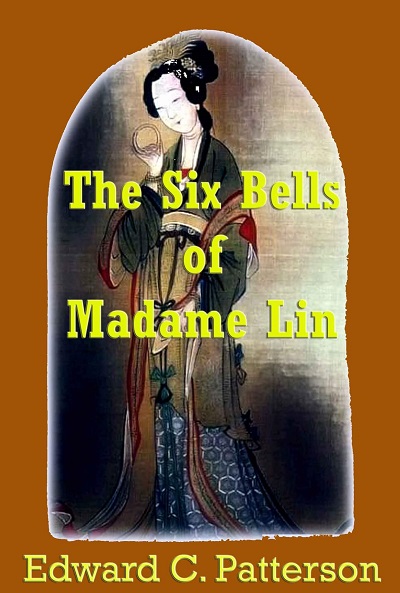
The Six Bells of Madame Lin is the first book in The Witch of Marigold Hall Trilogy, a fictionalized account of the struggles of Lin Mang, a blind woman who manages to navigate the world during the Mongol conquest of China in the 13th Century. Withou
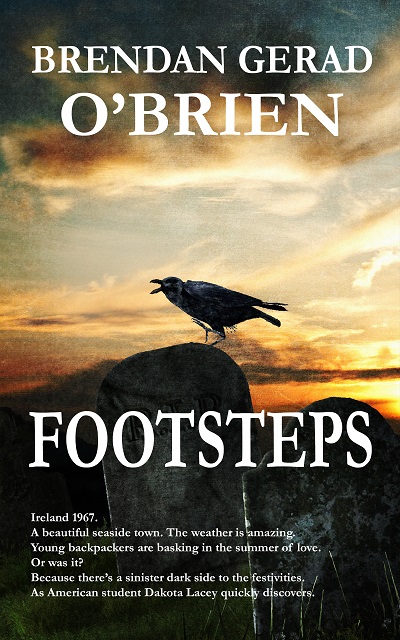
Ireland 1967. The Summer of love. Or was it?
A holiday weekend. Amazing weather. American student Dakota Lacey is hiking around Kerry.
But there’s a sinister, dark side to the atmosphere. Lone female hikers are being brutally attacked.