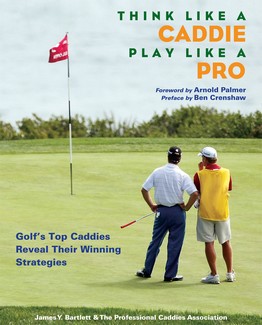
WORLDS GREAT CADDIES SHARE THEIR SECRETS ON HOW TO TRAIN AND TRUST YOUR INNER CADDIE TO LOWER YOUR SCORE For the first time - the worlds greatest Caddies share their secrets on how to train and trust your INNER CADDIE to Lower your score.
Think Like A Caddie, Play Like A Pro by golf-expert James Y. Bartlett and the Professional Caddies Association is full of advice from some of the world's best caddies, from past and present, such as Steve Williams, caddie for Tiger Woods; Bruce Edwards, caddie for Tom Watson; Matt Achatz, caddie for Rocco Mediate; Each shares their time-tested secrets for keeping a competitive edge and achieving a psychological advantage on the course.
With the foreword written by Arnold Palmer and the preface by Ben Crenshaw, Think Like A Caddie, Play Like A Pro is a must-have book for both the casual and seasoned golfer. Author James Y. Bartlett is a longtime golf writer and editor and a former features editor at Golfweek. The Professional Caddies Association has helped train and certify more than 150,100 new caddies worldwide.
Excerpt
Professional golfers have many advantages over the rest of us, mainly the overwhelming fact that they’re much better players than we are. But that isn’t all. Don’t forget their caddies, who provide all variety of invaluable service, from knowing yardages to gauging wind and reading greens, to what Ben Crenshaw calls “keeping a steady hand on the emotional tiller.” The premise of this nicely designed, very helpful book is to show amateur golfers how to think like caddies and, thus, avoid making many of the mental mistakes that send scores skyrocketing as surely as bad swings. Some of the advice belabors the obvious (think positively), but much is practical and insightful (“choose a shot you know you can make,” not a shot you’ve seen pros make). The chapter on using statistics to improve your game is especially revealing, as is the one on reading greens. In addition to tips, the book includes engaging anecdotes on caddie history and snappy sidebars on human-interest topics like the top five things caddies hate (yes, heavy golf bags top the list). A good mix of instruction and entertainment. --Bill Ott
Professional Reviews
THINK LIKE A CADDIE, PLAY LIKE A PRO
Professional golfers have many advantages over the rest of us, mainly the overwhelming fact that they’re much better players than we are. But that isn’t all. Don’t forget their caddies, who provide all variety of invaluable service, from knowing yardages to gauging wind and reading greens, to what Ben Crenshaw calls “keeping a steady hand on the emotional tiller.” The premise of this nicely designed, very helpful book is to show amateur golfers how to think like caddies and, thus, avoid making many of the mental mistakes that send scores skyrocketing as surely as bad swings. Some of the advice belabors the obvious (think positively), but much is practical and insightful (“choose a shot you know you can make,” not a shot you’ve seen pros make). The chapter on using statistics to improve your game is especially revealing, as is the one on reading greens. In addition to tips, the book includes engaging anecdotes on caddie history and snappy sidebars on human-interest topics like the top five things caddies hate (yes, heavy golf bags top the list). A good mix of instruction and entertainment. --Bill Ott
THINK LIKE A CADDIE, PLAY LIKE A PRO
In every professional and high-amateur tournament the golfer is assisted by a caddy. To be sure, the caddy does more than just carry a bag and clean the clubs. Bartlett, a longtime golf writer for the major golf magazines, along with contributors from the Professional Caddies Association and pro golfers, describes what a caddy does and how the same principles can be applied when playing golf without a caddy. How much better would we score if we had a caddy to provide a yardage estimate, point out hidden dangers and subtleties, and confirm club selection? How much better would we play if we were accompanied by a coach and cheerleader? It is these things a caddy does and even without a caddy they can be applied to one's personal game. The book is replete with narratives from both caddies and pro golfers illustrating these concepts. VERDICT All this, together with useful photographs, makes for a really good instructional guide that transcends the endless array of swing theories. This one's a solid choice for public library sports collections and for golfing readers. --Library Journal, Steven Silkunas
Now I don t know about you, but I always play better with a caddie at my side. Earlier this year, I caddied for the L.P.G.A. Tour player Brittany Lincicome, opening my eyes to how pivotal that job is at golf's elite levels. So I expected to love reading Think Like a Caddie, Play Like a Pro (Sellers Publishing), and I was not disappointed. There is technical talk, like reading greens and preparing your equipment, but the best advice is gleaned from the inside-the-ropes anecdotes contributed by notable professional caddies. What comes together is a reassuring tutorial in the kind of prudent mind-set, calming thoughts and useful golf insights Don't try to make shots you don't have that make a caddie so invaluable. The reader comes away understanding that we as golfers can rely on our inner caddie to play better golf. You will be nodding your head in agreement, absorbing the wisdom of the caddies Bruce Edwards and Steve Williams. One last tip don t forget the sunscreen. A good caddie always protects himself from the elements. --New York Times, Bill Pennington, August 30, 2010
Professional golfers have many advantages over the rest of us, mainly the overwhelming fact that they re much better players than we are. But that isn t all. Don't forget their caddies, who provide all variety of invaluable service, from knowing yardages to gauging wind and reading greens, to what Ben Crenshaw calls keeping a steady hand on the emotional tiller. The premise of this nicely designed, very helpful book is to show amateur golfers how to think like caddies and, thus, avoid making many of the mental mistakes that send scores skyrocketing as surely as bad swings. Some of the advice belabors the obvious (think positively), but much is practical and insightful (choose a shot you know you can make, not a shot you've seen pros make). The chapter on using statistics to improve your game is especially revealing, as is the one on reading greens. In addition to tips, the book includes engaging anecdotes on caddie history and snappy sidebars on human-interest topics like the top five things caddies hate (yes, heavy golf bags top the list). A good mix of instruction and entertainment. --Booklist - September 1, 2010
Professional golfers have many advantages over the rest of us, mainly the overwhelming fact that they re much better players than we are. But that isn t all. Don t forget their caddies, who provide all variety of invaluable service, from knowing yardages to gauging wind and reading greens, to what Ben Crenshaw calls keeping a steady hand on the emotional tiller. The premise of this nicely designed, very helpful book is to show amateur golfers how to think like caddies and, thus, avoid making many of the mental mistakes that --Booklist - September 1, 2010
From the mouths of many of the best Tour caddies, past and present, Think Like a Caddie, Play Like a Pro is a bagful of principles to easily apply to your weekend game. --Bob Denney, PGA Magazine
Want to review or comment on this book?
Need a FREE Reader Membership?
Reviews for "THINK LIKE A CADDIE , PLAY LIKE A PRO"
A good caddie is far, far more than merely a bag toter. They are part strategist, another pair of eyes, a source of course information, psychologist, manager, valet, etc. ‘Think Like a Caddie Play Like a Pro” provides you with a host of valuable information from inside the ropes in a very entertaining, easy-to-read format, complete with checklists and entertaining anecdotes.Get your copy signed for free - e-mail Dennis.PCAworldwide.com and request - book is also FREE when you become a FRIEND OF PCA - ASK HOW
This book tells the story of the 1999 Providence College Friars baseball team, the last season that the sport was played at the institution. Baseball was set to be eliminated after that season in order for the school to comply with Title IX regulatio
"HOMEGROWN: The Making of the 1972-73 Providence College Friars" is a retrospective of that remarkable season as well as a history of the school's basketball program, which was responsible for drawing the local talent that propelled that team to succ
This book tells the story of the 1999 Providence College Friars baseball team, the last season that the sport was played at the institution. Baseball was set to be eliminated after that season in order for the school to comply with Title IX regulatio