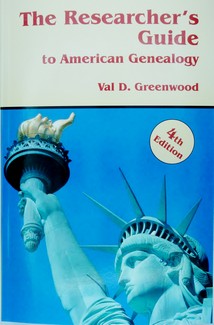
This is the book you will want to own if you are interested in researching your American forebears. First published in 1973 by Genealogical Publishing Company, it is now available in its 4th edition and has sold more than 110,000 copies.
This new 4th edition of The Researcher's Guide (published in Oct. 2017) has been completely updated, incorporating all the latest developments, principles, and resources relevant to family history research in the United States . There are now two chapters about technology as it relates to family history research--one dealing with significant concepts and definitions and the other with specific resources and applications, including major family history websites and Internet resources. In addition, virtually every chapter provides information on Internet websites pertinent to the subject discussed in that chapter.
Good instructional guidance is critical to the success of family history research, and this is where The Researcher's Guide is unsurpassed. It is both a textbook and an all-purpose reference book, designed to help the present generation of family history researchers better understand the methods and principles of family history research, and learn how to utilize all available resources. As Val Greenwood writes, "These are our ancestors we are talking about here; we owe it to them to get it right."
This book provides a clear, comprehensive, up-to-date instruction on American genealogy—no sound American genealogical project is complete without it.
"Recommended as the most comprehensive how-to book on American genealogical and local history research."—Library Journal
Excerpt
"This book has two chapters devoted to computer technology. This chapter deals with the whys and hows of family history’s wonderful involvement with computer technology. I will begin by seeking to clarify some important computer-related terminology and will then discuss some of the excellent resources that facilitate our research and assist us in getting things right when they are used wisely. The second of these chapters (Chapter 10)—without attempting to be a user manual—discusses some principles for the use of computer technology in family history research and then looks briefly at some of the excellent websites that have essentially come out of nowhere and have so wonderfully transformed the world of family history research."
(Excerpt from chapter 9, "Computer Technology and Family History.
Professional Reviews
American-Canadian Genealogist
In every field of study there is one book that rises above the rest in stature and authority and becomes the standard work in the field. In genealogy that book is Val Greenwood's "Researcher's Guide to American Genealogy." Arguably the best book ever written on American genealogy, it is the text of choice in colleges and universities or wherever courses in American genealogy are taught. Of the dozens of textbooks, manuals, and how-to books that have appeared over the past twenty-five years, it is the one book that is consistently praised for setting a standard of excellence.
In a word, "The researcher's Guide" has become a classic. While it instructs the researcher in the timeless principles of genealogical research, it also identifies the various classes of records employed in that research, groups them in convenient tables and charts, gives their location, explains their uses, and evaluates each of them in the context of the research process. Designed to answer practically all the researcher's needs, it is both a textbook and an all-purpose reference book. And it is this singular combination that makes "The Researcher's Guide" the book of choice in any genealogical investigation. It is also the reason why if you can afford to buy only one book on American genealogy in a lifetime, this has to be it.
This new third edition incorporates the latest thinking on genealogy and computers, specifically the relationship between computer technology (the internet and CD-ROM) and the timeless principles of good genealogical research. It also includes a new chapter on the property rights of women, a revised chapter on the evaluation of genealogical evidence, and updated information on the 1920 census. Little has changed or needs to be changed, because the basics of genealogy remain timeless and immutable. This third edition of "The Researcher's Guide," then, is a clear, comprehensive, and up-to-date account of the methods and aims of American genealogy--an essential text for the present generation of researchers--and no sound genealogical project is complete without it.
National Genealogical Society Quarterly
For almost thirty years, Greenwood's tome has remained an excellent, comprehensive guide for beginning researchers and quick reference for experienced genealogists. This review of the third edition, whose language continues to be simple and direct, focuses on four new or expanded areas: computer use, fleshed-out ancestors, evidentiary standards, and women's property rights.
The second edition, in 1990, introduced the burgeoning changes that computers were bringing to genealogical research. This third edition devotes almost four times the space to the subject. The chapter opens vividly, with a grueling reminder of the days before word processors; a description of the author's 1972 preparation of the first edition's 535 pages of camera-ready copy, using a then state-of-the-art typewriter.
The current chapter divides the subject by functions: word processing, organizing and storing data, producing information in graphic form, identifying and contacting people with mutual genealogical interests, and learning about resources and collections.
Even though rapid and continual change causes new information on this subject to be obsolete almost the moment it hits the page, Greenwood's material stands up to the best of the new works on the subject--especially his information on searchable databases. Regrettably, he did not alert his readers to the quantity of misinformation also on the Internet, or remind them of the importance of examining the source of each and every piece of information before adding it to one's own family files.
This third edition also builds upon the second in emphasizing the importance of historical context. The modern researcher's goal is not to gather names and dates but to learn as much as possible about each ancestor as an individual in his own time and circumstance. This assignment is challenging, but extremely rewarding. As Greenwood notes, there is little point in digging up ancestors if one does not bring them to life. Modern genealogists, he gently reminds his readers, have a responsibility to write the family history in such a way that future generations will also know those ancestors as individuals, not just as names on the family tree.
Greenwood's latest chapter on evidence discusses the demise of "preponderance of the evidence" as the standard of proof in genealogy. Adapted from the legal profession, the concept never really filled the needs of genealogists, who wanted a higher standard for proving their heritage. In 1997, as Greenwood notes, the Board for Certification of Genealogists officially dropped its use of the term and introduced the Genealogical Proof Standard. Following the Board's lead, Greenwood describes the quality of research and analysis needed to meet this standard.
Acknowledging a cry for help on elusive female ancestors, the third edition offers an entirely new chapter, "Property Rights of Women as a Consideration." Understanding these rights lets researchers interpret legal documents properly and know what additional court records might be available--especially if the women had been widowed or had inherited an estate. The chapter should be required reading for every genealogist.
With this third edition, Greenwood's "Guide" remains the single best genealogical reference on the market.
(Joan Ferris Curran, CG)
Review by Dawn Heslin on her blog/website,
Book Review: The Researcher’s Guide to American Genealogy 4th Edition by Val D. Greenwood. 25 Sep 2018
When it was originally published in 1973, The Researcher’s Guide to American Genealogy, by Val Greenwood, revolutionized its field. It was the first true textbook ever published about American genealogy. Combining how-to guidance, case study examples, and an extremely detailed discussion of genealogical records, The Researcher’s Guide was both an instant success and the go-to source for its users during each stage of their research. Following the publication of Alex Haley’s Roots and the TV miniseries that book spawned, sales of Mr. Greenwood’s book soared, assuring its reputation as the best book in American genealogy ever published.
Between 1973 and 2000, two additional editions of The Researcher’s Guide were released, primarily in response to the use of the personal computer for compiling, organizing, and publishing genealogical information. By 2000, the early stages of digitizing genealogy data, mostly on CD-ROM , were also in evidence.
Since the publication of the 3rd Edition of The Researcher’s Guide in 2000, the genealogy landscape has changed dramatically. Almost everyone now uses a computer for research. Thanks to the Internet, with a click of the mouse, genealogists have access to more data they could ever dream of studying; data they would have had to travel far and wide to come by in the past. Much of this information is free, or moderately priced through commercial subion services. To cite one crucial example, the entire U.S. federal census, from 1790 through 1940, is available online and completely indexed, from several providers. DNA has also become an important tool in genealogy in recent years. Whether or not they know where their immigrant ancestors came from, with a mere sputum sample, Americans can discover their ethnic origins in just a matter of weeks. This technology can help fill gaps in the family tree by, among other things, putting one in touch with others possessing a similar genetic make-up.
The 4th Edition of The Researcher’s Guide to American Genealogy both embraces the changes of the last seventeen years and yet transcends them. Mr. Greenwood has re-written every chapter and added two chapters about technology as it relates to family history research–one dealing with significant concepts and definitions and the other with specific resources and applications, including major family history websites and Internet resources. In addition, virtually every chapter provides information on Internet websites pertinent to the subject discussed in that chapter. Greenwood covers all the major changes in the field, including DNA research. The final result is a 4th Edition that is 25% longer than its predecessor. Given the unprecedented amount of information on the Internet, today’s researcher is able to reach beyond the vital statistics to a new world of understanding, both of his ancestors and of himself. Accordingly the author shows the reader how to build a family history about actual people, not just names and dates, from the myriad available sources. Mr. Greenwood also recognizes that not all sources researchers are seeking can be found online today—some never will be—that much information on the web is faulty or unsourced, and that researchers invariably enter dead ends or hit brick walls. Good instructional guidance, consequently, is critical to the success of family history research, and this is where The Researcher’s Guide is unsurpassed. It is both a textbook and an all-purpose reference book, designed to help the present generation of family history researchers better understand the methods and principles of family history research, and learn how to utilize all available resources. In short, this new 4th edition provides a clear, comprehensive, and up-to-date account of American genealogy—no sound genealogical project is complete without it.
x
xMy Review
I chose to read this book after receiving a free copy. All opinions in this review are my own and completely unbiased.
I’ve always been interested in my family history and started working on it years ago before the world of the internet. I eventually put it away and it has been in a box for many years. Reading this book and having it as a resource has sparked my interest again especially since my mom was adopted. She filled out some papers a few years ago wanting at least medical information but there was nothing available. Now with DNA testing available along with the resources in this book, I might be able to get further in my research. I’m excited!
For anyone who is interested in seriously working on their family history, this is a fantastic resource.