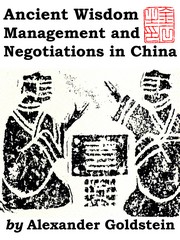
In the context of accelerated globalization, Chinese stratagemical thought highlights the comparative advantage of its people towards management with an adaptation of ancient wisdom for the new times and modern condition. This edition exercises Chinese style of management and business negotiation implemented via strategic thinking worked out and developed in China throughout the ages of history.
In the context of accelerated globalization, China’s stratagemical thought highlights the comparative advantage of the Chinese towards management with an adaptation of ‘ancient wisdom’ for the new times and modern environments. This edition exercises Chinese style of management and business negotiation implemented via strategic thinking worked out and developed in the Central Kingdom throughout the centuries-old history. Adopted here research methods include elemental analysis, inductive proving and deductive reasoning based on classical modelling. Developed on the linear constructive principle, this research consists of five methodological aspects which explain self-sufficiency of the total number of Chinese stratagems, their ability for introspection and pairing according to fixed enumeration, result-oriented characteristics, classification and textual criticism. After some data inquiry, I preliminary conclude that scholarship in the West is not yet got around to carry out a systematic research of Chinese stratagemical thought used for Sino-Western negotiation and collaboration in general. On the one part, Chinese strategic principles are designated by thoughtful observers and analysts who proceed from Sun-zi’s doctrine of warfare and the 36 stratagems in their idiomatic expression; on the other part, no compelling cultural explanation of them is provided in Western literature. No previous works go beyond various exemplary strategies and tactics to answer the fundamental for Chinese culture question: What is the glue that holds together all business principles of Chinese statesmen and entrepreneurs?
We are dealing with a real China, not the China of blue porcelain bowls and exquisite silk scrolls, but a China in the midst of pangs and throes of labour, a China facing the collapse and crisis of developments, a China of living millions of toiling humanity, with a desire to work and to live, struggling against floods and earthquakes, and living in a state of chaos without meaning, turmoil without direction, unrest without change, verbiage without conviction, action without purpose, and misery without hope, but a despair based on an intimate knowledge of present-day China as no foreigners know it. A madness and a loss of restraint and all decency produced by a loss of self-confidence, as if there were a common foreboding of evil, and man’s follies and evil passions are let loose in an each man for himself and scramble as one scramble can fight (category no. 4 混戰), the goal of which is the buying of a house and a car to live in security in the foreign settlements, and the holding of a large account in the Hong Kong and Shanghai Banking Corporation. Paint as one will a glorious picture of dream-China, the China of her classics and philosophy and art, sooner or later one will have to face the puzzle of a real China, and perhaps through a process of long and painful thought, demand of the past an answer to the present, and demand of the present a meaning for the future.
For China is the greatest mystifying and stupefying fact in the modern world, and that not only because of this country’s age or its geographical greatness. Among its largest population there is the oldest living nation with a continuous culture; once China was the greatest empire in the world, and it was a conqueror. It gave the world some of its most important inventions—it has a literature, a philosophy, a wisdom of life entirely its own; and in the realms of management and the art of operation, it soared where others merely made an effort to flap their wings.
Want to review or comment on this book?
Need a FREE Reader Membership?
Reviews for "Ancient Wisdom, Management and Negotiations in China"
Congratulations, Alex, on your new book, may it achieve every success. John
Reviewed by Ronald Hull
8/20/2015
Congratulations on this book. I will probably not read it because I'm not involved in business with China, but I believe those that are should probably read it and learn. I'm not saying that I won't be affected by what's happening in China. We all will.
My view of China is similar to your 2nd paragraph where you describe the "real" China that those who visit Beijing and the Great Wall do not really see as they buy fake artifacts as souvenirs to bring home of their wonderful experience in Chinese culture. Nothing could be further from the truth as a recent chemical plant explosion exemplifies. China is the sleeping giant in the equation and there is, probably no remedy from ancient wisdom to their dilemma of too many people and too much corruption and greed. The vast majority just trying to keep their heads above starvation and seeking security.
I'm reminded of Japan in the 1960s. An industrial engineering professor of mine, a student of Lillian Gilbreath, wrote a series of books on improving production (basically simplifying processes, substituting materials, and eliminating labor) that were not well received by American industry at the time. However, he made a good living consulting with the Japanese who took his processes to heart and began to whip the daylights out of American production, particularly in automobiles and electronics.
Once walked, the path of the Inner Compass leaves everyone transformed. Uncover a future with unlimited leadership possibilities. Master your ego
https://www.amazon.co.uk/dp/B09ZRRPFW5/