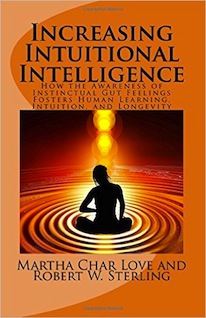
Increasing Intuitional Intelligence: How the Awareness of Instinctual Gut Feelings Fosters Human Learning, Intuition, and Longevity is written as a companion to Love and Sterling's first book published in 2011, What's Behind Your Belly Button? A Psychological Perspective of the Intelligence of Human Nature and Gut Instinct. It is a response to readers who have asked them to share more on how the knowledge of uniting Human multiple brains--gut and head--affects current issues in education, wellness and longevity, medicine, relationships and decision-making, and the evolution of mind.
The authors have selected the title Increasing Intuitional Intelligence because the ultimate goal of their lives' work as counselors and educators has been to increase human intelligence through the development of the intuition using the Somatic Reflection Process, which they first created in the 1970s. Love and Sterling demonstrate that Intuitional Intelligence connects instinct and feeling (our unconscious) with reason and sensory input (our conscious mind) and is brought forward in our awareness as insight and intuition for creative life. With the use of the intuition, the authors view Humans as self-regulatory with Intuitional Intelligence as the link to our awareness of our Human Nature and the ability to be aware of our unconscious--our own inner state of being (self-awareness)--and to being aware of the feeling state of others (empathy). They propose that it makes sense even to the logical mind that the first place to begin the work to increase one's intuition and Intuitional Intelligence is within our own instinctual feeling state, where the impact of life is registered in our gut feelings of emptiness and fullness.
Love and Sterling demonstrate that the biggest mental health and educational problem today has been that most people in our modern world are not aware of the important role of the gut holding our feeling memory and registering how life is impacting us. They suggest that the feelings of emptiness and fullness that are felt in our guts and relate to how well our needs as human beings are being met have for so long been confused in our awareness with the feelings of emptiness and fullness that accompanies hunger. The authors point out that we have missed the awareness of this vital instinctual feeling gauge in our gut. Until this feeling awareness in the gut is recognized and time is spent becoming aware of our gut feelings and the impact of life upon us from early childhood, Love and Sterling show us that we cannot step forward in developing higher mind and Intuitional Intelligence.
In this book the reader will look further at the process of education of our instincts from birth through old age and lay the foundations for evolving the higher intuitive mind and creative thinking. This book is particularly important for those in the field of education as the authors make suggestions for the education K through 12 of the two brains--gut and head--as a uniting intelligence. They also explore our future Human selves and what it could bring to our species to follow our instincts and develop an increased awareness of our gut and head as a two brain united intelligence, fostering our intuition that leads us to advancements in the sciences, medicine, mental health, increased wellness and longevity, and even the development of human telepathic communications.
You will find Increasing Intuitional Intelligence is divided into five main units that include the following chapters on the affects of consciousness of our gut instincts: 1. Step One to Increasing Intuitional Intelligence! Educating the Gut Brain, Learning, & Childhood Development; 2. Instinctual Awareness and Its Affects Upon Longevity; 3. Gut Feelings and Intuitional Intelligence as Applied to Psychology; 4. How the Consciousness of the Gut as a Brain Affects Religion and Culture; and 5. How Uniting our Multiple Brains Affects Health and Wellness and the Medical Profession.
Excerpt
Introduction to Increasing Intuitional Intelligence
Increasing Intuitional Intelligence: How the Awareness of Instinctual Gut Feelings Fosters Human Learning, Intuition, and Longevity is written as a companion to our book published in 2011, What’s Behind Your Belly Button? A Psychological Perspective of the Intelligence of Human Nature and Gut Instinct. It is a response to the readers who have asked us to share more on how our knowledge of uniting Human multiple brains—gut and head—affects current theory and practice in a number of subject areas as well as life experience, wellness, and the evolution of mind.
We have selected the title, Increasing Intuitional Intelligence, because the ultimate goal of our lives’ work has been to increase human intelligence through the development of our intuition. You may have already learned from business coaches that intuition is used for a majority of important decisions by the most successful business executives. They will often say that all we have to do is to listen to our intuition and act on it to develop it further. While it is true that it is important to practice using our intuition, there is a part of the learning process of developing intuition that we can not skip, and that is the inner work part. We can not skip right to the enlightenment state and be intuitively intelligent without quite a bit of inner work and self-awareness. That is what this book and What’s Behind Your Belly Button? is all about—the inner work it takes to become aware of your instinctual gut feelings to unite the gut and head brains and to increase Intuitional Intelligence.
First we must take the time to clear the emotional channels within us, clear out our old ways of perceiving ourselves and accompanying emotions that are blocking our intuitive awareness. This is where freeing our instincts and listening to our gut feelings is essential. Our Intuitional Intelligence connects instinct and feeling (our unconscious) with reason and sensory input (our conscious mind) and is brought forward in our awareness as insight. Intuitional Intelligence is linked to our awareness of our Human Nature and the ability to be aware of our unconscious—our own inner state of being (self-awareness)—and to being aware of the feeling state of others (empathy). It makes sense even to the logical mind that the first place to begin our work to increase our Intuitional Intelligence is within our own instinctual feeling state, where the impact of life is registered in our gut feelings of emptiness and fullness.
The problem has been that most people in our modern world are not aware of the important role of the gut holding our feeling memory and registering how life is impacting us. Our feelings of emptiness and fullness that is felt in our guts and relate to how well our needs as human beings are being met have for so long been confused in our awareness with the feelings of emptiness and fullness that accompanies hunger. We have missed the awareness of this vital feeling gauge in our gut. Until this feeling awareness in the gut is recognized and time is spent becoming aware of our gut feelings and the impact of life upon us from early childhood, we can not step forward in developing higher mind and Intuitional Intelligence.
In this book we will look further at the process of education of our instincts and lay the foundations for evolving higher mind and creative thinking. We talk quite a bit about the education of the young because we think that the learning process about the instinctual gut feelings we are born with begins at birth and needs to be included in the educational program as early as preschool age. In time, with proper care and attention, education, and a culture that supports instinctual awareness, the child will learn more and more to be attuned to his/her instincts. As his/her logical brain develops along with the awareness of his/her instincts and gut feelings, the child develops Intuitional Intelligence and a higher creative mind.
You will find Increasing Intuitional Intelligence is divided into five main units that include essays on the affects of consciousness of our gut instincts on many areas of life experience and are as follows: 1. Step One to Increasing Intuitional Intelligence! Educating the Gut Brain, Learning, Gut Feeling Awareness, & Childhood Development; 2. Instinctual Awareness and Its Affects Upon Longevity; 3. Gut Feelings and Intuitional Intelligence as Applied to Psychology 4. How the Consciousness of the Gut as a Brain Affects Religion and Culture; and 5. How Uniting our Multiple Brains Affects Health and Wellness and the Medical Profession.
Within these essays, we address a variety of subject areas exploring the importance of gut instincts and using gut intelligence in: the aging process (beginning at birth), emotions, developing Intuitional Intelligence, longevity, happiness, memory, fear of death and dying, decision-making, inner human needs, the learning process, children and school, parenting, social bonds, marriage, body awareness, personality development, emotional intelligence, relationships, human communications and technology, creativity, evolution of mind and our relationship to spiritual beliefs and religion, cultural history, and the medical profession.
In What’s Behind Your Belly Button?, we turned the current behavioral understanding of the Human psyche held in popular academia upside-down, inside-out and bottom-up with our conclusions from our clinical research based on our 40+ years of counseling and educational experiences that explored how people use their gut feeling responses as a source of intelligence. We demonstrated the idea of a two-brain system of intelligence—gut and head—in the Human being. In Increasing Intuitional Intelligence, we explain just how the two brain system functions psychologically for positive growth and development, well-being, a fulfilled life, and ultimately for developing our higher mind or Intuitional Intelligence.
We realize that this material is not easy to fully comprehend because it is both academic (requiring the use of the thinking brain) and also readers must research their own inner feelings (requiring the use of the feeling gut brain) and experiences to make sense of the new psychological image (view) of Human Nature that we propose. Most of us have very little experience with the conscious awareness of our gut feelings, so this is new to most people. We have found that readers and researchers alike are fascinated with the subject and have many questions about living with gut instincts and making the most of gut intelligence.
Although it is new for most of us to think of ourselves as having multiple brains as intelligence sources, it is an exciting prospect that hits home with many people even as they first begin to read about it and consider it in their own experience of themselves. To first become aware that you have a gut brain that has been guiding your behavior toward fulfilling your inner instinctive Human needs, explains much about ourselves and why we do and feel what we do. As a result, we have had many enthusiastic readers write to us, tell us they are successfully using the complete protocol for the Somatic Reflection Process that we include in What’s Behind Your Belly Button? for exploring gut feelings, and then ask us questions about how to further use gut feelings to unite the thinking and feeling brains to achieve well-being and happiness with a variety of life circumstances and issues. It is to answer many of these questions that we have written this second book, Increasing Intuitional Intelligence.
It is our hope that Increasing Intuitional Intelligence will help take our theories and interpretations of Human gut instincts into a place in current scientific knowledge that will revolutionize Behavioral Science and include a more functional model of the Human being. By a more “functional” model, we mean a way of thinking of who we are that is actually “usable” and “workable” when applied to Human life and allows for successful and happy living.
While gaining much attention to those interested in exploring gut intelligence, our clinical findings still lack substantial peer research and review. Our theories on Human instincts and gut intelligence are just now on the cusp of edging into a place in mainstream popular psychology and medicine with many research studies now being conducted on the importance of the gut brain and its affects upon mental health. For instance, recent Medical studies on mice headed by Premysel Bercik at Farncombe Family Digestive Health Research Institute at McMaster University show that neonatal stress in early life, such as maternal separation, changes the newborn’s gut bacteria and leaves it vulnerable to a variety of disorders that include disturbing gut functioning and interrupting the proper functioning of the head brain. This has been found to lead to anxiety and depression in adult life. Anxiety and Depression Association of America have calculated that Anxiety Disorders affects 40 million adults. These recent findings on the affects of early life stress on gut flora that lead to our most prominent disorder in Mental Health today are propelling research toward exploring the importance of somatic techniques (like the Somatic Reflection Process that we developed) to reduce stress levels and heal wounds of separation and anxiety.
The concepts of gut intelligence that we put forward are based upon our clinical experiences and what we have learned from the reported affects of using the Somatic Reflection Process that we developed on gut feeling awareness with hundreds of people, including ourselves. So while much of what we write may seem like conjecture and assumption, it is based on ample professional clinical experience. Our experience makes it very difficult for us to be quiet, even if our theories fly in the face of traditional academia. We are hoping that our discussions in this book will influence neurologists and other medical scientists, psychologists, educators, and graduate students in a variety of areas of study to conduct further research and experiments using our protocol of the Somatic Reflection Process to render more hard data on the affects on Human life of being more conscious of our gut feelings and instincts and uniting the two centers of intelligence.
Of course, the idea of the gut as a center of intelligence relating to Intuitional Intelligence is not new. For instance, the ancient Hindu placed the astral soul of Humans (one’s self-consciousness) in the pit of the stomach. For the modern Parsis (see Isis Unveiled and translation from the Vedic Sanskrit hymn in Rig-vedas) there exists a belief up to the present time that spiritual adepts have a flame in their navel that enlightens them and shows them the spiritual world and all things unseen, even at a distance. They call this inner vision through the gut the Lamp of Deshtur. And while a number of Mesolithic cultures revered the gut as a main center of intelligence, we propose that we have never had a culture with a balanced integration of the head and gut brains. In fact, modern people in general have left behind the consciousness of the belly and marginalized the importance of the enteric nervous system as a center of intelligence in favor of the upper thinking brain. Without the awareness of the gut brain information in our thinking, we leave out perhaps the greatest piece of information needed in our perception to help us make sound judgments through our intuition—and that is “the impact of life upon us from moment-to moment”. Now our task is to unify the two brains.
In our first book, What’s Behind Your Belly Button?, we have proposed a protocol and demonstrated the Somatic Reflection Process that we created in the 70s and used with people in counseling to do just that—unify the two brains. And by using this process with individuals, one person at a time, we can bring back the awareness of our gut responses so that we can unify our gut and head brains, thus developing a clear circuit of information in our perception to give rise to our Intuitional Intelligence. We see the increase of Intuitive Intelligence as an inevitable step for our human species if we are to survive and it will make many things possible that have only so far been speculated in science fiction or esoteric philosophical texts. Of course, these changes will only come through our need for adaption and survival. But as you will see as you read this book, the pressure to do so is already at our doorstep.
The subject of gut feeling intelligence as a path to developing Intuitional Intelligence is so new to our modern world that there is a great need for ample clarification of its meaning so that people may begin to understand within their own experience of themselves what these gut feelings are all about. This clarification also allows for the development of a model of Human Nature that is functional and successful in building a happy and peaceful world.
It is important to both feel into our gut feelings in the body and then to also understand with our thinking brain just what we are feeling, how our gut feelings are organized to reflect Human need, and what it means to have a Human Nature. We are not advocating the elimination of the use of the thinking brain in favor of a swing toward the use of the gut brain, but for the uniting of these two brains into a more functional Human intelligence system than ever before in Human history. It is only with these two brains working in unity— integrating our conscious and subconscious processes—that we can as a species, through time, develop our Intuitional Intelligence and evolve higher mind from our inner vision. Are we ready and able to make this needed advance in intelligence? We think so!
Professional Reviews
The Gift of Intuition - 5 stars Amazon Buyer
The 1970s were a time of foment and ferment in psychology. Many believed that the “thinking brain” played the most crucial role in human development, and questioned the existence of instinct. This focus on the cortical garden became the predominant model. Some, however, took another path, going deep into the weeds of instinct, emotion, intuition, and the collective unconscious. Among these were Robert W. Sterling and Martha Char Love.
Today, scientists are beginning to corroborate the path less taken. They have found that learning is genetically passed down through generations. Neuroscientists are now able to better study how our brain works and are finding that conscious actions have been preceded by an unconscious or non-conscious process. Our behavior begins long before we are aware of what the action will be. The work of psychologist Colwyn Trevarthen demonstrates the instinctual ability in infants to relate to others and share emotional responses. Jaak Panksepp, researcher in affective and social neurosciences, has shown the primary role of instinct, the subcortical nervous system and emotions in animals.
In clear and thoughtful language, Sterling and Love show how the Enteric Nervous System, the “gut brain” begins operation at birth and directs the development of the Central Nervous System or “upper thinking brain.” These two “brains” each contribute to the learning process and knowledge base of the individual. The “gut brain” or “second brain” or Hara gives us important information about our interior Self. The upper thinking brain is the sensory brain and gives us information about the world outside the Self. They develop through interaction with other people and the world.
Their book shows us the neurological and evolutionary basis for this essential symbiotic relationship, and how it unifies us within ourselves and with the world around us. Working together these two centers of intelligence give us the ability to self-regulate, so that we can continue to meet our needs for “control of one’s actions (freedom)” and “attention (social acceptance).”
The instincts and primary processes of the second brain have helped the human species to survive for thousands of years. In modern times, however, there has been a shift toward the upper thinking brain and consciousness directed toward the outside world. We in Western society have marginalized one of those ways of knowing, and have let the other become so dominant that we are wrecking that symbiotic relationship. In this way, the mind-body duality, begun centuries ago, is not only a cerebral concept but has had physiological ramifications.
When our feelings and “gut instincts” are ignored, we feel empty and unfulfilled. The response is to fill our gut with food and drink, but still we continue to feel empty. The authors developed a practice that helps people go back through their experiences to find the initial one that has caused the problem. They call this the “Somatic Reflection Process.” Our intelligence, or knowledge, comes from the Enteric Nervous System’s recording of the “impact of experience” while the Central Nervous System records the details. Understanding the role of each helps us keep these ways of knowing and interacting with the world balanced and operating as they were designed to do.
What has happened is that we’ve become less able to use our intuitive ability to know ourselves and the world. The authors write: “The intuition is based on past stored intelligence, which requires a combination of sensory experience and feeling experience.” As the authors write, a “mature intuition” is “thinking and feeling balanced and united.” Unless we do this, we are doomed to repeat the mistakes, to have the same experiences, as that of many past centuries.
By working on this integration, we can have greater control over our lives, without external control from “authority.” We can improve our relationships with others, including becoming more compassionate in our perspective and behavior, and our communication skills as evidenced by modern technology, lead longer healthier lives and have a better relationship with the environment. Ultimately, it will give us a greater spiritual experience. And this is what Sterling and Love mean by “increasing intuitional intelligence.”
This book is a must-read for anyone interested in human behavior, human nature and the human condition. I would recommend also reading their first book, What’s Behind Your Belly Button: A Psychological Perspective of the Intelligence of Human Nature and Gut Instinct.
Mary Clark
Author of Tally: An Intuitive Life
5 stars - Even Better than the First Book Good as the first book ...
Good as the first book is (What's Behind Your Belly Button), this follow-up exploration of the same basic subject is even better. Like the first, Increasing Intuitional Intelligence is a psychology book. It explains more deeply how to educate the second brain in the gut beginning in early childhood education. This book is written for educators and parents, as well as the general public, and the writing style is smooth and accessible.
By John B. Rosenman on January 1, 2016, on Amazon
Goodreads Review- 5 stars
I found some very useful research in this book for my psychology class. It's a good read with information about achieving self-awareness and a positive mental state using gut feeling intelligence as a guide to memory and intuition. Recommend highly.
Slaves who fled their masters were classified as insane. This term came from Dr. Samuel Cartwright who was an apologist for slavery in the pre-Civil War era. This release of my Anoka Time file is a look at slavery in the modern context of Minnesota N