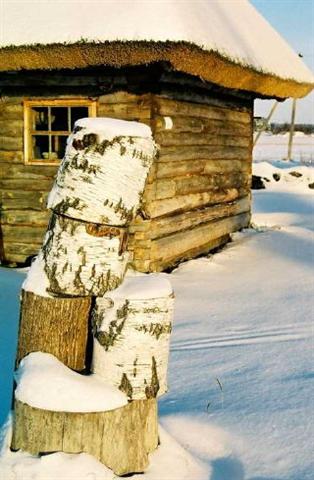
Climate shapes and directs socio-cultural intercation, development along with living conditions.
Only small portions of the Rus countries are south of the 50th. parallel & more than half of the Rus countries are north of 60th. parallel. Vast regions experience 6+ months of snow cover over a subsoil that is permafrost as deep as 300-400 meters. The average yearly temperature of nearly all of European Russia is below freezing. The average for most of Siberia is also below freezing as well. Most of Russia only has two seasons, Summer & Winter. There only very short intervals of distinction between them. Transportation routing, including entire railroad lines, are redirected in winter to traverse rock_solid waterways & lakes as was done to defeat the Axis in WW-II. There are areas of important exception to this description. One such is the moderate maritime climate of Kallinigrad Oblast on the Baltic Sea. The climate there is similar to that of the American Northwest such as Seattle or Portland. In Siberia, also called the Russian Far East, there is the influence of the Pacific Ocean currents, causing a type of monsoonal climate that reverses the direction of the prevailing winds in Summer & Winter, produces vastly differentiating temperatures. The narrow, subtropical band of territory provides warmer weather & a more hospitable climate mostly in the Crimea of Ukraine, the Rus's most popular summer resort area on the Black Sea has a very temperate climate. So temperate in fact that citrus fruit is grown there.
The Winter intense high_pressure systems cause winds to blow from the S & SW in all but the Pacific Region Siberian Kamchatka also called the Primorskoye Region. In the Summer low_pressure systems cause the prevailing winds to come out of the N & NW to most of the Rus landmass. It is this meteorological phenomenon that produces the Wintertime temperature variances between N & S. This may seen by the average January temperatures of _8° to -12°C in St. Petersburg & Moscow, _25 to -35°C on the Siberian Plain, and _40 to -55°C at Yakutsk located in east_central Siberia at approximately the same latitude as St. Petersburg. The Winter average temperature on the Mongolian border at a latitude is some 10° farther South is no warmer. The Summer temperatures are more affected by latitude. The Arctic islands average 4° to 8°C while the most Southern regions average 20° to 27° C. The Rus's potential for vast extremes is seen by the national record low of -94°C, recorded at Verkhoyansk in north-central Siberia & a record high of 38°C, recorded at several Southern locations along the Black Sea coast.
Every aspect of life is impacted by the Winter climate as it is by the Summer climate. Winter affects where & how long people live & work, types of crops grown ,& where they are grown. There is no part of the Rus that has a year-round growing season. It is the length & severity of Winter combined with the sharp fluctuations between Summer & Winter temperatures that imposes special requirements on many sectors of the economy. In regions of permafrost, buildings have to be constructed on pilings, machinery must be manufactured of special tempered steel & transportation systems must be engineered to perform at extremely low & extremely high temperatures. Additionally, during extended periods of cold & darkness, there are highly increased demands for energy, health-care, foods & textiles.
Close & enclosed living spaces combined with socio-cultural crowding in homes, places of social gatherings, etc. produce an ideal breeding & exchange media for the microbial causes of illness. This especially true for such nasties as influenza, pneumonia & the various myriads of rhino-viruses that we lump together and call, colds. Other health problems occur caused exacerbated by the climate/weather. Rheumatic & arthritic problems increase in intensity. Cardio-vascular problems are affected by the these climatic conditions as well. The demand for high-fat foods & quick energy-producing foods also has negative effects upon the body as much as it has positive.
Social customs vary in Winter. More alcohol is consumed, more deaths by freezing while inebriated, more fights & violent social reactions, more vehicular accidents due to loss of control, loss of portions of limbs due to frost bite & more are attributable to the cold. More babies are conceived during cold periods than during hot periods. Bathing, washing clothing & bedding, airing out of footwear, etc. are curtailed & thus enabling the conditions that produce such health concerns as lice, scabies, dermatitis of various types, fungal infections such as but not limited to, athlete’s foot & jock itch, pink-eye just to catalog a few.
Socially families get closer & share more with each when forced by climatic conditions to remain in close proximity to each other. Social gatherings are more appreciated & less apt to avoided or missed. The very games that people play are vastly different. Soccer also called football is played outdoors. Hockey is difficult to play without an icy surface. Fishing is done in a different way. Camping is not an option as an outdoor activity by choice. Hiking in the woods, seeking mushrooms & flowers just enjoying Nature are pastimes that are on hold until the warmer time comes.
Life is on a different schedule during the Winter than during the Summer. The cuisines use preserved food sources rather fresh sources during the Winter. All-in-all the impact of Winter is definitely a social stimulant that must be taken into consideration for the continued actions of life.
Sources:
Ivan P. Lushkin, PhD;
Russian Academy of Science-Meteorology
Yuri D. Sushenko, PhD;
Ukrainian Academy of Science-Anthropology
Climates of The Russian Lands
By Artur A Levin, PhD & Anatoly L. Marshak, PhD; Pamphlet in Russian published in Moscow in 1988
© Donald R. Houston, PhD 2004-2011
|