 The most fundamental fracture we need to heal is the war between own own mind and spirit. When we reconcile these two primary ways of being, many bigger wars will dissolve, or at the very least, have their negative impacts lessened.
WAR OF WORLDS:
Mind vs. Spirit
By Bill Cottringer
Nearly forty years ago, while plowing through the library of books required in my psychology studies, I accidentally stumbled upon a very intriguing paperback by Itzhak Bentov called Stalking the Wild Pendulum. As it turned out it was really one of those "meaningful coincidences," the new age spiritualist Robert Redfield writes about. This is because the “Wild Pendulum” is what my earlier reading of Joseph Clinton Pierce’s Exploring the Crack in the Cosmic Egg, along with the Berkeley Buddhist Episcopal philosopher Alan Watts’ thirty-five books on reconciling dualisms, inevitably lead to in my own quest to reconcile mind and spirit.
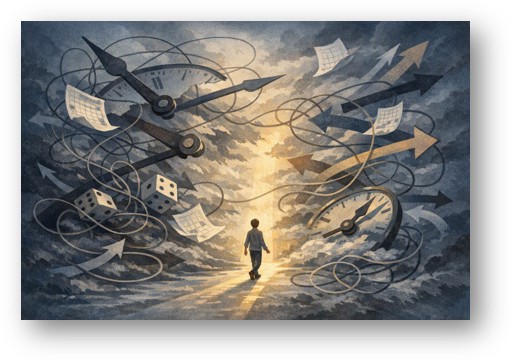
Well now, I can proudly say that I believe I have located that magical place between time and space where The Tao of Physics says the pendulum stops. This serendipitous milieu is the ultimate war of worlds—the eternal Yang and Yin battle between the brain’s mind and the soul’s spirit. As it turns out, the major wars of political ideology and theology, organized religion vs. State, personal relationship struggles, wants vs. needs, spiritual warfare between good and evil, and disruptive work conflicts are really just an outward reflection of the real war going on inside each and every one of us. Workable solutions to the external “wars” only come about by reconciliation of this internal war between our own minds and spirits during our journey to wholeness and completion.
Let is take a closer look at this internal war occuring between our minds and spirits. This table describes what is really going on below the surface of this journey we are all part of in tghe play of life.
ASPECT
|
MIND
|
SPIRIT
|
Primary Instrument
|
Brain
|
Soul
|
Awareness Realm
|
Conscious; material world; verbal; self-awareness
|
Unconscious; spirit world; non-verbal; awareness of oneness
|
Methods
|
Thinking, knowing, judging, perceiving, acting, doing, converging on conventional realities
|
Experiencing, feeling, imagining, creating, understanding, being, letting go to divergence
|
Content
|
Information, knowledge; thoughts, concepts
|
Images, dreams, wisdom, experiences, feelings
|
Vehicle
|
Words, communication, ego
|
Art, conscience
|
Motives
|
Restoring order: Attempting to unify, simplify, join, and belong as an insider
|
Creating chaos: Separating and being unique, independent and autonomous in solitude.
|
Tricks
|
Belief in artificial simplicity, easy acceptance of incomplete truths resistance to change and unfamiliarity
|
Not being able to verify validity of experience,
Intuition and direct knowing
|
Testing
|
Proving by consensual validation; comparison with truth standards; scientific method
|
Reliance on faith in the truth of experience and integrity of direct knowing
|
Goals
|
Knowledge of certainty, having control, testing truth, judging, spotting details and summarizing big life picture
|
Growing, accepting, opening up, understanding, exercising freedom, innocently exploring awesome mysteries of life
|
Rewards
|
Extrinsic pleasure: Security, personal success, literal meaning, happiness, concrete achievements, sharper consciousness
|
Intrinsic contentment: Love, wholeness, metaphorical meaning, peace, surprise, selfless service, increased awareness
|
The important reality to be aware of, which ironically has to come from both these sources of “knowing,” is that these two opposing, primary ways of being human, are equal and necessary in everything we do in life. Neither “side” of the equation is right or wrong or better than the other; the only thing we have to do is accept the equal importance and value of both divergent halves of being and then strive to reach a healthy balance between these two fundamental drives within ourselves. There is a season for everything.
Creative compromise seems to be the best way—for both halves of our self to declare a peace truce to the war so that each can stop and see what to give up and what to replace it with to allow forward movement. Otherwise we stay stuck as a hostage to the vicious circle we subconsciously created just so we could have the satisfaction and pleasure of un-creating it (but that is a book all by itself).
We may need to give up some familiar superiority, control and importance of inaccurate and incomplete truths we are convinced we know, and replace this “sacrifice” with something new, different and unfamiliar in order to move forward in unfolding our potential to become the best we can be. This is just another way to describe our perpetual journey of balance between loving and being loved and doing and being, and even between giving and taking and failing and succeeding. And in the end it is not whether you win or lose the game of life, but rather how well you play.
What happens when two people approach this magical place between time and space, or mind and spirit, simultaneously? I think that is what is called true love.
Something just dawned upon me in writing this article. Maybe the thoughts and feelings that our minds and hearts have are just expressions of our soul in its difficult effort to get to know itself. And just maybe all of us are just the ways God knows God. This is both an idea and feeling probably having enormous consequences, literally, metaphorically and everywhere in between. Maybe this is the creative compromise we are all looking for.
William Cottringer, Ph.D. is President of Puget Sound Security in Bellevue, WA. He is author of You Can Have Your Cheese & Eat It Too, The Bow-Wow Secrets and Threading Your needle With Life’s Rope. He can be reached at (425) 454-5011 or bcottringer.pssp.net
|

















Love Tinka