EDWARD HOPPER:
CAPTURING PRIVATE, SOLITARY MOMENTS
by Mary E. Martin
I have a fascination with the paintings of the American artist, Edward Hopper. Somehow—whether by technique, imagination or subject matter—he is able to create the most compelling and evocative scenes, which stir my imagination.
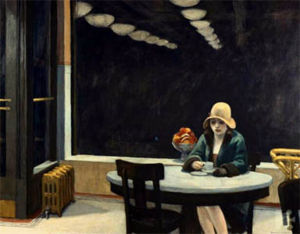
One of my favourites is Automat an oil painted by him in 1927. Click here to see this painting.
A young woman with a yellow felt hat sits absolutely alone in a barren restaurant drinking a cup of coffee. I look at this and immediately feel her isolation and loneliness as if it were my own. Is she running away? What thoughts are in her mind as she stares into the cup?
Right away, Hopper has got us speculating, as he does with all his paintings. Where did she come from? Where is she going? You’re caught right in the middle of a story which you can “read” backwards or forwards in time. I was so taken with this painting that the woman in it became the inspiration for a character in a short story, The Thief, and now a novel which I am writing. Struck by her isolation and self containment, I called her Celia.
I search the painting to see what emotions Hopper creates and how he does it. Behind the solitary woman is a large window, blackened by an impenetrably gloomy night. The lights or reflections of lights recede into the background giving a murky, tunnel-like effect, leading to nowhere. The radiator, crouching at the left of the painting, seems just as isolated as the girl in the composition, but almost looks more communicative than her. The lonely,
solitary moment is caught in time—permanently engraved on my mind.
Just think how many stories could grow from this one painting! Will someone, a boyfriend or family member enter that door, hoping to bring her back? If no one comes, where will she go as soon as she drinks her coffee? To a dingy hotel room? Onto a train to New York? That would be just like so many other Hopper paintings, which so often depict hotel lobbies, motels and railway cars. Or maybe she will change her mind and go back home.
Perhaps this painting speaks to me of the apprehension of the unknown as we proceed moment to moment through life. So often, we are unsure and tentative, fearing to venture out into the unfamiliar. Then again, maybe the girl is incapable of reaching out to others. After all, for me, Celia—the character in my story who was inspired by this painting— grew into a character that was desperate to get free of her self-imposed isolation from the world. And so, for me—art, painting, sculpture, and photography are so often an inspiration for writing. Of course, all art [whether it is painting or writing or music] speaks of its own time—that is, the time and place in which the artist lived.
Hopper painted much of his work in the twenties, thirties and forties of the last century, when rapid industrialization and urbanization were forcing people from their old dwellings and old ways of living. Consequently, so many people felt lost and displaced. And yet, the emotions evoked by his work are universal, whatever the time and place. Great art transcends time and place and touches a nerve in us all, which communicates those universal emotions and ideas to us. Just like a photograph, Automat is a permanent moment in time existing in a world which, at the same time, seems so transient.
And that is why such a painting as the Automat inspires me even today.
RESOURCE BOX: Mary E. Martin is the author of The Osgoode Trilogy, legal suspense novels, inspired by her almost thirty years of law practice. Please visit her at www.theosgoodetrilogy.com where you can read the short story about Celia called The Thief.
KEYWORDS:
EDWARD HOPPER: CAPTURING PRIVATE, SOLITARY MOMENTS by Mary E. Martin
AUTOMAT, by Edward Hopper
I have a fascination with the paintings of the American artist, Edward Hopper. Somehow—whether by technique, imagination or subject matter—he is able to create the most compelling and evocative scenes, which stir my imagination.
One of my favourites is Automat an oil painted by him in 1927. Click here to see this painting.
A young woman with a yellow felt hat sits absolutely alone in a barren restaurant drinking a cup of coffee. I look at this and immediately feel her isolation and loneliness as if it were my own. Is she running away? What thoughts are in her mind as she stares into the cup?
Right away, Hopper has got us speculating, as he does with all his paintings. Where did she come from? Where is she going? You’re caught right in the middle of a story which you can “read” backwards or forwards in time. I was so taken with this painting that the woman in it became the inspiration for a character in a short story, The Thief, and now a novel which I am writing. Struck by her isolation and self containment, I called her Celia.
I search the painting to see what emotions Hopper creates and how he does it. Behind the solitary woman is a large window, blackened by an impenetrably gloomy night. The lights or reflections of lights recede into the background giving a murky, tunnel-like effect, leading to nowhere. The radiator, crouching at the left of the painting, seems just as isolated as the girl in the composition, but almost looks more communicative than her. The lonely,
solitary moment is caught in time—permanently engraved on my mind.
Just think how many stories could grow from this one painting! Will someone, a boyfriend or family member enter that door, hoping to bring her back? If no one comes, where will she go as soon as she drinks her coffee? To a dingy hotel room? Onto a train to New York? That would be just like so many other Hopper paintings, which so often depict hotel lobbies, motels and railway cars. Or maybe she will change her mind and go back home.
Perhaps this painting speaks to me of the apprehension of the unknown as we proceed moment to moment through life. So often, we are unsure and tentative, fearing to venture out into the unfamiliar. Then again, maybe the girl is incapable of reaching out to others. After all, for me, Celia—the character in my story who was inspired by this painting— grew into a character that was desperate to get free of her self-imposed isolation from the world. And so, for me—art, painting, sculpture, and photography are so often an inspiration for writing. Of course, all art [whether it is painting or writing or music] speaks of its own time—that is, the time and place in which the artist lived.
Hopper painted much of his work in the twenties, thirties and forties of the last century, when rapid industrialization and urbanization were forcing people from their old dwellings and old ways of living. Consequently, so many people felt lost and displaced. And yet, the emotions evoked by his work are universal, whatever the time and place. Great art transcends time and place and touches a nerve in us all, which communicates those universal emotions and ideas to us. Just like a photograph, Automat is a permanent moment in time existing in a world which, at the same time, seems so transient.
And that is why such a painting as the Automat inspires me even today.
RESOURCE BOX: Mary E. Martin is the author of The Osgoode Trilogy, legal suspense novels, inspired by her almost thirty years of law practice. Please visit her at www.theosgoodetrilogy.com where you can read the short story about Celia called The Thief