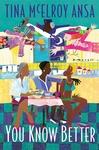
This is my first HarperCollins review for Tina McElroy Ansa's newest book, You Know Better. The book is about three women - a grandmother, daughter, and granddaughter - who are guided by a trio of local spirits, a black educational founder, hardcore nurse, and retired town whore. In the process, each woman learns how to transform generational curses into blessings.
We adults are not setting a very good example for our children. Fear sometimes drives adults to spend more time telling their kids what they can't do than what they can. Children become confused, questioning what's right, ultimately turning to popular media forms for answers. On MTV, we hear popular singers lashing out with words like “ho,” “bitch,” and “nigga,” influencing younger generations to use such words casually. Tina McElroy Ansa's newest work of fiction confronts the power of negative words. The book also demonstrates how morals dilute with succeeding generations. Ansa introduces some solutions via three spirits that guide three generations of women. The spirit trio consists of a local educational pioneer, hardcore nurse, and retired town whore.
Ansa’s first heroine, Lily Paine Pines, is a former schoolteacher, principal, school board administrator, volunteer, and respected pillar of Mulberry, Georgia. She still manages to put her daughter's and granddaughter's needs before anyone else's, including her own. In Lily, Ansa shows us a woman determined to meet the needs of family and community, who has succeeded over the years by sheer integrity. In short, Ansa has given us a heroine to assimilate.
The book opens with Lily combing the streets in the dead of night for her eighteen year-old granddaughter, on a strong hunch the girl is in grave danger. LaShawndra is as precious to her as 'though she were her own child, even if she has a "hoochie mama" (promiscuous) reputation.
Lily first sees the spirit of Miss Moses, local black educational founder, standing under a streetlamp by The Club, LaShawndra’s favorite hangout. Lily marvels over the fact she’d recently seen the woman’s obituary in a local newspaper. But if old Miss Moses is only a vision, she is still a blind and elderly one. Lily helps the lady into her car, and it becomes apparent higher forces are at work.
Lily’s portion of the book is titled “Faith” for what Miss Moses helps her find within. Lily is deathly afraid LaShawndra is going to end up pregnant at nineteen the way she and her daughter did. She comments about LaShawndra's goal to be in a music video, and how she has tried to redirect the ambition. The problem is, she has ignored her own needs. She learns from Miss Moses - who asks, "Child, where IS your courage?" - believing, in God and those you love, is enough.
The second portion of the book, “Hope,” is devoted to Lily’s ruthless daughter, Sandra Pines. She eventually gains this attribute from the stern spirit of Nurse Bloom, former midwife at Mulberry's first and only African-American hospital. It should suffice to say Sandra Pines begins her own spiritual journey as a neglectful, spiteful mother who loves pointing the finger at her daughter any time something goes wrong.
Sandra is Ansa's bodily portrayal of American values at worst. She is a modern woman with her own business, who has acquired an abundance of money, a symbol she favors over her daughter. On the day of two break-ins, Sandra blames LaShawndra for both (LaShawndra's place is one, Sandra's is the other). She cries, “What kind of person have I raised who would steal from her own mother? LaShawndra knows better!" That Sandra is more concerned for personal assets than for her daughter's safety reflects our misguided culture.
It is nonetheless through Sandra's learning that Ansa teaches us we can't ignore our hearts: Sandra remembers LaShawndra at age eight trying to make breakfast. The two images she recalls is her daughter burning the one good Calphalon pan, and the pain in her daughter’s voice when she “muttered, ‘I was just tryna please you!’” Isn't it interesting that "the kind of person who steals from her own mother" was once a child hoping for approval? Ignoring one's child can yield sad results.
Nurse Bloom, reading her thoughts, instructs Sandra to “bless her child” with the blessings she has received from Lily (productivity, love). This book makes it clear we must pass down our finest lessons.
LaShawndra’s is the final chapter. It is titled “Love." Enter the spirit of Eliza Jane Dryer. This spicy elderly lady wearing a short skirt, low-cut shirt, and inviting smile knows there is power in words. LaShawndra represents today's MTV generation: She calls herself and others "ho," "bitch," and "nigga" like she were buttering bread - all before Miss Dryer!
Miss Dryer, once a "hoochie mama" like LaShawndra, used to playfully berate herself in front of men for attention. She suspects LaShawndra is talking the talk of her ambition (being in a music video), but Miss Dryer insists the more times she calls herself a "ho," the more she'll be inclined to believe it till that is what she becomes. Evidence of Miss Dryer's warning has already presented itself many times within the story (LaShawndra's sleeping with a number of men who claim to be "in the music industry"). It is LaShawndra's careless lack of respect for herself and others that is the reason behind her hitching a ride with Miss Dryer out of Mulberry: She gave a key to a stranger who then broke into her friend Crystal's apartment (where LaShawndra also stays), landing Crystal in the hospital.
It is necessary to mention Crystal stands for responsible young people. She has treated LaShawndra like one of the family, letting her slide on rent, cooking her meals, and encouraging her children to call her “Auntie LaShawndra.” Unfortunately, we only experience Crystal through characters’ descriptions of her, and I can't help but think her mighty example would have had more impact in person.
Nonetheless, Ansa has painted a decent portrait of what young women like LaShawndra may aspire to be like.
Near book's end, LaShawndra finds herself increasingly distressed over her best friend's state, which she feels totally responsible for (for the first time ever). Miss Dryer persuades her to "face the music," paving the way back to Crystal, Lily, Sandra, and Mulberry.
You Know Better is about turning generational "curses" into blessings. More importantly, it is about how people can change.
|