AuthorsDen.com   Join | Login    
Where Authors and Readers come together!

SIGNED BOOKS    AUTHORS    BOOKS    SAMPLE CHAPTERS    AUDIOBOOKS    eBOOKS    STORIES    ARTICLES    POETRY    BLOGS    NEWS    VIDEOS    SUCCESS    TESTIMONIALS

Featured Authors:  Alexander Shaumyan, iShirley Francis-Salley, iLloydene Hill, iBruce Humphrey, iDonald Beaulieu, iGlen Schulz, iMiller Caldwell, iPamela Wiedenbeck, iShannon MacLeod, iJudy Joy Jones, i

  Home > Military > Articles Popular: Books, Stories, Articles, Poetry      Authors: A B C D E F G H I J K L M N O P Q R S T U V W X Y Z     

Regis H. Schilken

 Follow Me  

· Contact Me
· Books
· Articles
· Poetry
· Stories
· Blog
· 137 Titles
· 182 Reviews
· Save to My Library
· Share with Friends!
·
Member Since: Jun, 2005

Regis H. Schilken, click here to update your pages on AuthorsDen.


We Were One: the Story of fallujah
by Regis H. Schilken   
Not "rated" by the Author.
     
Recent articles by
Regis H. Schilken

• Book Review: Collecting Cooper by Paul Cleave (5 stars)
• Book Review: Transitioning Embedded
• Book Review: All Cry Chaos by Leonard Rosen (5-stars)
• Book Review: Tears of Deceit
• Book Review: Flight by Harrison Jones
           >> View all

Those who took Fallujah suffered more than we can imagine both there and psychologically at home.

 We Were One - Shoulder to Shoulder With the Marines Who Took Fallujah by Patrick K. O'Donnell

Heroic are those Marines who manage to come back from Iraq alive, carrying with them the agonizing mental and physical scars of battle that may not heal in a lifetime. In We Were One: Shoulder to Shoulder With the Marines Who Took Fallujah, the ghastly horror of war is brought to life with grisly realism because historian Patrick O’Donnell had the guts to walk side by side with the Marines of the 3rd Battalion, 1st Marine Regiment, as they fought their way into and through Fallujah.

Their battle was like no other. It involved the unimaginable task of Marines fighting through Fallujah by clearing the enemy from one house after another as they worked their way slowly through the streets with its labyrinth of alleys and passageways between buildings.

O’Donnell’s description of clearing a house leaves little to the imagination. Marines would enter a building’s first floor. A team of two would kick in a room door while tossing a grenade. That Marine would enter and spray the room with gunfire hoping to kill or disable any enemy within. Often the enemy had erected barriers behind which they would hide ready to cut in half the first Marine who entered with point blank, machine gun accuracy.

Then too, O’Donnell describes how many of the drug-hyped, suicidal enemy would sit in a room knowing that as they died, they could take a Marine or two with them. It is difficult for the mind to even comprehend clearing a house or a large apartment building against this type religious fanaticism.

We Were One is difficult to read because of the horrors told there: bodies cut in half, men with faces missing, soldiers decapitated, legless; Marines who had to continue the fight after wiping the bloody pulp from their faces and weapons of another Marine who had just been obliterated.

The book is well written and easy to follow even though it contains many acronyms. A reader might want to write down their meanings the first time they’re given. There are several maps to help the reader visualize Fallujah and arrows to indicate specific assault movements.

I would highly recommend We Were One not just to the general public, but to our government in Washington specifically, because the story is real. It is in Iraq today where Fallujah-like battles are fought by U.S. soldiers and those brave Iraqi men willing to fight beside them. It may help elected officials see first hand every emotion that goes along with the loss of a close buddy, or the elation of victory.

This is an unforgetable story about boys who become men on the battlefield, whose objective was to survive one day, and then the next, and the next. It is a story about men who forged a unique bond that only the battle-weary can experience - a bond in which each would make the ultimate sacrifice for the other, a bond that made them one.


Want to review or comment on this article?


Need a FREE Reader Membership?
Popular Military Articles
  1.  Recreating Luftwaffe WW2 History
  2.  Of Uniform Concern: A Casual History o
  3.  Submerged Shadows: WW2 submarine crew
  4.  The Swiss SM-90 and SM-3 CBRN respirat
  5.  Notes on the Swiss Army Helmet M(19)18
  6.  A Brief History of Convair F-106A 59-0
  7.  Two diverging takes on Veteran's Day,
  8.  The Greatest Loss - U.S.A.T. Dorcheste
  9.  A Cold Warrior's Final Patrol: Russian
  10.  German Wartime Ejection Seat Developme
  11.  IN MEMORIAM
  12.  A Brief History of the Convair F-106 '
  13.  Creating an authentic 2WK Luftwaffe Ai
  14.  A 'reverse-racist' encounter in the p
  15.  Mach-2 Orgasms: The need for speed...
  16.  Navy Brat 4 Ever
  17.  IN THE NAME OF GOD - ALLAH ?
  18.  Saving Our Canine Vets, This Veterans
  19.  Weasel Conspiracy-the War in Vietnam L
  20.  A Marvelle-ous New Approach to Leaders
  21.  Helping Our Vets and Homeless Pets
  22.  A Son Remembers His WWII Dad
  23.  Parochialism and Joe Biden’s candidacy
  24.  St. Crispin's Day Battles in English H
  25.  Veteran's Day Message, Take Heed Once

Free Book Review Program
Select a book to read and review today!

U S Chemical and Biological Defense Respirators by Kalikiano Kalei

An illustrated developmental history of the American military chemical and biological protective respirator for use against war agents, this work provides photographs of actual respirator specimens and several useful appendices, in addition to its en  
Member BookAds

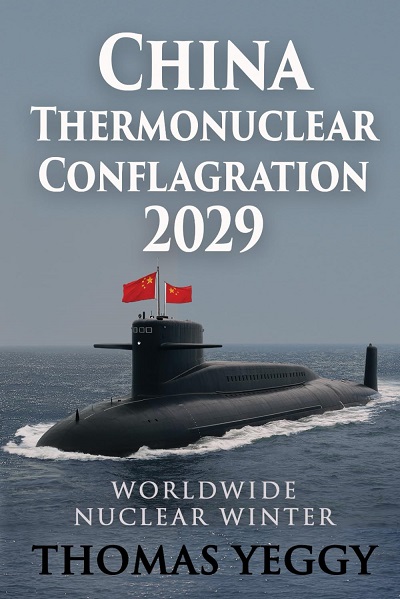
China Thermonuclear Conflagration 2029: Worldwide Nuclear Winter by Thomas Yeggy

We stood by once and watched the world burn. Will we do it again?  
Member BookAds

Mushroom Cloud: Book I of the First Strike Series by Thomas Yeggy

Mushroom Cloud, a fact-based historical novel, is the first book of The First Strike Trilogy: USA and the Soviet Union are building nuclear arms for a face off in a potential nuclear war in the late 1950's and early 1960's.  
Member BookAds