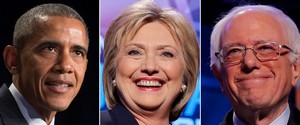
Obama’s Critique of Bernie Sanders
In his address to the graduating class at Howard University on May 7th, Pres. Obama challenged the central theme of Bernie Sanders’ presidential campaign. He chastised Bernie Sanders for wanting too much. He said that compromise is accepting what you can, and then trying for a little more somewhere or sometime down the road. He argued quite vociferously against revolutionary transformation. Incrementalism is the art of politics, he averred, or striving for what is achievable. Compromise also spares everyone concerned the clashing of ideologies, of hurt feelings, and the ability to get other things done later. That is what a president must do in office. He or she must be willing to compromise and accept less than what is desired.
Obama’s words are a good defense of his time in office. He has met the opposition at every juncture in trying to accomplish almost anything. He has made a few spectacular successes, achieved many minor changes, and met with many failures, large and small. And although their two positions are not—nor have they been—the subject of a debate, it is fair to ask “who has the better position?”
Bernie Sanders wins this contrived debate hands down.
In order to fairly judge who has the better position, we must consider not only the words each used (meaning), but also the words that precede and follow those meanings (context), the time and place in which they are said (setting), and the purpose that each has in mind (who is their audience?). The issue comes down primarily to purpose—who is their audience, and what is each trying to accomplish?
Let’s begin with Sanders since his purpose and audience are readily known. Bernie Sanders is a candidate for the highest office in the land. Indeed, many have referred to it as the “leader of the free world.” His audience is vast, it is diverse, and it encompasses every culture, every ideology, every religion, and to some extent, to the hopes and dreams of all wherever they reside. He must, of necessity, articulate a far reaching vision of what could be. He must inspire, he must show passion, and he must speak from facts, from logic, from experience, as well as from his heart. This is his “propitious moment,” his “tipping point” in time. He must show that he wants to be elected, that he has the moxie, the heart, and the drive to lead his team. He may never again have such a vast audience, such a moment, or such a setting. He sells everyone short including himself if he tells less or expects less.
The president’s position is valid, but within the limited framework of negotiations, or as a defense of his time in office, or as an indirect way of offering tacit support for Hillary Clinton’s candidacy without actually endorsing her. Incrementalism, however, is no substitute for a clear vision that includes the good that we can do, the hope for a better life, and what we need to change on a grand scale in order to make them a reality.
The two positions are not pragmatism v. pragmatism, rather pragmatism v. idealism. With pragmatism the debater argues from the limited position of reality, of what is possible, and with the limitations of budgets and opposition. He argues from facts. But the idealist must argue with the tools of rhetoric. Facts do not inspire; vision, and supreme ideas couched in wonderful phrases can inspire (e.g. MLK’s speech “I Have a Dream”). There is a time and place for everything.
Carry on, Bernie. The stage is yours.