Some other religions in this world
Are worked out for inspiration
And people’s living emotions,
The feeling for the grim grandeur
And mystery of the universe and
A quest for security in time and space,
Satisfying man’s spiritual force
And unerring instincts for life.
There are moments in our lives,
Perhaps during the loss of our dears
Or during the phase of convalescence
From a serious sickness or calamity,
Or perhaps on a chilly autumn morn
As we look at the falling leaves
And a sense of death and futility
Overcomes us when we live more
Than the life of the senses
And we look over the visible world
Straightforward to the open sky. . .
Such moments come to all habitants
Of the Asian regions as of the West,
But reactions of them are different,
Decidedly different, I would say.
As for the Asians, their Confucius,
With his common sense,
Who dismisses supernaturalism
As the realm of the unknowable
And expends utterly little time over it,
Is equally emphatic in the assertion
Of the superiority of the human mind
Over nature and in the denial
Of nature’s way of life or naturalism
As the human way—an attitude
Clearest in another great thinker
By the name of Mencius.
The Confucian conception
Of man’s place in nature is that
Heaven, Earth and Man are regarded
As the three powers of the universe.
It’s a distinction somewhat
Corresponding to the threefold distinction
Of supernaturalism, humanism
And naturalism. Heaven is seen
As consisting of the clouds, the stars
And all those unknowable forces
That the Western legal phraseology
Sums up as "acts of God"
While the earth is seen as consisting
Of mountains and rivers
And all those forces ascribed
In Greek mythology to Demeter
Or Ceres, her Roman equivalent,
And Man occupies an all-important place
Between the two entities.
Man knows where he belongs to
In the scheme of things
And is greatly proud of his central space.
Like a Pagoda’s roof
And unlike the Gothic spires,
His spirit does not aspire to the heavens
But broods over the earth.
So, the question is: Whether does Man
Belong first to Heaven or Earth?
Any religion’s greatest achievement
Is to attain a measure of harmony
And happiness in this earthly life
Known as ‘the worldly attainments.’
The flying form of a Chinese roof
Suggests that the harmony and happiness
Is first to be found at home. Indeed,
The home stands for all of us
As a symbol of the worldly scale of values,
But the Asians have achieved
This simple ideal not by laziness of effort
But by a positive worship of simplicity,
Or the religion of common sense
Summarized by the name of ‘the heavens.’
How this can be achieved
The West has to realise for its own welfare.


 Share
Share Print
Print Save
Save Follow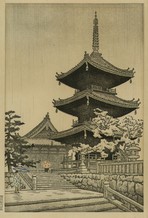






compelling read
when living simple is common sense after all.
Always,
Deborah
I plan to just simply disappear from life altogether. But my writings, now in electronic form, will remain forever in hyperspace… Unless they are erased or deleted by religious fanatics of the future.
Ron