You are a fearless poet, unafraid to let your emotions guide your pen,
and they do so with guile and stealth and masterful strokes of misdirection. Do they have a destination? I'll need to keep coming back to find out. Wonderful craftsmanship that leave me gasping for more.
Beautiful and mysterious. Ekphrastic in nature. An interesting interpretation of the image I'm thinking. Your poetry is still as challenging as it was years ago. Enjoyed this. Peace... r
When I see the statue depicted, the first thing I wonder is, "how on earth did the sculptor get cold stone marble to look like soft veiling?" I think everyone wonders that. And I think your first lines capture that wonder, but then, somehow, you lift the veil. Perhaps the better question is, "why did the sculptor veil her? Nothing is hidden."
So what other things are veiled, and why are they veiled? Furniture, stored, forgotten, avoiding dust. Future. Death. Secrets. Lies. Mystery. Things we don't want brought to light.
Here, in this poem's second stanza the paradox is that the figure's inner light reveals a shadow cast by a lie. Who lied? "Killers of prayers". "Strippers of layers of civilised worlds".
I can see the chiseler in that. Chiseling off layers of marble, as too we, in society, chisel away layers of civilisation. Under the guise of becoming deeper-- delving into spirituality, theology, sociology-- our meanings become more and more shallow.
And as in the last stanza with the sculptor, in all our discarding of past rubble, for all the laying bare we've done, all we've done really is to make laying bare unremarkable.
In the end, we readers are left feeling exposed, and wondering for all the world what freedom really is. --Charlie
BTW, I love that word "afloat". The images that concocts...!
Completely aside from the fact that that particular statue in reference is a marvel of human art sculpturing, your chosen words have a piquency and pungency that lingers in the mind not unlike the subtle aroma of an unidentifiable but intriguing incense wafting by on a sunset zephyr. Even such moments of unexpectedly delightful balm pale against a backdrop of savagely odoriferous reactivity. But then, the world is, and always has been, full to the brim with lies, narcissistic deceits and myopic iconoclasms. Especially when the frame of reference is female.
Your poem is worded in a way that more confounds me rather than enlightens. But the image reveals much about how women were treated in the past… and still are.
I was attracted to the statue because of the skill of the sculptor to be able to, carving on stone, carefully overlay what could be mistaken for human flesh with a diaphanous covering of even a transparent nature. In today's variable world of computerized and printed virtual-reality, an eye and hand like this, goes unappreciated.
A piece of wordsmithing that could have multiple meanings and messages, leaving the reader with a riveting consideration of identity with"wiped away by a norm mimicking freedom." How gender universal that line is.
Exploring the impact of literary icon Flannery O'Connor's noted legacy on the cultural realities of modern-day America, the world, and a certain author.
Exploring the impact of literary icon Flannery O'Connor's noted legacy on the cultural realities of modern-day America, the world, and a certain author.


 Share
Share Print
Print Save
Save Follow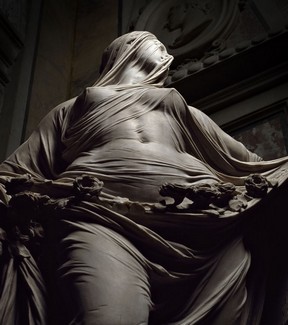

and they do so with guile and stealth and masterful strokes of misdirection. Do they have a destination? I'll need to keep coming back to find out. Wonderful craftsmanship that leave me gasping for more.
So what other things are veiled, and why are they veiled? Furniture, stored, forgotten, avoiding dust. Future. Death. Secrets. Lies. Mystery. Things we don't want brought to light.
Here, in this poem's second stanza the paradox is that the figure's inner light reveals a shadow cast by a lie. Who lied? "Killers of prayers". "Strippers of layers of civilised worlds".
I can see the chiseler in that. Chiseling off layers of marble, as too we, in society, chisel away layers of civilisation. Under the guise of becoming deeper-- delving into spirituality, theology, sociology-- our meanings become more and more shallow.
And as in the last stanza with the sculptor, in all our discarding of past rubble, for all the laying bare we've done, all we've done really is to make laying bare unremarkable.
In the end, we readers are left feeling exposed, and wondering for all the world what freedom really is. --Charlie
BTW, I love that word "afloat". The images that concocts...!
I was attracted to the statue because of the skill of the sculptor to be able to, carving on stone, carefully overlay what could be mistaken for human flesh with a diaphanous covering of even a transparent nature. In today's variable world of computerized and printed virtual-reality, an eye and hand like this, goes unappreciated.
Ron