Excerpted from a travel essay entitled Riding High in Eastern Turkey, a journey I took several years ago. This excerpt recounts the encounter my six fellow travelers and I had with the world famous Mount Ararat, known to be the final resting place of Noah's Ark after the Biblical flood water had receded.
JOURNEY TO MOUNT ARARAT
by John Herlihy
As we depart from the shores of Lake Van and proceed to our next destination, the city of Kars near the Iranian border, we found ourselves finally on the “silk road”. Along the way, there were two notable sights worth mentioning as we draw near to the melancholy approach of journey’s end. Moving across the sweeping plains of Mesopotamia, we view the majestic Ishak Pasha Palace in the distance. Fortunately, we will not have to make our way on donkey, or worse on foot, to the glorious vantage point of the palace, set on a craggy knoll atop a highland plateau with sweeping views of the local countryside clear to the horizon. Built in the 18th century in the Ottoman style — the Harem section of the palace was completed in 1785 — with layers of administrative sections blending into the interior after the fashion of the Topkapi Palace in Istanbul with its similarly layered courtyards. Three sides of the palace face the grand spectacle of the open plain that lay below like a broad and inviting carpet spreading to infinity. In the distant line of dust lay the city of Dogubeyazit, a settlement with a long history and distinguished by the fact that it lies just 15 kilometers in the shadow of the majestic Mount Ararat.
The famous Mount crept up on us silently like an animal on all fours. We were coming into the final stages of the tour in blissful ignorance of its impending approach and had a long stretch of road in front of us before reaching our next destination in the city of Kars, a city that was occupied after the Russian invasion and witnessed the Battle for Kars in 1878. We had grown accustomed to the leisurely pace of the broad Mesopotamian plain passing us by beyond the car window, the gentle rolling hills and featureless mounds almost taken for granted on the jaded side of journey’s end. “There it is,” Evelyn intoned, as though she had just crawled up over the horizon and seen the dark side of the moon. “Suitably snow-capped in July,” she added in a deadpan manner, as though adding additional paint to some masterpiece with a final flourish. We all stared out of the windows of the van in unison and a hushed silence filled the air for once amid this talkative group of conversationalists who were my fellow travelers.
What strikes the onlooker of this magnificent vision is its noble presence amid the gentle slopes and foothills that form the hem of the mountain’s garment, together with the supreme solitude it conveys in all its loneliness, all dressed in white, like an expectant bride, awaiting the recognition of the moment. What is it about such natural artifacts as mountains and oceans that resurrect ageless sympathies buried deep within the well of the soul, feelings that seldom find room in our everyday consciousness, in which plans and worries, unreasonable expectations and natural confusions color our days with their turmoil and moods. Now the sacred mountain lay before us in the distance for our reflection and appreciation. You can drop a stone into the well of such an experience, but never hear its splash at bottom’s end. A collective shout to our driver, Zahir — who doesn’t speak much English, but didn’t need to in this case - brings the van to a halt for some picture-taking, as we all scramble out with our digital cameras. We click away, but can hardly see anything in the viewfinder, whose digital image fades when set against the direct light of the sun, a systemic failure that modern technology has yet to resolve.
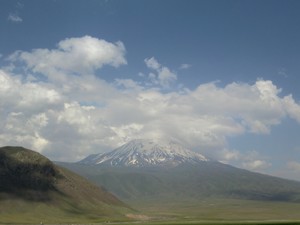
The mountain is the ghost in the image. As individual journeyers, we stand by the side of the road in awe of its presence. The mount stands majestic in its solitude. There are no extravagant mountain cliffs, sharp peaks, or rocky crags as you might find in the Rockies or the Alps. The rise from flatland to mountainside is gradual and purposeful, as though the flatland and rolling pastures had suddenly changed their mind in some primordial era of geologic evolution to create this more suitable pathway to the mountain, not to mention the grandeur of the mountain itself. As we gaze from horizon to horizon, a leisurely incline begins to emerge and turn into the bulky back of some sleeping behemoth. The grass line gives way to a grayish pavement of slate and stone which features the beginnings of the seams and run-off valleys of the ascending mount. No doubt, from the perch of the mountain bluff, the surrounding grasslands look like a peasant’s skirt, with a variety of greens enlivening the enfolding land as it pays tribute to the encroaching peak, the resting place of Noah’s Ark according to the Bible (Genesis 8:4; Book of Jubilees 7:1) in which the mountains of Ararat are directly mentioned.
Treeless and amid the setting of this grand sweeping expanse, the twin peaks of the mount are covered with a frosting of snow, giving the appearance of a seasonal anomaly in the harsh summer light. The peaks appear to be floating as though in levitation against the backdrop of eternal blue mounted in the sky. The mountain is a stand-alone; the mountain is one and unique of its kind. It has one life that is as eternal as anything on earth can be. The mountain has one life, one soul. It breathes of life and eternity, stability and firmness. It has wisdom to convey and an experience to unfold to the onlookers. It beats with one heart and is invested with all the qualities that we wish to imbue. Behold Ararat, the resting place of Noah’s Ark, the island in the flood; the sanctuary spared death and destruction because it harbored no living thing until the arrival of those individuals and animals that God had spared. This mount was destined to become the place of repose for the tired and anguished souls of humanity as they returned to the safety of its abiding presence of land. It still fills the hearts of seasoned travelers of the modern era with admiration and awe for its sacred presence and its enduring mystique.
We climbed back into the van and continued on with our journey across the great plain of Mesopotamia; but a silence continued to reign for some time within the van, as though, not that the cat had got our tongues, but that seemingly a unicorn had made an appearance into our world from some distant imaginary one and held us firmly in its embrace, a lingering blessing that continued to haunt the mind for some time as a luxury of the imagination, in the wake of the experience of the mountain. In fact, we didn’t simply depart from the Mount. It followed us around throughout the day like a shadow mirage, different angles, different visions, and different light from morning to afternoon to dusk, always there is the background, promising to be a day-long experience that would not give us up until we forgot its presence and then suddenly it was gone. I put my hand on my heart in a brief and final salutation to the sanctity and blessing of the mountain before giving up its ghost for the last time. Now I realize that the mountain continues to come with me as a mountain of the mind, a traditional symbol if you will of that otherworldly embrace that will not give us up and offers serenity and peace to the aspiring soul.
From your lavish description, you appeared to be greatly moved by coming up on the scene of Mount Ararat in an otherwise, rather normal, tour. Just from its description, I don't see the mountain as exciting, even though it is, and has been studied, as the resting place for Noah's Ark. Perhaps that is what turned you onto the moment.
US State Journals, pages for you to fill in the blanks.
Nurture your creativity with My Indiana Journal, an interactive journal designed to spark your imagination and self-motivation
"The statues of Savannah's Monument Square are silent. The statue of the solemn girl in Bonaventure Cemetery—made famous in John Berendt's blockbuster book, Midnight in the Garden of Good and Evil—can't speak. Only Savannah's literary monuments can g




 JOURNEY TO MOUNT ARARAT