Taj Mahal, Banquet Hall of Eternity
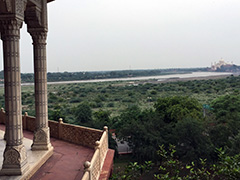
For the last eight years of his life, the Mogul Emperor Shah Jahan (King of the World) looked out from his gilded prison in the Agra Fort across the greensward along the Yamuna River at his creation, the Taj Mahal, the tomb of his great love Mumtaz Mahal (and after his death in 1666 his own tomb). This same view can be seen today, almost unchanged in 350 years. No big structures interrupt the picture. The river gently sweeps by. On the soft southern riparian edge nestles the white mausoleum that the great Indian poet Rabindranath Tagore, said, rises “above the banks of the river like a solitary tear suspended on the cheek of time.”
The Axis is East and West. From his balcony the aging Shah watched the tomb, lodged in the skin of the earth, transform from a shimmering pearl at sunrise to a shadowing white jewel over the day becoming on cloudless nights a luminous diamond in the moonlight. Behind him was Mecca, the holiest city for Muslims, birthplace of Mohammed, and where he received his first revelation of the Qur’ an. For a ruler devoted to the arts, this was the place to contemplate the relentless passage of time from birth to final breath. This is the great and telling view of Taj Mahal.
The image of the Taj Mahal commonly associated with the mausoleum is the view looking north after the visitor penetrates the red sandstone southern gateway and sees the structure at the end of the long reflecting pooling. The view is compelling and begins with the mausoleum appearing as an almost ghostly apparition beyond the dark portal with its arch shaped doorway, the iwan, that mimics the giant iwan below the dome of the Taj Mahal, but it is the lesser approach to this masterpiece. The Shah and his royal relatives came along the river. The path through the southern gateway was means of entry for members of the Shah Jahan’s court, other supplicants to the emperor, and is the means that tourist hordes utilize today.
Over the centuries since its construction the esplanade beyond the southern gate has been altered and manipulated to bring an alternate meaning to the significance of the Taj Mahal. Like the almost blinding light that surrounds the structure once a visitor crosses the shadowy width of the South Gate, the mausoleum dematerializes only to be reconstituted once beyond this screen to satisfy the objectives of a different story. Even in the emperor’s time and continuing to today, the dreamy presence of the Taj Mahal has engendered another myth that changes what the tomb represents, diminishing its spiritual significance and secularizing it for the tourist market.
All the stories associated with the tomb are great tales that the elegant forms of the monument constructed in the pearlescent white polished marble from the Markrana quarry, the same quarry in Rajasthan that supplied the stone for the American White House and still supplies the world with white marble today. The severe geometric block surmounted by a dome incised with arches and flanked by minarets embodies the Taj Mahal’s immense attraction. The sensuous black inlaid calligraphy of the exterior, the iridescent and colorful semiprecious stone lapidary and the exquisite floral wall bases of the interior deepen the aesthetic mystery.
The mausoleum is structure where the implied content is as great as the form that attracts three million visitors a year. As deciphered today, the Taj Mahal is about great love. Shah Jahan so loved his second wife, Mumtaz Mahal, who died in the birth of their fourteenth child in 1631, that he built this monument to house her remains. It took eleven years to construct and another ten to add the southern gateway, mosque, and guesthouse. The emperor spent billions of rupees (today’s rupee) building the tomb. Abdul-Hamid Lahori, a historian of Shah Jahan’s reign, records in his Padshah-nama that the emperor’s black beard, turned white overnight in grief at Mumtaz’s death. He fell ill and became a recluse, still spending the empire’s fortune. He depleted so much of the Mogul Empire’s wealth that his own son Aurangzeb deposed him. Imprisoned in his own quarters in the Agra Fort, the fallen emperor spent the last years of his life gazing at the white marble mausoleum down the sweep of the river Yamuna pining for his beloved.
Far and wide visitors, especially foreign visitors, spread the compelling story of an emperor’s love. Jean-Baptiste Tavernier spread the fable that the inconsolable Shah Jahan intended to build a second black mausoleum for himself on the opposite back of the river facing his wife’s tomb. When the British took over India, the Mogul Empire had faded and the Taj Mahal was in disrepair, but the legend of unwavering love became the important legacy. In the late 1780s and ‘90s, the artist Thomas Daniell came to exotic India and painted several images of the Taj Mahal that became popular commercial aquatints. The romantic poets and writers of the 19th century embraced these images. Journalist and poet Edwin Arnold wrote,
“Not a piece of architecture, as other buildings are, but the proud passions of an emperor’s love wrought in living stones.”
By the beginning of the 20th Century, The Taj Mahal was threatened with destruction. Lord Curzon, the new Viceroy of India, preserved the mausoleum, but he made an essential change to the plan of the monument. Lord Curzon eliminated the gardens, the reservoir, and intersecting canals that lay to the south of the Taj Mahal. He replaced them with a central reflecting pool flanked by with long lawns after the English imperial fashion. In one move he managed three things. He implemented on aspect of his political policy to play Muslim and Hindu rivalries against one another, diminishing their threat to English power. He saved a world-loved monument. He diminished the Islamic importance of the mausoleum because the original layout was intended to be an earthly reflection of the Garden of Paradise important to Islamic tradition.
The Taj Mahal was planned as “chahar bagh,” a Persian model for the Garden of Paradise that Babur, founder of the Mughal Empire, introduced to India in 1526. Paradise was divided into four parts by four rivers that intersect in the middle. Each quadrant of paradise has a separate garden planted with varied trees, flowers, and specimen plants. This arrangement can be seen in Daniell’s painting. The mausoleum was positioned at the north end. Shah Jahan and his architects altered the typical plan, in which a mausoleum was placed at the center of the intersecting waterways. Instead, the tomb is placed at the north end of a vast triumphal way. Located at the center of the four waterways, was a large ornamental pool with fountains termed the reservoir of abundance after Mohammed’s vision of paradise. Positioning the mausoleum at the end of the central pool enhanced the whole concept of this place as an earthly paradise. The square in front with a vaporous reflection of the symmetrical Taj Mahal in the pool and crossing canals underscores the metaphor of the whole. The focus of visual attention is on mausoleum as the termination point where all God’s bounty rests in a banquet hall of eternity.
The loss of the reservoir and crossing canals removed two essential elements of paradise allegory. The remaining waterway becomes a reflecting pool that is a common feature of monumental design. Its objective is not spiritual, but aesthetic. It focuses importance on the structure it mirrors. The idea that the mausoleum was a creation of paradise on earth had been eliminated. All we are left with is the beautiful monument. The striking black marble calligraphy becomes the only code to the paradise metaphor. There are many inscribed on the Taj Mahal such as Sura 89 from the Qur’an written on the southern façade of the arched entrance that says,
“But O thou soul at peace,
Return thou unto thy Lord, well-pleased, and well pleasing
unto Him.
Enter thou among my servants,
And enter thou My Paradise.”
To most visitors, unless they speak and write Arabic, these references are lost. The prevailing myth of the Taj Mahal as a great love story remains. In 2005 a Bollywood historical drama film Taj Mahal: An Eternal Love Story was released to record box office receipts. The story begins with Shah Jahan, known as Prince Khurram when he is about 19 years old. Khurram was Emperor Jahangir's favorite son, whom Jahangir wanted to be the future Mogul Emperor of India. The prince, passionate about hunting, goes into the jungle, where he meets Persian princess Arjumand Begum. Their meeting is love at first sight. After many court intrigues, a first political marriage, and Emperor Jahangir dies, Khurram becomes ruler Shah Jahan. He finally marries the love of his life, Arjumand Begum, who becomes Mumtaz Mahal. The couple live happily for a while until misfortune occurs. Shah Jahan goes to war, but loses his way back to his camp. Muntaz lies dying in childbirth. With her last breath, Mumtaz Mahal asks Shah Jahan to construct for her a beautiful mausoleum. She describes a tomb that would be so beautiful it would express their love for each other to all eternity. Mumtaz's death is a great tragedy for Shah Jahan. Bereaved and reformed, he fulfills his wife's last wish to build the Taj Mahal (The Crown Palace), the Seventh Wonder of the World. The Taj becomes a tribute to the Shah as the greatest lover of all time. At his death, his body is laid down next to his love, thus culminating of their love after death. Most of this is Bollywood fiction.
There are many who dispute the love story. They say that such devotion to a woman, even a favorite wife, is too simplistic an idea for an autocratic ruler who vaunted his grandeur and munificence to the world. For a tomb of this size to be built over a woman is without precedence in Islamic funerary tradition. An acute observer might perceive the symbolic and allegorical significance of the mausoleum to be an example of a sovereign infatuated with his own grandeur. Perhaps both ideas are true . The Shah made the death of a spouse a symbol of beauty. The Taj Mahal, made of many precious materials, is the most magnificent of mausoleums. But I prefer another interpretation, one that can be appreciated in the painting by the cousin of Rabindranath Tagore, Abanindranath Tagore, who wanted to reawaken the spiritual in Indian art, as opposed to the materialism of western art. “The Passing of the Shah Jahan,” can be interpreted as a meditation on the passing nature of life. An old man looks out from his prison at a creation that will remain after he has gone, on a river that will flow by for years and centuries beyond. The tomb celebrates what is lost and what remains when all living things depart for eternity. The tomb is a potent allegory about all life, joy, death, and what lies beyond. A tear for departure lies upon the living land. Love is there, but it is not all.






I never got to India, but had I, I surely would have tried to see the Taj Mahal and Red Fort in Agra. I'm sure the monument is very beautiful, but, I believe that close-up it will be somewhat dirty, neglected, and in disrepair. I may be wrong, but after visiting many monuments like this from the past, especially in poor countries, I found the sad truth rather than what the shining photographs appeared to portray.
Ron