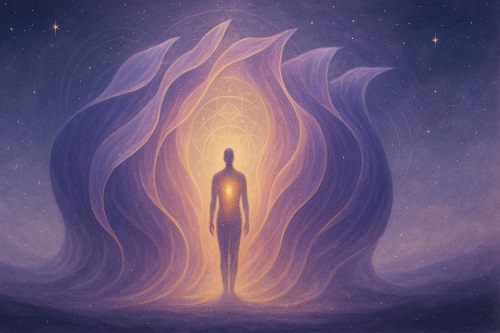
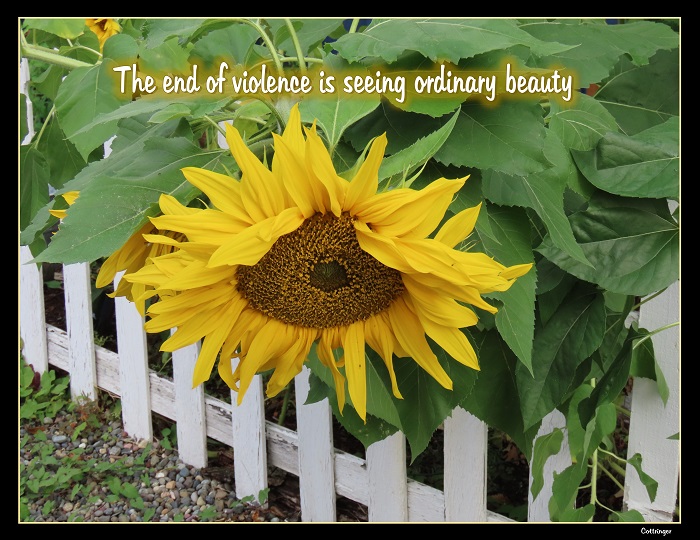
 There are three levels to travel in becoming centered--going to the center of thinking, feeling and being.
CENTEREDNESS
by
William Cottringer
There is a peaceful and powerful place we all strive to find. This place is the center of our being. There are three simultaneous levels of travel to the journey—sorting through the endless dualisms of our minds to locate the center of our thinking; opening our hearts to find the center of our feeling; and working hard to shed the artificial clothing of our souls to discover the true center of our being. The experiences we have and the wisdom we learn from these levels defines the quality of our lives. Centeredness is the reconciliation of our REAL and IDEAL selves.
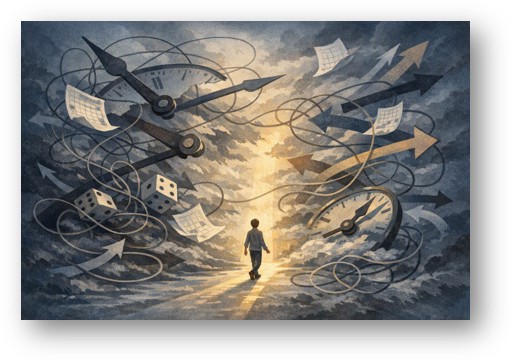
The journey to this Golden Mean is full of joys and successes, as well as bruises and broken bones, failures and disappointments, and detours and distractions—depending upon the adventurous style of the traveler. This is our human journey as spiritual beings—our personal story. The destination is the same, but the journey is what is unique.
The destination is to find GOD. God is everywhere-- but especially in the center of our thinking, feeling and being.
There are two processes we engage in to travel to these centers:
1. Personal Development—The real literal functions of life; removing obstacles and resolving problems, which keep us from making progress towards our goals. Obstacles include such things as unsuccessful thinking, lack of social and people skills, poor communication, lack of determination or desire to improve, not learning from failure and not seeing the connection between our choices and the consequences we get.
2. Spiritual development—The ideal metaphorical goals of life; discovering operating principles and governing truths, which open up our creativity and unfold our potential. This is the process of restoring order to the chaos we helped create through our personal development efforts—by reconciling our sense of separation from our underlying urge of unity, and all the other this and that, yes and no, right and wrong, good and bad “opposites” we took apart.
These two processes are going on simultaneously in a circular cause and effect vicious circle, but we often don’t know that because we are not yet operating from a balanced position to be able to see both sides of the equation, much like not being able to traverse and see the unity of the bigger gap between life and death. We only “know” the particular place from where we are standing and looking, at a given time.
THE CENTER OF THINKING
The journey to the center of our thinking is a long one full of seemingly unlimited dualistic ideas—this and that, yes and no, right and wrong, pleasant and unpleasant, happy and sad, good and bad and so on. It appears that a common evolution in our thinking involves going to the left and then to the right so we can get back to the middle.
This is actually the creative process—where creative truth and wisdom get discovered by combining and then transforming opposites into something new, such as responsible freedom, tentative conclusions and inside-out change. This often results in the flash realization that things are not always as they appear.
Balanced thinking eventually opens the door to the road to the center of feeling. Here we begin to feel the reconciliations we “know” in our minds to be more true . We are beginning to believe them, so that we eventually practice them.
The experience of "enlightenment" is usually what starts our journey to the center of our thinking.
THE CENTER OF FEELING
On our journey to the center of our feeling, we discover God speaks to us in two different voices:
--A loud and frequent one (which oddly we are often oblivious to) that says, “I love you unconditionally just as you are with all your shortcomings and faults. I forgive you for your sins.”
--An occasional whisper (which is seldom missed) that says, “But we both know you can always be a little better if you just obey my suggestions, try harder, improve some of your faults and quit sinning.”
We try to pass on all the wisdom we have learned from the center of our thinking with these two voices—to our children, to significant others in our relationships and to other people in general. However, we haven’t really reconciled these two different voices ourselves and too often over-focus on the second one and even forget the first voice.
Getting to the center of our feeling starts with self-exploration and ends with self-understanding and self-acceptance. Only then—when we accept God’s unconditional love to heal ourselves and become more whole—can we achieve this important sense of balance and make progress at our own personal development and begin to apply this balance to further our spiritual development. We eventually learn these two journeys are really occurring simultaneously and affecting each other, and also that giving unconditional love with our time to others is what helps reconcile our thoughts and feelings so we can begin the journey to the center of our being.
The experience of "falling in love" is what often starts our journey to the center of our feeling.
THE CENTER OF BEING
Getting to the center of our being requires us to take the important life operating principles and governing truths we have learned in our heads and believe in our hearts, and applying them in our everyday life. The road to the center of our being is hidden by a paradox we must somehow understand and practice. This paradox has a lot to do with the two voices of God—Grace and Salvation, in religious terms.
Grace is God’s unconditional love which forgives us from our sins in misusing the gift of human free will to resist surrendering and obeying God’s will; Salvation is understanding the folly of this original sin and then using free will to pass on the Good News of this Grace to others.
By operating from the ultimate balanced position—the center of our thinking, feeling and being—we finally discover how to do this by using our talents and opportunities to help others be more successful in their personal development, so they can too eventually travel through these three levels of thinking, feeling and being themselves. We are often already doing all this without really knowing it; when we do realize it, things begin to make much more sense.
The experience of "being born again" is what usually starts the journey to the center of our being.
The purpose of our life is to get to the center of our being so we can demonstrate this process to others. We have to become balanced in our own thinking, feeling and being so we are sensitive enough to know when the timing is right for others to see, hear and learn from the clues we have to share. In the meantime, we have plenty to keep us busy—continually striving for this ideal position of balance which is always elusive, as it is actually a journey not a destination, or your life unfolding—a work in progress.
William Cottringer is a Success Coach, College Teacher, Sport Psychologist and Writer from Collinsville, IL. He is author of You Can Have Your Cheese & Eat It Too. He can be reached at ckurtdoc.charter.net
|