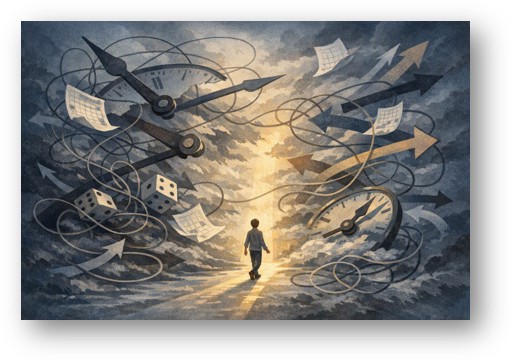
The current divide is made up of gaps between us and life, us and others, and us and ourselves. What originally created the Divide and gaps is the only thing than can cure the problem.
Our Greatest Challenge: Closing Wide Gaps
By
Bill Cottringer
“There is an unalterable and widening gap between exterior and interior, symbol and content, form and function -a gap, which is making the environment more and more inarticulate, impossible to understand and difficult to manipulate.” ~Charles Jencks.
We can all feel the pain of the Great Divide between people everywhere today. This Divide is driven by the three main conflicts confronting us. These three conflicts involve: (a) us vs. life (b) us vs. others, and (c) us vs. ourselves. These three conflicts in turn, involve gaps on both sides of the fence, which some want to close, while others want to expand. The epitome of the human Divide is found in the fundamental dominant hierarchy of the nature of nature itself. From my current perspective, this Divide was originally created by the human ability of self-consciousness, which separated us from the rest of nature. As it turns out, this “affliction” may be the only way to close some of the more destructive gaps that it created.
Here are three of the most pervasive and harmful gaps:
|
· The 5% of the universe we can see and know.
|
vs.
|
The 95% of the unknown, unseen universe.
|
|
· The few elites with all the money and power.
|
vs.
|
The many deprived poor without this money and power.
|
|
· Where we want to be physically, mentally, emotionally, socially, vocationally, and spiritually, from our personal perspective.
|
vs.
|
Where we are and need to be with these dimensions, from life’s perspective.
|
Consider the many other gaps that make up the Divide:
|
· What leaders know and can do
|
vs.
|
What followers know and can do.
|
|
· Having hope and optimism about life and people.
|
vs.
|
Seeing people and life through a cynical, pessimistic lens.
|
|
· Being open-minded.
|
vs.
|
Being close-minded
|
|
· Willingness to embrace change, conflicts and failures
|
vs.
|
Resisting change, avoiding conflicts, and denying failures.
|
|
· The espoused, ideal values preached by institutions and organizations.
|
vs.
|
The real values actually practiced by the people.
|
|
· Denotative word meanings.
|
vs.
|
Connotative interpretations of word meanings.
|
|
· Empathy.
|
vs.
|
Sensitivity.
|
|
· Absolute morality.
|
vs.
|
Relative morality.
|
|
· Competitive, win-lose mentality.
|
vs.
|
Cooperative, win-win mentality.
|
|
· One-size-fits-all, shotgun educational curriculum for classes of students.
|
vs.
|
Customized curriculum for individual students
|
|
· What we all have in common.
|
vs.
|
Our individual differences.
|
|
· Other-directedness.
|
vs.
|
Inner-directedness.
|
|
· Listening only to respond cleverly.
|
vs.
|
Listing to understand and respond in kind.
|
|
· Intrinsic motivations.
|
vs.
|
Extrinsic motivation.
|
|
· Free will.
|
vs.
|
Destiny.
|
|
· Responsibility.
|
vs.
|
Irresponsibility.
|
|
· Perception of free choice.
|
vs.
|
The reality of social conditioning.
|
|
· Convergent thinking
|
vs.
|
Divergent thinking.
|
|
· Trusting.
|
vs.
|
Distrusting.
|
|
· Efforts made.
|
vs.
|
Results achieved.
|
|
· Head’s thoughts.
|
vs.
|
Heart’s feelings.
|
|
· Our ideal best self.
|
vs.
|
Who we are pretending to be.
|
|
· Safety and security.
|
vs.
|
Environmental forces threatening these needs.
|
|
· Reacting.
|
vs.
|
Acting.
|
|
· Creation.
|
vs.
|
Destruction.
|
|
· Reality as perceived.
|
vs.
|
Reality as existing.
|
|
· Political extremists who want to widen these gaps, with less regulations and more individual freedoms.
|
vs.
|
Political extremists who want to do the gap-closing for the people, with more policies and restrictions on freedoms.
|
It is ironic, that what caused these gaps—human self-consciousness—is the only cure. Here are some sensible gap-closing guidelines:
· Identify the littler gaps that can collectively help close the bigger ones. Sometimes a small change, well-timed and strategically placed, can yield very large results. An example is changing some negative words to positive ones, making an unpopular announcement of an impending change, more acceptable.
· First, seek to understand the true nature of the right gap that needs closing first, by getting in the trenches and observing and listening closely to what is being said and done. Just remember to get out of the swamp when you are knee deep in allegators.
· Gap-closing can’t be done for people; people must learn how to do it themselves, which requires expert, committed teaching and training of the essential knowledge and skills needed to do this. This is represented in the (modified) popular saying, “Don’t give a person a fish to eat for a single meal, but teach him or her how to fish, so the person can catch their own fish and have meals the rest of their life.”
“Believing there is a bridge from where you are to where you want to go is 99% of the battle. The other 1% is to cross it.” ~Richie Norton.
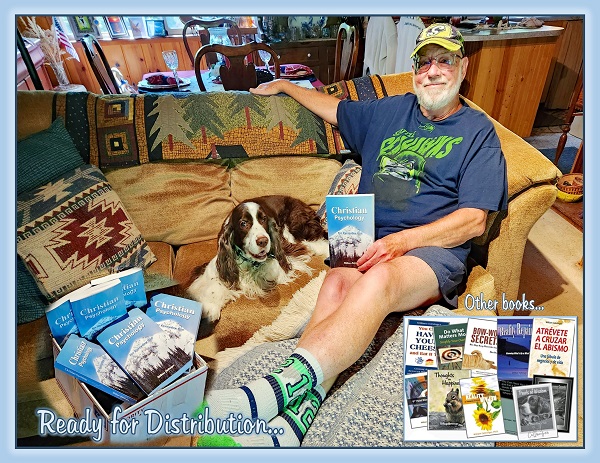
William Cottringer, Ph.D. is retired Executive Vice President of Puget Sound Security in Bellevue, WA, along with being a Sport Psychologist, Business Success Coach, Photographer and Writer living on the scenic Snoqualmie River and mountains of North Bend. He is author of several business and self-development books, including, Re-Braining for 2000 (MJR Publishing); The Prosperity Zone (Authorlink Press); You Can Have Your Cheese & Eat It Too (Executive Excellence); The Bow-Wow Secrets (Wisdom Tree); Do What Matters Most and “P” Point Management (Atlantic Book Publishers); Reality Repair, (Global Vision Press), Reality Repair Rx (Publish America); Thoughts on Happiness; Pearls of Wisdom: A Dog’s Tale (Covenant Books, Inc.) Coming soon: A Cliché a day will keep the Vet Away (Another Dog’s Tale). Bill can be reached for comments or questions at (206) 914-1863 or ckuretdoc.comcast.net.
|









Another example is families who change their minds and regret claiming "freedom" for their failure to use any form of protection against COVID-19 after they get the disease and suffer greatly, some dying. I call that, learning the hard way.
Finally, I love the phrase, "[G]et out of the swamp when you are knee deep in allegators. Especially that last word--original?
Ron