The Tao of Teams
by
Bill Cottringer
“Alone we can do so little; together we can do so much.” ~Helen Keller, activist.
Effectiveness and successful results in today’s government, business and non-profit organizations is mostly delivered by effective teams. The Gestalt Principle silently chants the game-winning mantra as a cheerleader behind the lines--that the whole is much greater than the mere sum of its parts. Or in team language, the team working together can accomplish much more than any individual team member can alone. Champion sports teams epitomize effective teamwork. The Tao, or way of team building, involves these three important aspects discussed below:
Team Development
Teams typically progress through Tuckman’s five stages of development during the team building process:
1. Forming: This is the beginning stage where team members politely get to know each other’s hobbies, interests, skills, and preferences. The forming stage is characterized as “cocktail chit-chat” with focus on discussing roles, responsibilities, and timelines.
2. Storming: Here is where uncomfortable conflicts about values, decisions and perspectives start disrupting forward progress and when authority begins to be questioned. During this critical stage of development team members are functioning more as individuals than a cohesive team and members compete for roles and responsibilities.
3. Norming: To get to this stage of team development, the team must resolve conflicts assertively with supportive communication. During the norming stage, members agree on roles and responsibilities, reach consensus on important decisions and actions, and actively delegate or assume productive responsibilities as a more cohesive unit.
4. Performing: Norming has to resolve the storming stage to get to where the team performs most effectively as a cohesive team working both autonomously and together, as needed, with peak communication and minds being read.
5. Mourning: The final stage of group development is in the adjournment process, where the team completes all needed work to finish the job. This state is characterized by sadness and a mixture of excitement or uncertainty about the future.
Team Roles
In today’s world of mixed on-site, face-to-face, remote, and virtual interactions, a hybrid organizational structure has emerged. This involves a hybrid organizational structure, where: (a) the typical hierarchy structure is used to maintain needed standards, familiarity, and stability, and to navigate emergency situations, with centralized authority and decision-making by the team leader, and (b) the new leaderless holacracy structure with shared authority and decision-making based on the team roles belonging to the team members. The following team roles (Belbin) are normally required for effective team development and team building:
1. Action-Oriented Roles
a. Implementer: The implementor is good at being organized, prioritizing, and structured and doing things logically and orderly for predictable results.
b. Shaper: Extroverted, natural leaders working well under pressure, good at motivating and encouraging others to be productive in meeting goals and staying on task.
c. Completer-Finisher: Introverts who ensure the quality of work in performing perfecting, detailing, refining, and analyzing functions.
2. People-Oriented Roles
a. Coordinator: Democratic collaborators making the most of other member’s talents and expertise, in being calm, experienced, cooperative, and confident and using open communication.
b. Resource Investigator: The positive, diplomatic, and flexible inquisitive member who loves to explore new opportunities and options and make new useful networking contacts.
c. Team Worker: People who are versatile and adaptive to change and work well with different personalities; being cooperative and supportive in maintaining cohesion of the team.
3. Thought-Oriented Roles
a. Monitor-Evaluator: The go-to-person in complex situations; introverted, impartial decision-maker using strong analytical, strategic, and critical thinking skills to solve problems.
b. Specialist: The subject matter expert of the team, sharing knowledge and intervening in specific moments; being highly entrepreneurial and committed to the team’s success.
c. Plant: Outside-the-box thinkers generating new ideas and innovative strategies as the driving force behind team growth and progress.
Team Rules
Effective teams agree to follow these basic ground rules in playing roles and progressing through the stages of team development:
1. Fully embrace the Gestalt Principle in working together as a cohesive team to accomplish much more than any of the team members can working alone.
2. Say what you mean and mean what you say, with zero tolerance for unwanted negativity, sarcasm, judgments, biases, exclusion, private agendas, or unverified assumptions.
3. Communicate supportively by conveying respect, good listening, empathy, equality, freedom and provisionalism. Avoid creating a defensive tone by leaving out things like superiority, control, insensitivity, personal attacks, over-certainty, offensive profanity, and rudeness.
4. Resolve all conflicts assertively for the team to click in stopping the storming and starting the norming. Do this without being reckless, insensitive, or irresponsible in imposing your rights to wrongly offend others.
5. All team members have to be included, use their knowledge and abilities, and share responsibilities in helping the team to perform productively.
6. Choose your words wisely, because words can create their own realities and mean many different things other than what you intend. Also control non-verbal communication that may impede good communication.
7. Embrace diversity, equality, and inclusion fully with an open mind in accepting and understanding different values, beliefs, and perspectives as being valuable to the team.
“To build a strong team, you must see someone else’s strength as a complement to your weakness and not a threat to your position or authority.” ~Christine Caine, activist.
Dr. Bill Cottringer is author of several business and self-development books, including, Re-Braining for 2000 (MJR Publishing); The Prosperity Zone (Authorlink Press); You Can Have Your Cheese & Eat It Too (Executive Excellence); The Bow-Wow Secrets (Wisdom Tree); Do What Matters Most and “P” Point Management (Atlantic Book Publishers); Reality Repair (Global Vision Press), Reality Repair Rx (Publish America); Critical Thinking (Authorsden); Thoughts on Happiness, Pearls of Wisdom: A Dog’s Tale (Covenant Books, Inc.). Coming soon: A Cliché a day will keep the Vet Away and Christian Psychology for Everyday Use (Covenant Books, Inc.). Bill can be reached for comments or questions at (206)-914-1863 or ckuretdoc.comcast.net.




















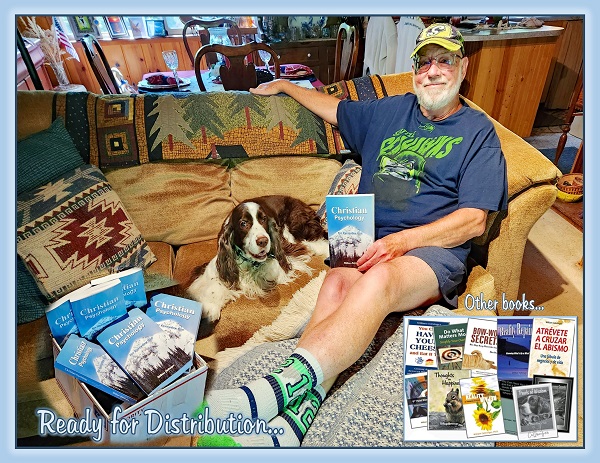


I've never been a joiner, so that's probably why I'm not a very good team player. From a course I had about small groups, it was concluded that in small groups the one who talked the most was often picked as a leader by the group.
In my late retirement, I'm basically a loner with the assistance of one employee. My collaboration has with other authors, largely helping them accomplish a task, like publish a book. I have a volunteer who helps proof my work but does little editing. I am in a writers group, but have chosen not to take one of the traditional officer roles. Recently, the president has gone AWOL I hope she isn't too ill or has died. There are many tasks that the ambitious group as embarked with no one volunteering to do them.
Ron