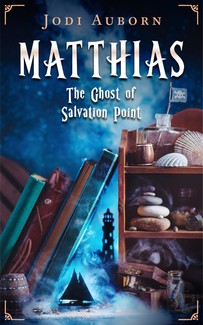
This article is about the author's influences that inspired her to write her children's ghost story, "Matthias: The Ghost of Salvation Point."
Like my previous novels, Stormwind of the North Country and Secrets of the North Country, Matthias is based on a "long" short story that I wrote when I was younger. It was originally called The Son of the Seafarer, and since it was a birthday gift for my dad, I attempted to write it as a serious "adult" story. Looking back at it years later, I realized that the writing was so bad that it was unintentionally humorous and melodramatic. When I decided to re-write it and turn it into a book in August 2013, I was shocked at how much work that it actually needed! That was when I knew that it just didn’t work as an adult story; it was meant to be a book for kids.
In The Son of the Seafarer, the main character, Dylan Flint, was a 20-something man who buys a lighthouse as a gift for his wife. The ghost (known simply as "MacMurray" in the original story), didn't really do much, and in fact didn't even appear until the very end. In the original story, Dylan could neither see the ghost or talk to him. The villians Sleeter and Quint, instead of being the treasure hunters that they are in the book, were real-estate men who wanted to tear down the light station to build a tourist resort (too much like "Lavina" in my first novel, Stormwind of the North Country.) So I kept the basic idea and even some of the original conversations and scenes, but otherwise began a totally fresh and new story. It took over a year to write - MUCH longer than I thought. When I started writing it, I expected that it would be maybe just a 50-page novella, but it grew...AND GREW...into the almost 200 pages that it is now.
Like the original story, Matthias was going to be a gift for my dad. He loved lighthouses and the ocean, and was the one who had also gotten me interested in them when I was a teenager. He was also a very talented storyteller who could make up the scariest ghost stories - on the spot - during all of our family camping trips when I was a kid. However, he died unexpectedly before the book was finished.
After that, researching and writing this book took on more meaning for me. It turned out that writing it was like therapy for me as I dealt with his death, and it made me feel closer to him during that time. Since I was writing it in his memory, I considered it especially important to get the dialogue and storyline just right, as well as making sure that the facts about lighthouses were historically accurate. I consider this book a tribute to my dad, and I hope that I did it justice.
|






http://ronhullauthor.com/poems/lighthouselove.htm
http://ronhullauthor.com/poems/lighthousesplitrock.htm
Ron