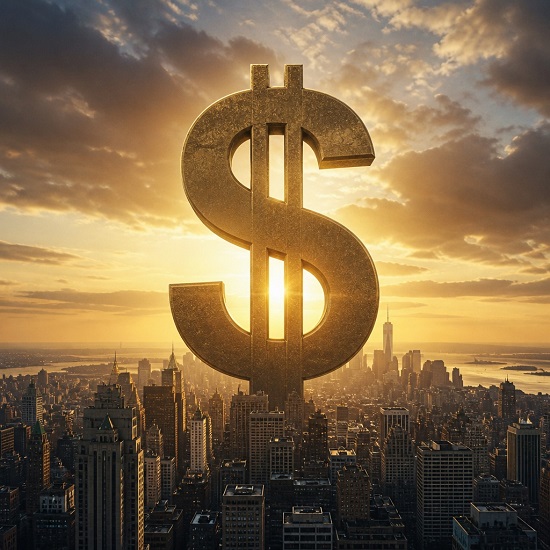
In this new Dispatch from the Heartland, I turn my attention to the hidden architecture of American capitalism — not the shining promises we celebrate, but the quiet costs we rarely acknowledge. Behind every product, service, and convenience lies a system that shifts its weight downward, asking ordinary citizens to shoulder what institutions prefer not to carry. The Underside of Capitalism is an inquiry into who truly pays, and why the burden keeps finding its way back to us.
The Underside of Capitalism: Who Pays for Everything?
by John Herlihy
We Americans are fond of telling ourselves a beautiful story about capitalism. It is the story of opportunity, of freedom, of the open road. Work hard, we say, and you can get ahead. Apply yourself, and you can build a life. Be clever, be industrious, be persistent, and you might even become rich — fabulously rich, unimaginably rich, billionaire rich, perhaps even trillionaire rich. This is the upside of capitalism, the part we celebrate, the part we teach our children, the part we hold up as proof that the system works.
And in many ways, it does work. Capitalism has created wealth, innovation, mobility, and a standard of living that would have astonished our ancestors. But beneath this shining surface lies another story — a quieter, more concealed story, one that rarely makes its way into the speeches, the slogans, or the patriotic hymns. It is the story of who pays for everything. Because in capitalism, nothing is free. Nothing. Every service, every convenience, every institution, every benefit — someone pays for it. And more often than not, that someone is the ordinary citizen.
We rarely stop to think about it, but the entire machinery of American life is funded from the bottom up. The federal government, the state government, the local government — all of them draw their lifeblood from the taxpayer. Every road we drive on, every school we send our children to, every fire truck that races down the street — all of it is paid for by the same people who use it. Not by corporations. Not by billionaires. Not by the system itself. By the citizen.
Even the programs most people assume are “government benefits” — Social Security, Medicare — are not gifts from above. They are funded by the worker, deducted from every paycheck across an entire lifetime. The government administers the programs, but the worker pays for them. It is one of the great misconceptions of modern life that the government “gives” us these things. In truth, we give them to ourselves.
And then there is the vast, invisible world of advertising — the billboards, the commercials, the online banners, the sponsored posts, the endless stream of persuasion that saturates our lives. Who pays for all of that? Not the companies, not really. The cost of advertising is quietly folded into the price of every product we buy. We pay for the privilege of being sold to. We pay to be persuaded. We pay to be influenced. We pay for the pretty pictures, the false claims, the wild side effects, the outright lies.
The same is true of the global media giants that claim to offer “free” content. Nothing is free. The advertisers pay for the platform, and the consumer pays for the advertisers. The cost is simply hidden, embedded in the price of the goods we purchase. We pay for the news we read, the videos we watch, the apps we use — not directly, but indirectly, invisibly, continuously.
Insurance is another masterpiece of capitalist design. Millions pay for services they may never use, and the company profits whether they use them or not. It is a system built on the mathematics of risk and the emotion of fear, but the risk is borne by the individual, not the institution and so of course is the fear.
And then there are tariffs — one of the most misunderstood costs in the entire economic system, partly because POTUS repeatedly claimed that the tariffs are paid for by foreign entities. When tariffs are imposed on foreign goods — wine, honey, steel, automobiles, electronics — the public imagines that foreign companies are being punished, that the government is “charging” them for access to the American market. But that is not how tariffs work. The foreign exporter does not pay the tariff. The American importer pays it, and the importer passes the cost directly to the American consumer. Tariffs are simply another tax — a hidden tax — paid by the citizen every time they buy a product touched by international trade. It is one more example of how the cost of the system is quietly shifted downward.
But perhaps nowhere is this downward shift more evident than in the world of financial institutions — the banks, the lenders, the credit‑card companies, the fee‑collectors, the interest‑harvesters. These institutions present themselves as service providers, but they function as toll‑booths on the road of modern life. Every transaction, every withdrawal, every late payment, every overdraft, every swipe of a card carries a fee, a penalty, an interest charge. The banks pay almost nothing in interest to the depositor, yet charge exorbitant interest to the borrower. They profit from debt, from delay, from misfortune, from human error. They profit when you spend, when you borrow, when you slip, when you struggle. And when their own mismanagement leads to collapse, the public steps in to rescue them — the same public that pays their fees, their penalties, their interest, their profits. It is capitalism’s most elegant sleight of hand: the financial sector extracts wealth from the citizen at every turn, yet convinces the citizen that it is providing a service.
Over the decades, more and more responsibility has been shifted onto the individual. Retirement once meant a pension; now it means a 401(k). Healthcare once meant employer coverage; now it means deductibles, premiums, co‑pays, and out‑of‑pocket surprises. Customer service once meant a human being; now it means self‑checkout, self‑service, self‑management. The burden has been transferred, inch by inch, from the institution to the individual.
And yet, we continue to celebrate the upside of capitalism without acknowledging the underside — the underside where the worker pays, the consumer pays, the citizen pays. The system works, yes. But it works because ordinary people keep it working.
This is not an indictment of capitalism. It is simply a recognition of its structure. Capitalism is a brilliant engine for creating wealth, but it is also a brilliant engine for distributing cost — downward, silently, invisibly. It is a system that rewards initiative, but it is also a system that depends on the quiet, continuous contributions of millions of people who will never appear on the cover of a magazine or ring the bell at the stock exchange.
And so we arrive at the real question, the question almost never asked:
If the worker funds the system, supports the system, and absorbs the risk of the system — then who is the system truly designed to serve?
In the Heartland, we understand this intuitively. We live it every day. We know that the system works — but we also know who pays for it. And perhaps that is the most revealing truth of all.
|