I would not enter on my list of friends
…. the man
Who needlessly sets foot upon a worm.
--William Cowper, Winter Walk at Noon
While doing some research on insects for the little children’s book AD Author Andrew James Turner and I are writing, The Adventures of Little Andy and His Insect Friends, I was fascinated by what I’ve discovered concerning the role insects have played in life, literature, and poetry.
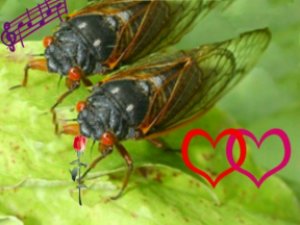
And this is extremely interesting to me at this point in time since 15 states are about to be inundated by the 17-year Cicada.
The billions of cicada nymphs destined to pop through our topsoil soon are going to affect everyday life for weeks to come, and people living in these 15 states may suddenly find the Great Outdoors - not so Great. Although, I for one, look forward to their visit.
Folks in these 15 states may soon have to constantly dodge these airborne insects, and they may also have to alter their carefully made plans for outdoor weddings, picnics, and family outings at the park.
They may even have to monitor their dogs and cats who may view the thousands of dead cicada carcasses lining the ground as a Giant Animal Buffet Table.
My two dogs, Turbo and Blanca, are already licking their chops, anticipating their arrival, but I should add that you should not let your pets eat too many of these cicadas. Overindulgence can make them quite ill; so please monitor their cicada intake.
And there are, of course, other ways to view this Dawn of the Living Cicada.
The physical act of the cicada nymph emerging from the ground (after 17 years of living a subterranean existence sucking plant roots) has inspired a number of cultures, from the Aztecs to the Chinese, to revere the insect as a symbol of reincarnation or rebirth.
Some Native Americans even believed that the cicada had the power to renew life - to the point that they concocted medicines from cicadas to treat war wounds.
Dr. Rory B. Egan, of the Department of Classics at the University of Manitoba, has written that the cicada also played a symbolic role in ancient Greek culture.
"Plato lived and worked in Athens, a city whose traditions gave pride of place to the cicada whose image was emblazoned on some of the city's coinage," Egan wrote in Cicadas in Ancient Greece.
"One of the major Greek historians, Thucydides, who was himself an Athenian of the generation before Plato's, tells us that in earlier times the people of Athens wore gold ornamental cicadas in their hair, and later authorities report that the cicadas were emblematic of Athenian 'autochthony,' a concept which asserted that the earliest ancestors of the Athenians were sprung from the local soil, thus bequeathing to their posterity an inalienable right to the land."
But the lowly insect was more than a symbol of eternal property rights to the Greeks. The cicadas also inspired Greek poetry, including this snippet of an ode from the Anacreontea collection:
"Esteemed you are by every human/As the summer's sweet-voiced prophet/The Muses love you, and Apollo too..."
Other poets would follow suit in their admiration of the cicada, even songwriter Bob Dylan, who confused the insect for a locust. (For the record, locusts belong to the grasshopper family.)
The Romantic poets would also hear the call of the insect world, if not exactly the cicada, and use these lowly creatures as a yardstick by which they would measure a person's humanity.
"At first reflection, it might seem a bit over the top for anyone to suggest that insects and other lower life forms are deserving of moral consideration," says Humane Society of the United States Historian Bernard Unti, who has recently written, Protecting All Animals: A Fifty-Year History of the Humane Society of the Untied States.
“But this feeling goes back at least as far as the late 18th century, to Blake, Burns, Cowper, Pope, Shelley, Wordsworth, and other poets in the Romantic tradition," Unti adds. "They thought of nature in all its expressions as having value, and in their writings framed even the treatment of insects as a litmus of enlightened sensibility toward all life.”
This same ethic quickly found its way into early 19th century domestic education literature directed at our children, the first 'humane education' readers.
I am extremely heartened that our little children’s book, Little Andy and His Insect Friends, will in its own humorous little way, attempt to foster kindness to all living creatures – even tiny bugs.
Pity the poor creature, human and nonhuman, who views the insect as merely a nuisance - or even as a meal!













I will never forget when [what I was told were "13-year cicadas" woke in Chapel Hill. People pulled over their cars! One day, it was quiet -- or as quiet as it gets in the country, this day & age --, and the next, you couldn't hear yourself think. [Not complainin', just 'splainin'; though I gotta admit, it was nice when the noise
died down]. Love your article, Ed. 'TUDE-!!! ((((( 'FISS')))))
i love almost all of God's creations, but wonder why He had to make *ugh* bugs...He has His reasonings. i'm not too fond of creepy crawlies, but try not to kill them...can't stand the mess :)
enlightening, educational, fine write! :)
now 17 year locusts, i remember them! adore that pic...they're not supposed to come to texas, but i sure remember them in ohio...i always said they had red devil eyes LOL but a beautiful song
(((HUGS))) and love, karla. :)
I care about insects....but hey just not "Spiders" okay!!
Keep then outa sight and they will be saved by the bell!!
Love Tinka