AuthorsDen.com  Join | Login 

 
Where Authors and Readers come together!

Authors | Books | Audiobooks | eBooks | Signed Bookstore | Stories | Articles | Poetry | Blogs | News | Events | Reviews | Videos | Success | Gold Members | Testimonials

Featured Authors:  Rochelle Brandon, iMargot Dillard, iJohn DeDakis, iRobert Liu, iNeenah Davis-Wilson, iT. Weber, iGlen Schulz, iTrennis Killian, iCharles Keller, iValerie Boggess, i

  Home > Action/Thriller > Articles
Popular: Books, Stories, Articles, Poetry      Authors: A B C D E F G H I J K L M N O P Q R S T U V W X Y Z     

Sam Vaknin

 Follow Me  

· 477 titles
· 125 Reviews
· Share with Friends!
· Save to My Library
·
Member Since: Jul, 2000

   Sitemap
   Contact Author
   Message Board
   Read Reviews


Books
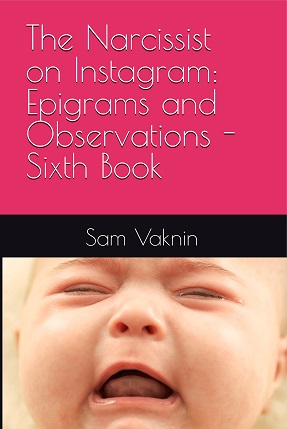
· FREE The Narcissist on Instagram: Epigrams and Observations - Sixth Book

· FREE The Narcissist on Instagram: Epigrams and Observations - Sixth Book

· The Narcissist on Instagram: Epigrams and Observations - Fifth Book

· Poetry of Healing and Abuse

· World in Conflict, Mind in Transition: Sam Vaknin Interviews

· FREE The Narcissist on Instagram: Epigrams and Observations - Fourth Book

· FREE The Narcissist on Instagram: Epigrams and Observations - Third Book

· FREE The Narcissist on Instagram: Epigrams and Observations - Second Book

· FREE The Narcissist on Instagram: Epigrams and Observations - First Book

· FREE A Critique of Piketty's Capital in the Twenty-first Century [


Short Stories
· Hunting Bambi

· Ned’s Short Life

· Sexsomnia

· Fugue

· The Galatea of Cotard

· Live Burial

· Lucid Dreams

· A Dream Come True

· Anton's Trap

· The Elephant's Call


Articles
· Triggering Cascade, Trauma Imprinting, and Total Reactance

· Lessons of My Life

· FILM REVIEW The Place (2017)

· Teen Suicide and Social Media

· The Best Offer

· Cryptoassets (such as cryptocurrencies): Pyramid Schemes or Public Goods?

· 2017 Encyclopedia Britannica Ultimate Knowledge Pack

· Narcissists HATE Christmas, Holidays, and Birthdays

· A Cerebral Narcissist on His Sexuality

· Narcissist's Frustrating, Negativistic, and Passive-Aggressive Behaviors


Poetry
· Her Birthday

· Hebrew Love

· My Putrid Lover

· Twinkle Star

· Synthetic Joy

· Our Love Alivid

· The Miracle of the Kisses

· Selfdream

· In Moist Propinquity

· A Hundred Children

         More poetry...
News
· FREE E-BOOK Abuse, Trauma, and Torture - Their Consequences and Effects

· FREE E-BOOK Narcissistic and Psychopathic Leaders

· FREE EBOOK The Hitler File (Excerpts)

· NEW eBOOK Excerpts from the Archives and Case Studies

· EIGHTH EDITION - Malignant Self Love - Narcissism Revisited

· NEW BOOK - After the Rain - How the West Lost the East

· NEW EBOOK Personality Disorders Revisited

Sam Vaknin, click here to update your web pages on AuthorsDen.

Books by
Sam Vaknin


See all Books
by Sam Vaknin


Symbol and Essence
by Sam Vaknin
Last edited: Monday, June 7, 2010
Posted: Monday, June 7, 2010


There are three types of symbols.


Aborigines in Australia believe that the entire universe is regenerated whenever they chant their songlines (Yiri). This is reminiscent of the Copenhagen interpretation of Quantum Mechanics, which postulates that particles – and, really, the entire world – are the outcomes of choices made by observers (the “collapse of the wave function”). The ancient Hebrews – and many orthodox Jews to this very day – swear by the miraculous power of their alphabet and its numerical equivalent (gimatria). The real name of God is so potent that it is never to be uttered lest in wreaks havoc and calamity on the world. Christian tradition equates Jesus Christ with the word (logos) that brought our universe into existence. This kind of magical thinking regards symbols not as representations but as handles attached firmly to real-life objects. 

There are three types of symbols: 

(1) Symbols that reflect intrinsic (mental) states. As Locke had observed, here the symbol is the essence, though awareness and enlightenment are required as the context in which these symbols can operate and evoke the inner landscape that they represent.

(2) Symbols that stand in for extrinsic (actual or objective) conditions or objects. Here the symbol is a representation and, as Wittgenstein famously commented, it requires interpretation or mapping before it can resolve appropriately. “Mapping”, therefore, is not merely reference: it relates both to the outside world and to the state of knowledge and experience of the subject (as in psychologism, or logical positivism). We combine representation and interpretation (strong subjective input of secondary qualities) to yield perception and description of the world. Still, the mental representation engendered by the symbol must share (primary) qualities with the object it represents. This correspondence or sharing of qualities has survival value in that it fosters monovalent communication.

(3) The third class consists of symbols that stand in relation to cultural artefacts, or constructs, or memes. Here the symbol and the object it represents are one and the same. Any distinction between symbol and symbolized is spurious. 

Combinations (strings) of symbols produce meaningful statements which really amount to compounded symbols. The same rules and taxonomy apply to them as to their more fundamental and simpler building blocks.  

But, if symbols are intrinsically meaningful, how come we fail to immediately and directly comprehend foreign languages (or to the uninitiated, mathematics)? The answer is that we lack the context or the theory that will allow us to translate from one language to another. Symbols refer to reality or stand in for it only within semantic fields. Even then – and contrary to Quine’s dictum – we can always produce a set of workable (albeit inaccurate) translations (functional translation hypotheses).

Many theories of meaning are contextualist and proffer rules that connect sentence type and context of use to referents of singular terms (such as egocentric particulars), truth-values of sentences and the force of utterances and other linguistic acts. Meaning, in other words, is regarded by most theorists as inextricably intertwined with language. Language is always context-determined: words depend on other words and on the world to which they refer and relate. Inevitably, meaning came to be described as context-dependent, too. The study of meaning was reduced to an exercise in semantics. Few noticed that the context in which words operate depends on the individual meanings of these words.

Gottlob Frege coined the term Bedeutung (reference) to describe the mapping of words, predicates, and sentences onto real-world objects, concepts (or functions, in the mathematical sense) and truth-values, respectively. The truthfulness or falsehood of a sentence are determined by the interactions and relationships between the references of the various components of the sentence. Meaning relies on the overall values of the references involved and on something that Frege called Sinn (sense): the way or "mode" an object or concept is referred to by an expression. The senses of the parts of the sentence combine to form the "thoughts" (senses of whole sentences).

Yet, this is an incomplete and mechanical picture that fails to capture the essence of human communication. It is meaning (the mind of the person composing the sentence) that breeds context and not the other way around. Even J. S. Mill postulated that a term's connotation (its meaning and attributes) determines its denotation (the objects or concepts it applies to, the term's universe of applicability).

As the Oxford Companion to Philosophy puts it (p. 411):

"A context of a form of words is intensional if its truth is dependent on the meaning, and not just the reference, of its component words, or on the meanings, and not just the truth-value, of any of its sub-clauses."

It is the thinker, or the speaker (the user of the expression) that does the referring, not the expression itself!

Moreover, as Kaplan and Kripke have noted, in many cases, Frege's contraption of "sense" is, well, senseless and utterly unnecessary: demonstratives, proper names, and natural-kind terms, for example, refer directly, through the agency of the speaker. Frege intentionally avoided the vexing question of why and how words refer to objects and concepts because he was weary of the intuitive answer, later alluded to by H. P. Grice, that users (minds) determine these linkages and their corresponding truth-values. Speakers use language to manipulate their listeners into believing in the manifest intentions behind their utterances. Cognitive, emotive, and descriptive meanings all emanate from speakers and their minds.

Initially, W. V. Quine put context before meaning: he not only linked meaning to experience, but also to empirically-vetted (non-introspective) world-theories. It is the context of the observed behaviors of speakers and listeners that determines what words mean, he said. Thus, Quine and others attacked Carnpa's meaning postulates (logical connections as postulates governing predicates) by demonstrating that they are not necessary unless one possesses a separate account of the status of logic (i.e., the context).

Yet, this context-driven approach led to so many problems that soon Quine abandoned it and relented: translation - he conceded in his seminal tome, "Word and Object" - is indeterminate and reference is inscrutable. There are no facts when it comes to what words and sentences mean. What subjects say has no single meaning or determinately correct interpretation (when the various interpretations on offer are not equivalent and do not share the same truth value).

As the Oxford Dictionary of Philosophy summarily puts it (p. 194):

"Inscrutability (Quine later called it indeterminacy - SV) of reference (is) (t)he doctrine ... that no empirical evidence relevant to interpreting a speaker's utterances can decide among alternative and incompatible ways of assigning referents to the words used; hence there is no fact that the words have one reference or another" - even if all the interpretations are equivalent (have the same truth value).

Meaning comes before context and is not determined by it. Wittgenstein, in his later work, concurred.

Inevitably, such a solipsistic view of meaning led to an attempt to introduce a more rigorous calculus, based on concept of truth rather than on the more nebulous construct of "meaning". Both Donald Davidson and Alfred Tarski suggested that truth exists where sequences of objects satisfy parts of sentences. The meanings of sentences are their truth-conditions: the conditions under which they are true .

But, this reversion to a meaning (truth)-determined-by-context results in bizarre outcomes, bordering on tautologies: (1) every sentence has to be paired with another sentence (or even with itself!) which endows it with meaning and (2) every part of every sentence has to make a systematic semantic contribution to the sentences in which they occur.

Thus, to determine if a sentence is truthful (i.e., meaningful) one has to find another sentence that gives it meaning. Yet, how do we know that the sentence that gives it meaning is, in itself, truthful? This kind of ratiocination leads to infinite regression. And how to we measure the contribution of each part of the sentence to the sentence if we don't know the a-priori meaning of the sentence itself?! Finally, what is this "contribution" if not another name for .... meaning?!

Moreover, in generating a truth-theory based on the specific utterances of a particular speaker, one must assume that the speaker is telling the truth ("the principle of charity"). Thus, belief, language, and meaning appear to be the facets of a single phenomenon. One cannot have either of these three without the others. It, indeed, is all in the mind.

We are back to the minds of the interlocutors as the source of both context and meaning. The mind as a field of potential meanings gives rise to the various contexts in which sentences can and are proven true (i.e., meaningful). Again, meaning precedes context and, in turn, fosters it. Proponents of Epistemic or Attributor Contextualism link the propositions expressed even in knowledge sentences (X knows or doesn't know that Y) to the attributor's psychology (in this case, as the context that endows them with meaning and truth value).

Web Site: Philosophical Essays and Musings


Want to review or comment on this article?


Need a FREE Reader Membership?


New Articles by Sam Vaknin
article Image
The Narcissistic Personality Disorder and Pathological Narcissism - a Primer.
Pathological Narcissism and the Narcissistic Personality Disorder (NPD)
article Image
The psychology and sociology of art, artists, and the creative process.
Art, Artists, and the Creative Process
article Image
Economics affects every aspect of our lives. Hence the importance of studying the ethical, moral, and philosophical question it provokes.
The Philosophy of Economics - Part II
article Image
Economics affects every aspect of our lives. Hence the importance of studying the ethical, moral, and philosophical question it provokes.
The Philosophy of Economics - Part I
article Image
Detailed studies of five terrorist organizations in the Balkan.
Terrorists and Freedom Fighters - Part II
article Image
Detailed studies of five terrorist organizations in the Balkan.
Terrorists and Freedom Fighters - Part I
article Image
The role of women in the post communist countries in transition.
Women in Transition
article Image
Articles about mental health issues and Personality Disorders
Mental Health Articles by Sam Vaknin
article Image
Essays about various topics in current philosophy. <br>
Philosophy Articles by Sam Vaknin - Part I
article Image
These seven movies deal with moral and ethical dilemmas. "The Matrix" - with the nature of reality, "Titanic" - tackles the moral obligation versus se
Moral Deliberations in Films
article Image
Diplomats and Non Government Organizations (NGOs) thrive in trouble spots.
Diplomats and NGOs
article Image
Can religious communities co-existence? A study of the Balkan case.
Religions and Co-Existence
article Image
Language and media play decisive roles in political and economic conflicts.
Language and Media Articles
article Image
Issues in microeconomics and macroeconomics studied through the prism of economies in transition.
Economics Articles - Part II
article Image
Issues in microeconomics and macroeconomics studied through the prism of economies in transition.
Economics Articles - Part I
article Image
Articles and essays regarding the societies, politics, economics, geopolitics and history of countries in Central Eastern Europe and South Eastern Eur
International Affairs Articles - Part II
article Image
Articles and essays regarding the societies, politics, economics, geopolitics and history of countries in Central Eastern Europe and South Eastern Eur
International Affairs Articles - Part I