To start an intellectual fire, rub two facts together.
This may seem reasonable, maybe even clever. Perhaps nothing more.
You have to be familiar with contemporary public schools to understand how profound the answer is. Permit me to explain.
Modern, progressive education (i.e., what we are doing every day to the country’s children ) is fundamentally a war against facts, against knowledge, against information, against truth. You would never guess that an Education Establishment would adopt such a strategy. But ours did, years ago.
We can imagine some ed professors at Harvard chortling: “Yeah, that's how we dumb down the whole society, we just take away all the knowledge. Then we rule.”
“OMG. It's so tempting when you put it like that.”
In time, rubbing two facts together will be impossible. There won't be any facts left. That's the joke.
The situation is much worse than you may suppose. Many college students don't know the simplest stuff, such as who won the Civil War. A professor at Notre Dame famously lamented that his students are “know nothings.”
Going back 100 years, there has been a steady, relentless vendetta against facts and knowing facts. If you don't memorize something, in what sense do you know it? But the policy is official: no names, no dates, no poetry, no multiplication tables, no facts permanently inscribed in your brain.
So what will the children learn instead of knowledge and facts? They will learn the politically correct feelings and opinions that the ideologues in charge want them to know. No facts allowed in this mix.
Personally I think this is perfect recipe for a weak, irresolute society. And also for bad writing.
Yes, there are literary implication when we talk about facts. I've long been in love with the word specificity. It is often the magic ingredient in good poetry and prose. I've often written in the margin: More specificity.
Consider this fairly ordinary sentence: The skinny man ran across the asphalt street and climbed over a cinderblock wall.
It's wonderfully specific. You see that asphalt. Those cinderblocks. A thin man running. Conrad said that the writer’s main job “is to make you see it.” You do that most easily when you use lots of facts.
So we see that it's not just intellectual fires, it's fires in general. Intellectual, literary, and political. Rub facts together.
Typically, soft words, vague words, abstract words, these are all dead on arrival. The brain wants hard words, precise words, concrete words, words that convey lots of information.
Decades ago I wrote an essay titled “In Praise of Stark Lucidity.” Some professor complained that the word stark is unnecessary. So’s your old man. “In Praise of Lucidity” is classy, quite good enough for the average intellectual journal, but nothing special. Stark lucidity, however, is high-voltage. You can tell that the writer is ready to fight over this. In truth, I remember vacillating. Finally, I decided, some extra excitement is better than no extra excitement. I still enjoy savoring the title.
QED: My message is to other writers. Keep an eye on the public schools. You'll see they're waging war against everything you care about.
--------------------------------------------------------
Bruce Deitrick Price is a novelist, artist, poet,
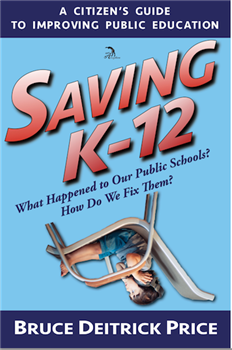
and education reformer. His most recent book is “Saving K-12 – What happened to our public schools? How do we fix them?"
See "The Crusade Against Knowledge":
http://www.improve-education.org/id70.html







Adding a link has been impossible for five days. I hope everyone curious about this issue will look at this article: "The Crusade Against Knowledge":
http://www.improve-education.org/id70.html
Dewey and his bunch were not primarily interested in academic achievement. They were interested in social engineering. Knowledge got in their way. So they were always looking for ways to prejudice people against facts. I get that part. What's disturbing for me is that so many educated people were eager to jump on the bandwagon.
Bruce Price
I was looking for your qualifications as an educational expert. I see that you do not have any advanced degrees but mention professors in education in your bio and in your discussion as though you are familiar with them. But then, as a member of Mensa, I can see that you probably found traditional education rather boring and are self-taught. That's okay, but doesn't hold up in highly credentialed fields if you want to be an expert.
I have a doctorate in education, and am very proud of what I studied during my dissertation: philosophy, educational philosophy, computer science, and testing. But I'm not proud of my degree that has been tarnished by the watered-down coursework that is required for anyone entering teaching and worse, still watered down for higher degrees in teaching and education. At least I have my masters Internet management. Degree in industrial engineering to fall back on.
Yours is a common lament. But I don't see it the way you see it. I don't think memorizing so-called facts, makes much difference in a world where those facts can easily be looked up from cyberspace in a nanosecond. Why clutter your brain with encyclopedic facts like those kids who can spell every word in the dictionary? My twin brother required his daughter to learn the multiplication tables. She completed her degree in zoology, but has had a career in pharmaceutical sales management. She uses a whole different skill set in management. Her science degree just got her foot in the door.
I have no kids and little knowledge of what goes on in grade schools. But my undergraduate school was a teacher's college and I found that most of the students going into teaching were mediocre students looking to settle down with a husband/wife they found in college and some little homey town with a guaranteed lifelong occupation, healthcare, and good pension, allowing them to retire in their fifties. They did poorly on math and science and therefore, avoided those courses with hard information. They are the ones who are teaching our kids, progressive or not. They just are of lower intellect than you and therefore can't impart wisdom and knowledge the way that you can and wants them all to.
BTW, besides the 3Rs, my grade school was filled with historical myths like how George Washington was so honest and strong enough to throw a coin across the Potomac. Jim Crow and other travesties done to the Native Americans wasn't discussed in our history hours. Just patriotic bull.
Ron